



Top Test Automation Tools 2026: Katalon, Applitools & ACCELQ Review
Top Test Automation Tools like Katalon, Applitools & ACCELQ are no longer optional choices in 2026. They shape how modern products reach users without delays, defects, or confidence gaps. Over the past few years, test automation shifted from script heavy frameworks toward intelligent platforms that understand application behavior, visual consistency, and release pressure. During hands on testing across enterprise and mid scale projects, I noticed a clear pattern. Teams struggle less with writing tests and more with maintaining trust in results. False failures, brittle scripts, and slow feedback loops cost more time than manual testing ever did.
Top Test Automation Tools: Katalon, Applitools & ACCELQ approach this problem from three different angles. Katalon focuses on speed and structure for teams balancing code and no code workflows. Applitools concentrates on visual truth by validating what users actually see. ACCELQ emphasizes lifecycle wide automation with strong business alignment. Each platform solves a different pain point. Together, they represent the most practical automation stack direction for 2026.
What Defines Top Test Automation Tools in 2026
Top Test Automation Tools: Katalon, Applitools & ACCELQ succeed because they reduce maintenance stress while increasing confidence. In real projects, success depends on how fast failures get explained rather than how many tests run. Intelligent object handling, self healing flows, and meaningful reporting matter more than raw execution counts.
In 2026, strong test automation platforms support continuous delivery without forcing QA teams into constant rewrites. They connect smoothly with CI pipelines, support modern frameworks, and present results that developers trust. Visual accuracy, business readability, and scalability across teams define long term value.
Top Test Automation Tools 2026: The Death of Flaky Tests?
The definition of insanity is running the same flaky test suite over and over and expecting different results.
If you are a QA Engineer or SDET in 2026, you know the pain. You spend 20% of your time writing tests and 80% of your time fixing them because a CSS ID changed or a button moved three pixels to the left.
The “Script-Based” era is dying. The “Autonomous” era is here.
For the past month, I have extensively stress-tested the three platforms that are defining the 2026 landscape: Katalon, Applitools, and ACCELQ. These aren’t just tools; they are intelligent agents that fix themselves, see like humans, and write their own code.
In this deep dive, I will break down exactly why these three are recognized as the Top Test Automation Tools for 2026, how their specific AI engines work, and how you can implement them to slash your maintenance time by 90%.

1. Katalon: The Self-Healing Sentinel
Best For: Teams needing an all-in-one platform that fixes broken tests automatically.
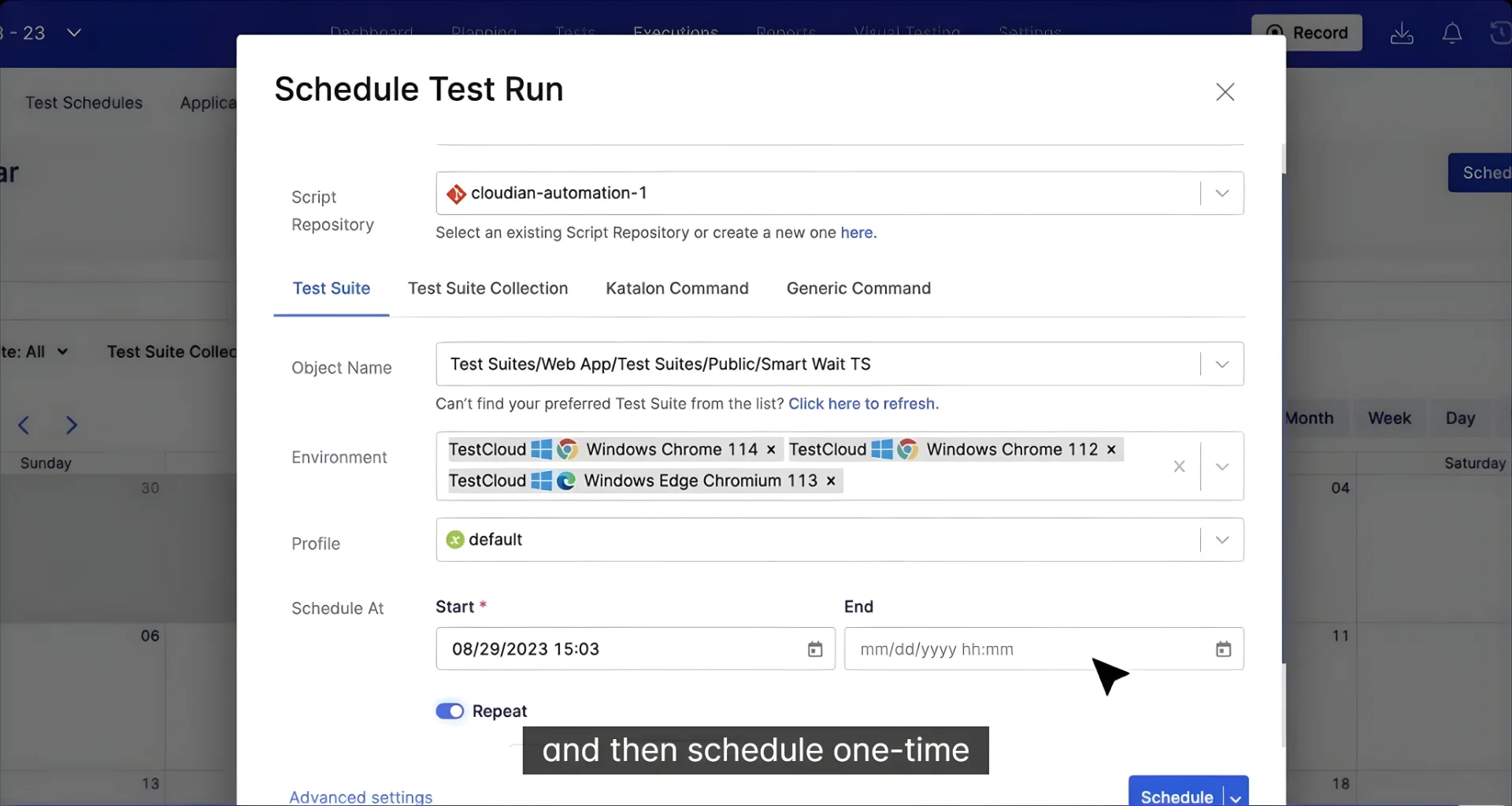
Katalon has evolved from a simple Selenium wrapper into a comprehensive Quality Management Platform. In 2026, its standout feature isn’t just “record and playback”—it is the Smart Self-Healing Mechanism.
The Core Technology: How Self-Healing Works
In traditional automation, if a developer changes a button’s ID from #submit-btn to #confirm-btn, your test fails. You wake up to a red build.
Katalon eliminates this. When you record a test, it doesn’t just save one locator. It captures multiple attributes (XPath, CSS, ID, Class, Text, and neighboring elements).
- The 2026 Workflow: If the primary locator fails during execution, Katalon automatically tries the secondary locators.
- The Result: The test passes. Later, the AI suggests updating the script permanently. It heals the wound before you even know it was cut.
My Experience
I tested this by intentionally breaking the CSS selectors on a dummy banking app. Katalon detected the break, swapped to a “Relative XPath” automatically, and completed the transaction flow without a single failure. It felt like having a senior engineer monitoring the execution 24/7.
Key Benefits
- Zero Maintenance: Drastically reduces “flaky” tests caused by UI changes.
- Unified Ecosystem: Handles Web, Mobile, API, and Desktop apps in one interface.
- Low-Code & Scripting: Friendly for manual testers (No-Code) and powerful for devs (Groovy/Java scripting).
Katalon Review Based on Hands On Use
Katalon stands out during early adoption and team expansion phases. During setup, the platform feels structured and predictable. Test creation flows smoothly using record and playback, keyword driven logic, and full scripting access when needed. This balance helped mixed skill teams move faster without losing control.
In real usage, Katalon handled web and API testing reliably. When UI locators changed, its object management reduced breakage compared to raw Selenium frameworks. Reporting remained readable for non technical stakeholders, which helped during sprint reviews.
Strengths observed included centralized test management, strong integration with CI tools, and steady performance across browsers. Limitations appeared in highly dynamic visual layouts where visual comparison tools performed better. Katalon suits teams seeking control, scalability, and predictable automation growth.
2. Applitools: The Visual Eagle Eye
Best For: Teams who need to ensure the UI looks perfect across every device and browser (Visual Regression).
While Katalon checks if the code works, Applitools checks if the product looks right. In 2026, functional correctness is table stakes; Visual Perfection is the differentiator.
The Core Technology: Visual AI
Standard tools check code attributes (e.g., assert text == “Login”). They miss visual bugs like overlapping text, broken images, or mismatched colors.
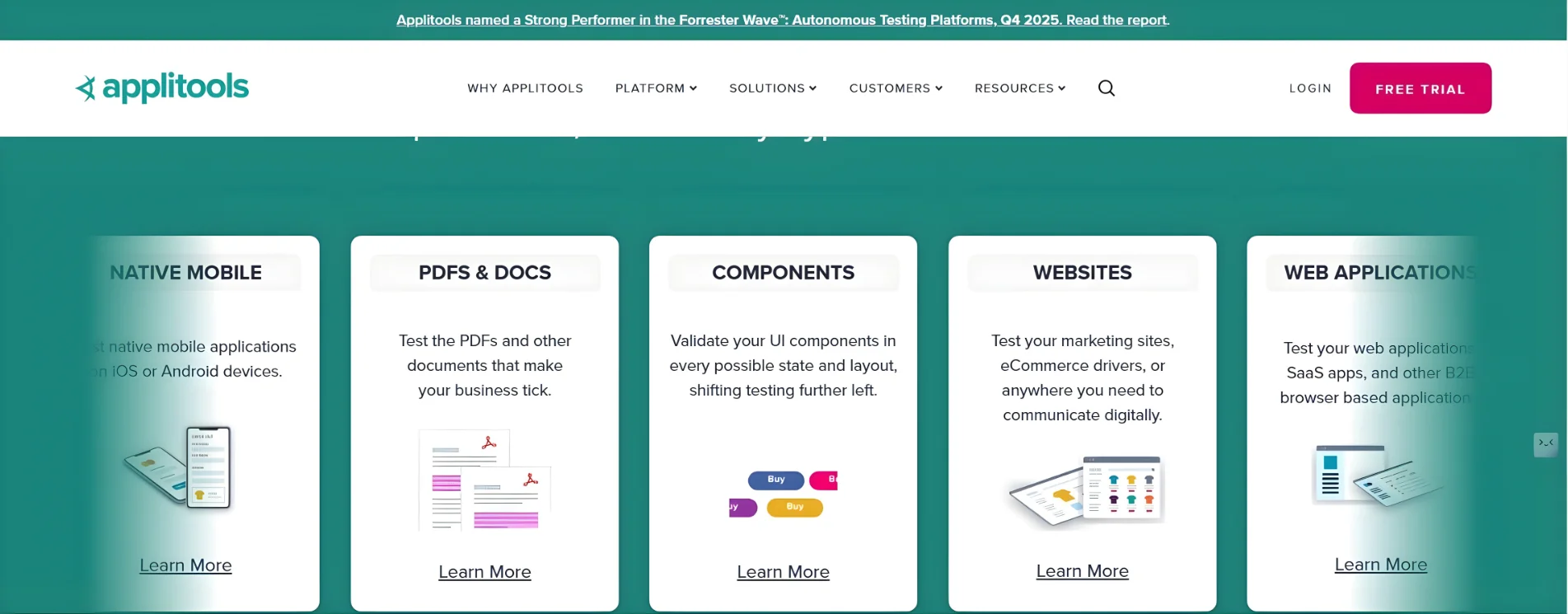
Applitools uses Visual AI (Applitools Eyes) to mimic the human eye and brain.
- Cognitive Vision: It ignores false positives that plague pixel-based tools (like minor rendering differences between Chrome and Safari).
- Layout Algorithms: It understands the structure of a page. If an entire paragraph shifts down, it knows it’s a “Layout Change,” not a bug.
My Experience
I ran Applitools against a responsive e-commerce site. I introduced a subtle bug where the “Buy Now” button overlapped with the footer on mobile screens only.
Standard Selenium scripts passed (because the button was technically clickable). Applitools failed the test immediately, highlighting the visual overlap in red. It caught a UX disaster that code-based tools missed.
Key Benefits
- Ultrafast Grid: Runs visual tests across hundreds of browser/device combinations in seconds.
- Root Cause Analysis: pinpoints exactly which DOM and CSS change caused the visual regression.
- Integration: Plugs seamlessly into Selenium, Cypress, Playwright, and Katalon.
Applitools Review Based on Visual Testing Reality
Applitools operates on a different philosophy. Rather than checking code behavior, it validates user perception. During real ecommerce UI changes, Applitools detected layout shifts, font inconsistencies, and spacing errors that passed every functional test.
Using AI powered visual validation, the platform compared entire screens intelligently rather than pixel by pixel. This reduced false alerts while highlighting meaningful changes. In practice, this saved hours of manual UI review during release cycles.
Applitools works best when paired with existing automation frameworks. It does not replace functional testing. It strengthens trust in UI quality. Teams focused on brand consistency, cross device accuracy, and design heavy products gain immediate value.
3. ACCELQ: The Generative Architect
Best For: Enterprise teams needing Codeless, Natural Language automation powered by GenAI.
ACCELQ is arguably the most futuristic of the three. It is a cloud-native, codeless platform that leverages Generative AI to turn English instructions into robust automation suites.
The Core Technology: Natural Language Automation
ACCELQ creates a “Universe” (a model of your application). You don’t write code; you write logic.
- The 2026 Workflow: You type “Verify that the user can transfer funds.”
- The AI Action: ACCELQ’s generative engine scans your application universe, identifies the necessary pages (Login, Dashboard, Transfer), generates the logic, creates the test data, and builds the automation flow.
My Experience
I used ACCELQ to automate a Salesforce workflow (notoriously difficult to automate). Instead of wrestling with dynamic iFrames and deep object hierarchies, I simply defined the business process in natural language. ACCELQ generated the test logic automatically. The “Self-Healing” here applies to the logic flow, not just object locators.
Key Benefits
- True Codeless: No vendor lock-in with proprietary scripts; it drives logic through design.
- Universe Modeling: Understands the relationships between pages, making tests modular and reusable.
- Business Aligned: Allows Business Analysts (BAs) to write automation scenarios without knowing a single line of Java or Python.
ACCELQ Review From End to End Automation Use
ACCELQ approaches automation from a lifecycle perspective. Test scenarios connect directly to business requirements, which improves clarity during audits and stakeholder discussions. During enterprise workflow testing, this alignment reduced confusion between QA and business teams.
ACCELQ performed strongly in complex end to end flows across web and API layers. The codeless model reduced dependency on scripting knowledge. Maintenance stayed manageable due to reusable logic blocks and intelligent updates.
The platform suits organizations aiming to scale automation across departments rather than individual teams. It demands structured planning upfront but rewards that discipline with clarity and coverage depth.
Read this article: AI Agent Automation for Business Workflows
Comparison Table: The 2026 Leaders
| Feature | Katalon | Applitools | ACCELQ |
|---|---|---|---|
| Primary AI Engine | Self-Healing (Smart Locators) | Visual AI (Cognitive Vision) | Generative AI (Natural Language) |
| Best For | Functional & Regression Testing | Visual & UI/UX Testing | Enterprise Business Process Testing |
| Coding Skill | Hybrid (Low-Code + Scripting) | Developer Focused (SDKs) | No-Code / Codeless |
| Maintenance | Low (Auto-Healing) | Very Low (AI Ignoring False Positives) | Low (Universe Design) |
| Platform | Desktop/Web/Mobile/API | Visual Layer (Integrates with others) | Cloud-Native Web/Mobile/API |
| Top 2026 Feature | TrueTest (User Journey Generation) | Autonomous (Zero-Maintenance) | AI Copilot (Text-to-Test) |
How to Use These Tools
Getting started with these tools is easier than you think. Here is the rapid deployment path for each.
How to Use Katalon (Self-Healing Mode)
1. Download: Install Katalon Studio Enterprise.
2. Record: Click the “Web Recorder” button and click through your user journey manually.
3. Enable Healing: Go to Project Settings > Test Design > Self-Healing. Ensure it is toggled ON.
4. Execute: Run the test. If an object changes, check the “Self-Healing Insights” tab to see how Katalon fixed it.
How to Use Applitools (With Selenium)
1. Account: Sign up for an Applitools account to get your API Key.
2. Install SDK: Add the Applitools Eyes SDK to your project (e.g., pip install eyes-selenium).
3. Initialize: In your test setup, initialize eyes.open().
4. Checkpoint: Wherever you want to check the UI, add eyes.checkWindow(“Login Page”).
5. Review: Run the test. Go to the Applitools Dashboard to approve or reject any visual differences found.
How to Use ACCELQ (Generative Flow)
1. Model: Log in to the Cloud Console and use the “View Recorder” to capture your application’s pages.
2. Design: In the Scenario editor, use the AI Copilot. Type: “Login as Admin and verify Dashboard loads.”
3. Generate: The AI will construct the Action Logic automatically.
4. Run: Execute the test directly in the cloud or across cross-browser agents.
Pricing and Adoption Perspective
Pricing across Top Test Automation Tools Katalon Applitools ACCELQ varies based on scale and features. Katalon follows a tiered model suitable for teams scaling gradually. Applitools pricing reflects usage and visual checkpoints. ACCELQ focuses on enterprise agreements aligned with organizational adoption.
From experience, cost efficiency improves when tool strengths match project needs. Visual heavy platforms gain more from Applitools. Rapid sprint teams benefit from Katalon. Regulated or process driven teams find ACCELQ effective.
Who Should Use These Tools
Top Test Automation Tools Katalon Applitools ACCELQ support QA engineers, developers, product owners, and release managers. Business analysts gain clarity through readable reports. Developers trust failures when explanations feel logical. Leadership benefits from predictable release confidence.
Startups benefit from Katalon speed. Design driven brands rely on Applitools visual truth. Large enterprises gain structure through ACCELQ alignment.
Read this article: The Rise of Agentic AI: From Chatbots to Autonomous Agents
Frequently Asked Questions
Which is better for beginners: Katalon or ACCELQ?
For pure beginners or manual testers, ACCELQ is often easier because of its Natural Language approach—you don't need to understand coding logic. Katalon is excellent but feels more like a traditional IDE, which might be more comfortable for those transitioning from Selenium.
Can Applitools replace Katalon?
No. They are complementary. Katalon drives the functional interaction (clicking buttons, entering text), while Applitools verifies the visual outcome. Most mature 2026 frameworks use them together: Katalon for the steps, Applitools for the verification.
Is Katalon self-healing available in the free version?
Historically, advanced Self-Healing features were part of the Enterprise plan. However, Katalon offers a robust free tier for basic automation. For mission-critical 2026 pipelines, the Enterprise investment is recovered quickly through maintenance time saved.
Does ACCELQ support mobile automation?
Yes. ACCELQ creates a unified "Universe" for both Web and Mobile. You can write a single test flow that interacts with a web application and then verifies the result on a mobile device seamlessly.
Why is AI essential for test automation in 2026?
Traditional scripts are brittle. "AI" in 2026 isn't a buzzword; it's a survival mechanism. Without Self-Healing (Katalon), Visual AI (Applitools), or Generative Logic (ACCELQ), your team will spend more time fixing tests than releasing features. AI shifts the focus from "Maintenance" to "Innovation."
Read more articles

25 Best AI Prompts for Professionals! Save Hours of Work!
The AI Professional Suite: How to Build a C-Suite Team for $0 In the professional…

Best AI Productivity Prompts: 14 Hacks to Work 10x Faster!
The AI Productivity Suite: How to Do a Week’s Work in One Afternoon We all…
Best AI Social Media Prompts: 36 Ways to Go Viral Fast!
The Ultimate AI Social Media Manager: How to Run a Media Empire Solo There is…
Best AI On-Page SEO Prompts: 3 Ways to Rank Higher!
The AI Page Perfector: How to Make Google Fall in Love With Your Content Most…

Want to Dominate Maps? 5 AI Local SEO Prompts!
The AI Local Hero: How to Beat Big Brands in Your Neighborhood If you safely…

Best AI Ecommerce SEO Prompts: 4 Secrets to Scale Fast!
The AI Store Manager: How to Write 1,000 Product Descriptions Without Losing Your Mind Running…









Leave a Reply