



The AI SEO Strategist: How to Rank #1 Without Spending Hours on Research
SEO (Search Engine Optimization) usually feels like doing taxes. It is tedious, it involves massive spreadsheets, and if you get it wrong, you pay the ultimate price: zero traffic. Most creators simply guess. They write an article titled “My Thoughts on Coffee” and subsequently wonder why it never shows up on Google.
The truth is, Google is a sophisticated algorithm. Therefore, to speak to an algorithm, you absolutely must speak its language. You need to know exactly what people are typing into that search bar, why they are typing it, and what specific words search engines expect to see in your content. You do not need expensive, complicated tools to start. You just need the right frameworks.
Today, I am handing you the highly requested “SEO Module” of our prompt library. These 4 AI Keyword Research Prompts directly act as your personal SEO Agency. Furthermore, we are going to build a complete content roadmap, decode user psychology, and find the hidden gem keywords that your competitors are completely missing.
Ready to get found? Let’s start the search.
Tone & Style Configuration
Before executing these highly effective frameworks, choose your distinct voice to completely avoid robotic AI outputs. Pick one Tone and one Writing Style from this menu and paste it directly into the {Tone} and {Style} brackets if you decide to expand upon these outputs later.
- Tone of Voice (Pick One): (Default), Authoritative, Caring, Casual, Cheerful, Coarse, Conservative, Conversational, Creative, Dry, Edgy, Enthusiastic, Expository, Formal, Frank, Friendly, Fun, Funny, Humorous, Informative, Irreverent, Journalistic, Matter of Fact, Nostalgic, Objective, Passionate, Poetic, Playful, Professional, Provocative, Quirky, Respectful, Romantic, Sarcastic, Serious, Smart, Snarky, Sophisticated, Subjective, Sympathetic, Trendy, Trustworthy, Unapologetic, Upbeat, Witty.
- Writing Style (Pick One): (Default), Academic, Analytical, Argumentative, Conversational, Creative, Critical, Descriptive, Epigrammatic, Epistolary, Expository, Informative, Instructive, Journalistic, Metaphorical, Narrative, Persuasive, Poetic, Satirical, Storytelling, Technical.
Phase 1: The Master Plan (Keyword Strategy)
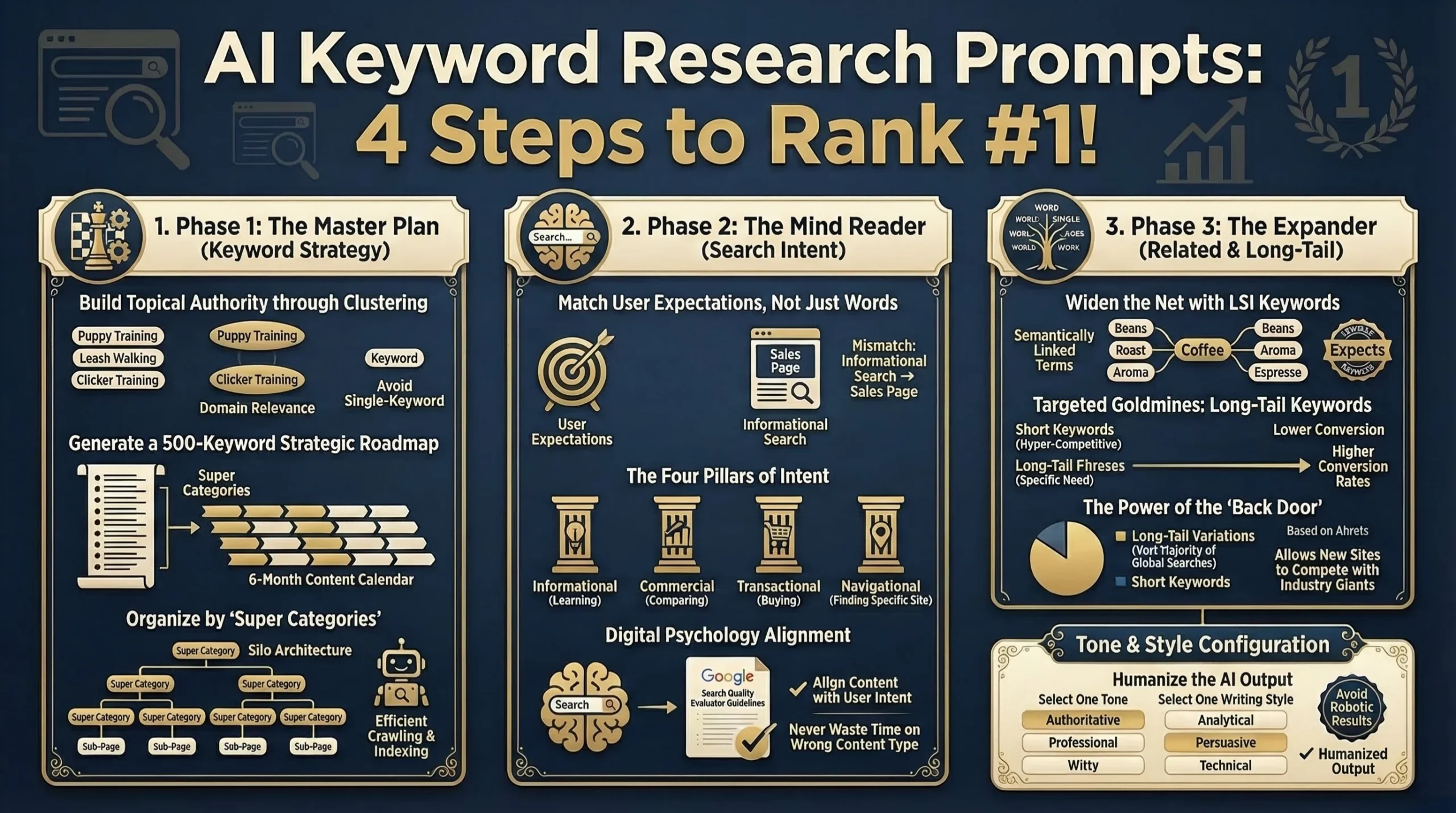
Amateurs pick one keyword. Conversely, professionals meticulously build a “Cluster.” If you want to rank for “Dog Training,” you cannot just write one single article. You must extensively cover “Puppy Potty Training,” “Leash Walking,” and “Clicker Training.” You strictly need topical authority. Leading industry resources like Search Engine Journal consistently emphasize that clustering is the most effective way to build undeniable domain relevance.
The Keyword Strategy prompt is undeniably the most powerful tool in this entire stack.
The Power: It does not just give you a basic, random list; moreover, it generates a massive 500-keyword strategy heavily organized by “Super Categories”.
The Output: It successfully creates a table that includes the Keyword, the Search Intent, a Click-Bait Title, and a Meta Description for every single topic. Consequently, this is not just research; it is your entire content calendar for the next 6 months, handed to you on a silver platter.
Prompt 1: Keyword Strategy
Prompt Template: Please ignore all previous instructions. Please respond only in the English language. You are a market research expert that speaks and writes fluent English. You are an expert in keyword research and can develop a full SEO content plan in fluent English. “{Seed Keyword}” is the target keyword for which you need to create a Keyword Strategy & Content Plan. Create a markdown table with a list of 500 closely related keywords for an SEO strategy plan for the main keyword “{Seed Keyword}”. Cluster the keywords according to the top 10 super categories and name the super category in the first column as “Category”. There should be a maximum of 6 keywords in a super category. The second column should be called “Keyword” and contain the suggested keyword. The third column will be called “Search Intent” and will show the search intent of the suggested keyword from the following list of intents (commercial, transactional, navigational, informational, local or investigational). The fourth column will be called “Title” and will be catchy and click-bait title to use for an article or blog post about that keyword. The fifth column will be called “Description: and will be a catchy meta description with a maximum length of 160 words. The meta description should ideally have a call to action. Do not use single quotes, double quotes or any other enclosing characters in any of the columns you fill in. Do not self-reference. Do not explain what you are doing. Just return your suggestions in the table.
Read this article: Best AI Sales Writing Prompts: 3 Steps to Close More Deals!
Phase 2: The Mind Reader (Search Intent)
Ranking is not just about aggressively matching words; meanwhile, it is entirely about matching expectations. If someone actively searches for “Best Running Shoes,” they desperately want to buy (Commercial Intent). If they search “How to tie running shoes,” they want to learn (Informational Intent). If you accidentally write a sales page for an informational keyword, Google will immediately and mercilessly bury your page.
The Get Search Intent for Keywords prompt acts as your digital psychologist.
How it works: You feed it a large list of keywords, and it rapidly classifies them into Commercial, Transactional, Navigational, or Informational.
Why it matters: This strictly ensures you never waste precious time writing a blog post when you should have written a product page (or vice versa). Therefore, it perfectly aligns your content with what the user actually wants, which is a core pillar of Google’s Search Quality Evaluator Guidelines.
Prompt 2: Get Search Intent for Keywords
Prompt Template: Please ignore all previous instructions. Please respond only in the English language. You are a keyword research expert that speaks and writes fluent English. I will give you a long list of keywords, and I want you to classify them by the search intent, whether commercial, transactional, navigational, informational, local or investigational. Once done, please print them out in a markdown table with “Keyword” as the first column, and “Search Intent” as the second. Here are the keywords – {Your Keywords}
Phase 3: The Expander (Related & Long-Tail)
Now that you possess your core strategy, you urgently need to widen the net. Google absolutely loves “Topical Authority”. It wants to see that you use the correct, industry-standard vocabulary.
The Related Keyword Generator prompt quickly finds the words that are semantically linked to your main topic.
The Latent Semantic Indexing (LSI) Trick: These are specific words Google fully expects to see. For instance, if you write about “Coffee,” Google expects to see “Beans,” “Roast,” and “Barista.” This prompt safely gives you that exact list so you can naturally weave them into your text and significantly boost your relevance score.
Prompt 3: Related Keyword Generator
Prompt Template: Please ignore all previous instructions. Please respond only in the English language. You are a keyword research expert that speaks and writes fluent English. I want you to generate a list of 40 keywords closely related to “{Seed Keyword}” without duplicating any words. Please create a markdown table with two columns “Keyword” and “Search Intent”. The first column should be the keyword you generated, and the second column should be the search intent of the keyword (commercial, transactional, navigational, informational, local or investigational). After the table, please print “List of same keywords separated by commas:”. On the next line print the same list of keywords at the bottom separated by commas. Do not repeat yourself. Do not self-reference. Do not explain what you are doing.
Finally, we deploy the ultimate secret weapon: the Long-Tail Keyword Generator.
The Secret Weapon: Short keywords (e.g., “Shoes”) are nearly impossible to rank for. However, long-tail keywords (e.g., “Best waterproof running shoes for flat feet”) are incredibly easy. They have less traffic, but the conversion rate is massive because the user knows exactly what they want. According to extensive data from Ahrefs, long-tail variations comfortably make up the vast majority of all global web searches. This specific prompt securely finds those low-competition goldmines for you.
Prompt 4: Long-Tail Keyword Generator
Prompt Template: Please ignore all previous instructions. Please respond only in the English language. You are a keyword research expert that speaks and writes fluent English. I want you to generate a list of 40 long-tail keywords for “{Seed Keyword}”. Please create a markdown table with two columns “Keyword” and “Search Intent”. The first column should be the keyword you generated, and the second column should be the search intent of the keyword (commercial, transactional, navigational, informational, local or investigational). After the table, please print “List of same keywords separated by commas:”. On the next line print the same list of keywords at the bottom separated by commas. Do not repeat yourself. Do not self-reference. Do not explain what you are doing.
Frequently Asked Questions
Can AI really replace tools like Ahrefs or SEMrush?
For foundational strategy and brainstorming, yes. AI is incredibly adept at understanding semantic relationships between words. However, AI cannot currently give you live data like precise "Search Volume" or numerical "Keyword Difficulty". Use these AI Keyword Research Prompts to systematically build the topics, then use a free tool like the Google Keyword Planner to verify the actual volume.
What is “Search Intent” mentioned in the prompts?
Search Intent is the fundamental psychological reason behind a search.
- Informational: "What is SEO?" (Wants to learn)
- Commercial: "Best SEO tools" (Comparing options)
- Transactional: "Buy Ahrefs" (Ready to buy) Consequently, the prompts categorize this automatically so you always write the correct type of content for the user.
How do I effectively use the “Super Categories” from the first prompt?
Use them to actively structure your website's Silo Architecture. If the AI suggests "Puppy Training" as a Super Category, make that a primary menu item on your blog, and put all the related articles directly under it. Furthermore, this tremendously helps search engines successfully crawl and index your site efficiently.
Why should I exclusively target “Long-Tail” keywords?
Because new websites simply cannot ever compete with massive giants like Wikipedia or Amazon for short keywords. Long-tail keywords are your reliable "back door" into the search results. You might only get 100 visitors a month, but they are highly targeted, ready to convert, and much easier to rank for.
Do I strictly need to use all 500 keywords generated?
No! Treat the Keyword Strategy output strictly as a buffet. Pick the 50 topics that are most relevant to your specific business and completely ignore the rest. It is significantly better to write 10 amazing articles than 500 mediocre ones.
Read this article: Best AI Marketing Prompts: 4 Secrets to Skyrocket Your Sales!

25 Best AI Prompts for Professionals! Save Hours of Work!
The AI Professional Suite: How to Build a C-Suite Team for $0 In the professional…

Best AI Productivity Prompts: 14 Hacks to Work 10x Faster!
The AI Productivity Suite: How to Do a Week’s Work in One Afternoon We all…
Best AI Social Media Prompts: 36 Ways to Go Viral Fast!
The Ultimate AI Social Media Manager: How to Run a Media Empire Solo There is…
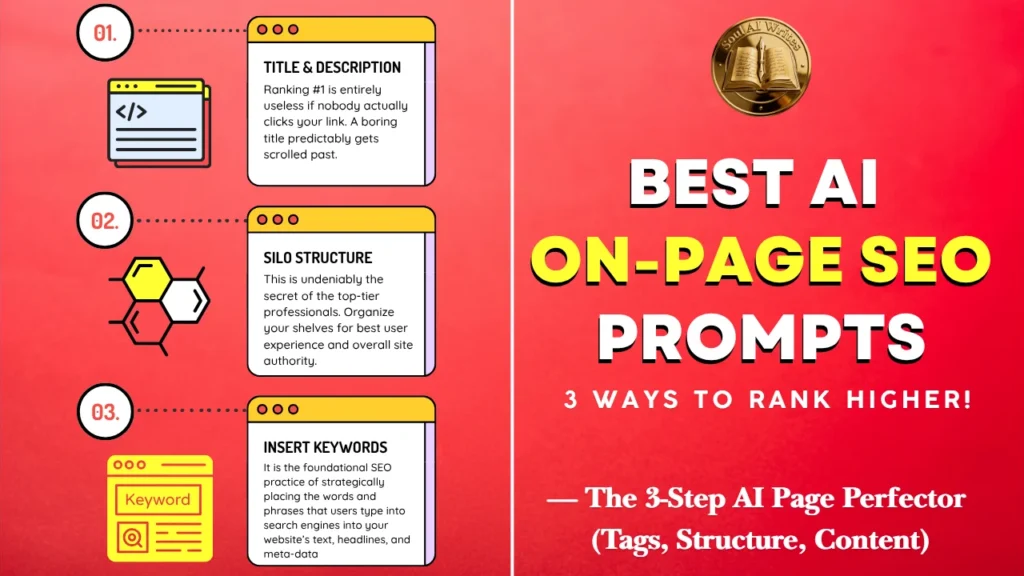
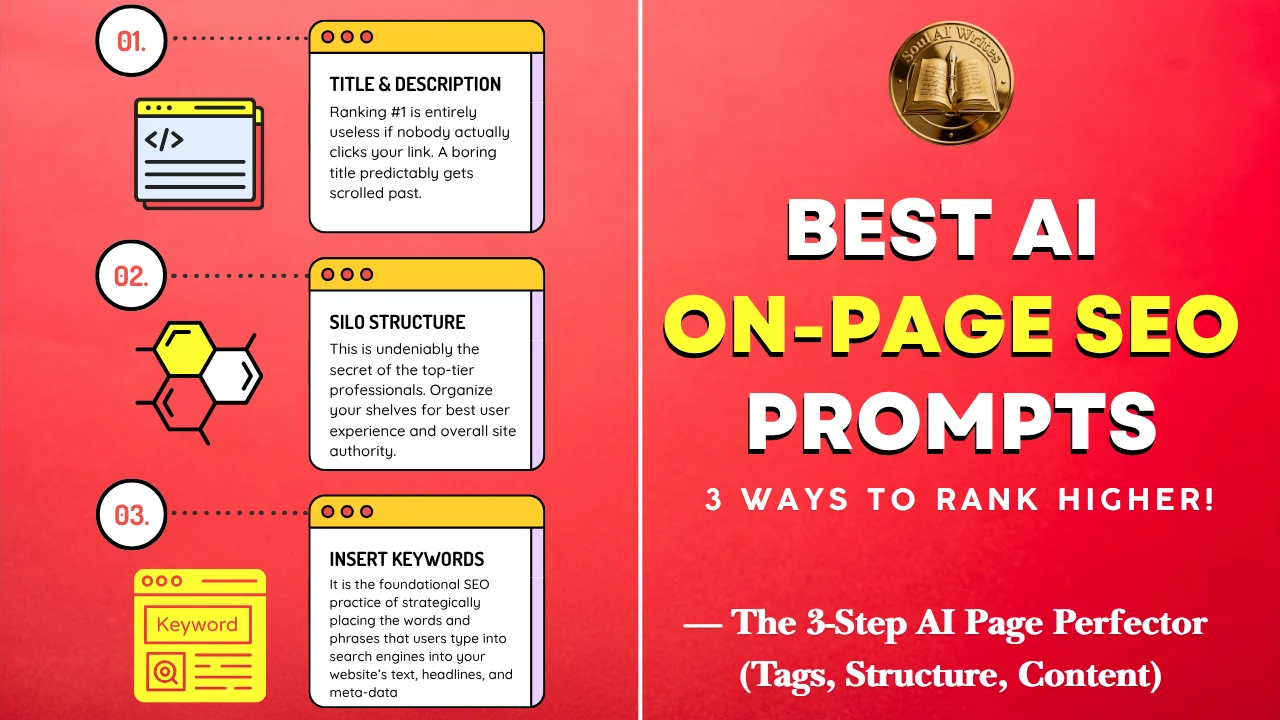
Best AI On-Page SEO Prompts: 3 Ways to Rank Higher!
The AI Page Perfector: How to Make Google Fall in Love With Your Content Most…
Want to Dominate Maps? 5 AI Local SEO Prompts!
The AI Local Hero: How to Beat Big Brands in Your Neighborhood If you safely…

Best AI Ecommerce SEO Prompts: 4 Secrets to Scale Fast!
The AI Store Manager: How to Write 1,000 Product Descriptions Without Losing Your Mind Running…











Leave a Reply