


The AI Page Perfector: How to Make Google Fall in Love With Your Content
Most people assume SEO is about manipulating search engines. However, it is fundamentally about organizing information. Imagine walking into a massive library where all the books are thrown in a messy pile on the floor. That is exactly what most websites look like to a search engine. They possess absolutely no structure, the titles are incredibly boring, and the core keywords are completely missing. Consequently, Google’s crawler arrives, gets heavily confused, and leaves without indexing your hard work.
On-Page SEO is entirely about cleaning up that chaotic mess. It is about clearly telling the algorithm: “This page is about X, it definitively belongs in Category Y, and here is exactly why it matters to the reader.”
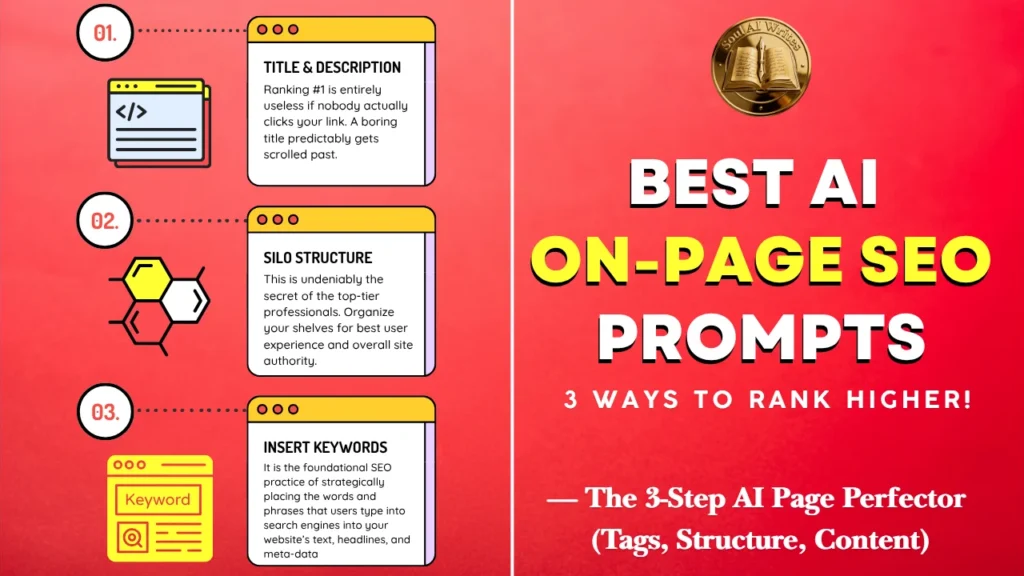
Today, I am handing you the highly specialized “On-Page Module” of our digital library. These 3 AI On-Page SEO Prompts directly act as your dedicated technical librarian. Furthermore, we are going to flawlessly rewrite your tags to boost clicks, organize your site structure for maximum authority, and surgically insert keywords without ever ruining your natural writing flow.
Ready to clean up your site? Let’s optimize.
Tone & Style Configuration
Before executing these highly effective frameworks, choose your distinct voice to completely avoid robotic AI outputs. Pick one Tone and one Writing Style from this menu and paste it directly into the {Tone} and {Style} brackets within the prompts below.
- Tone of Voice (Pick One): (Default), Authoritative, Caring, Casual, Cheerful, Coarse, Conservative, Conversational, Creative, Dry, Edgy, Enthusiastic, Expository, Formal, Frank, Friendly, Fun, Funny, Humorous, Informative, Irreverent, Journalistic, Matter of Fact, Nostalgic, Objective, Passionate, Poetic, Playful, Professional, Provocative, Quirky, Respectful, Romantic, Sarcastic, Serious, Smart, Snarky, Sophisticated, Subjective, Sympathetic, Trendy, Trustworthy, Unapologetic, Upbeat, Witty.
- Writing Style (Pick One): (Default), Academic, Analytical, Argumentative, Conversational, Creative, Critical, Descriptive, Epigrammatic, Epistolary, Expository, Informative, Instructive, Journalistic, Metaphorical, Narrative, Persuasive, Poetic, Satirical, Storytelling, Technical.
Phase 1: The First Impression (Meta Title & Description)
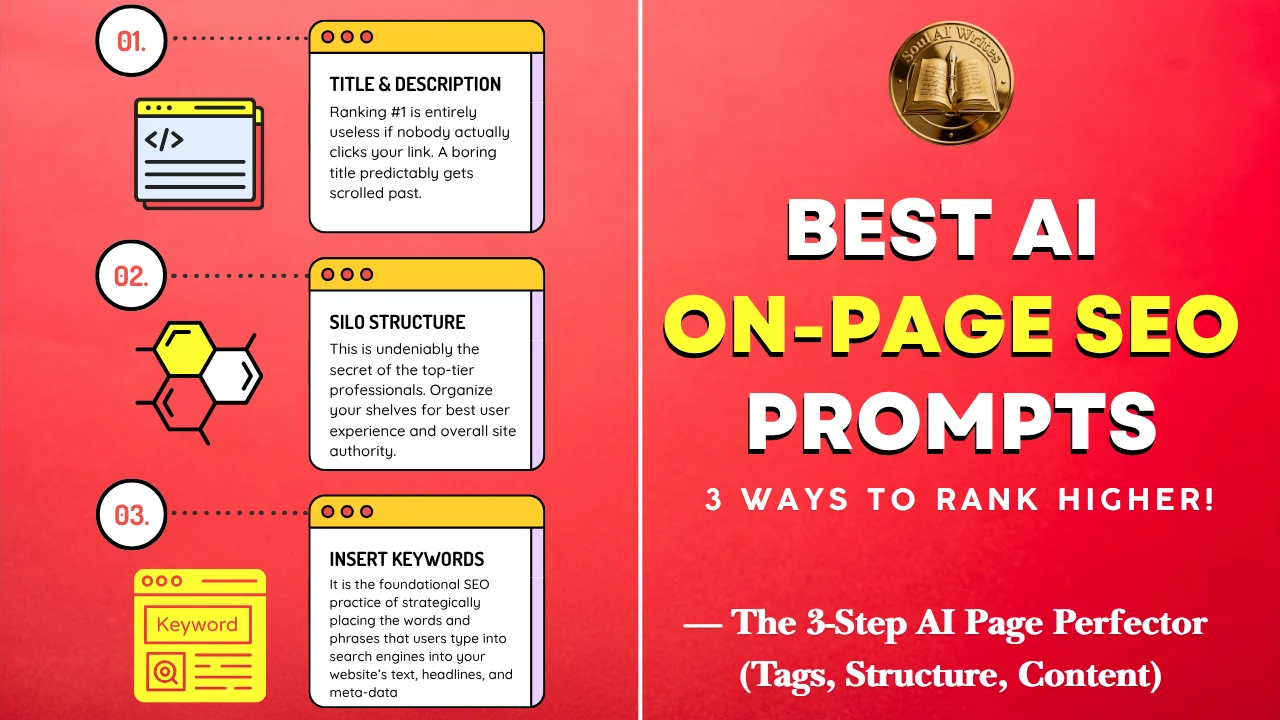
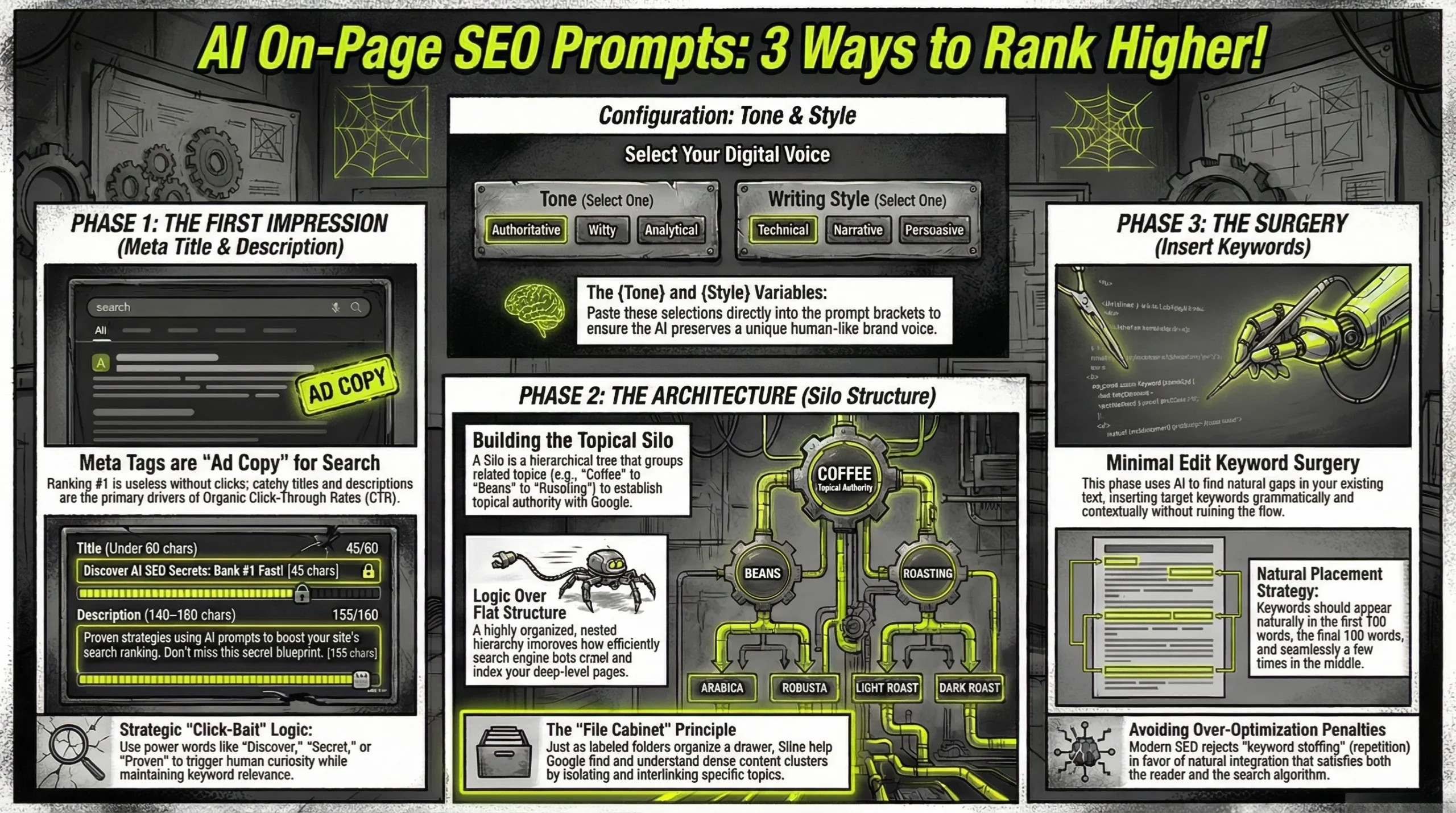
Ranking #1 is entirely useless if nobody actually clicks your link. Your Meta Title and Meta Description function as your direct “ad copy” on the Google search results page. A boring title predictably gets scrolled past. Conversely, a fantastic title securely wins the click, even if you are organically ranked #3 or #4.
The Meta Title & Description Generator prompt is your ultimate CTR (Click-Through Rate) booster.
The Difference: Most AI tools just lazily stuff keywords into the text. Meanwhile, this specific prompt explicitly asks for “Catchy page titles” and “Click-bait meta descriptions” to maximize human curiosity. Official documentation from Google Search Central constantly reiterates that accurate, engaging snippets are a primary driver of organic click-through rates.
The Rules: It rigidly enforces strict character limits (under 60 characters for titles, 140-160 for descriptions) so your persuasive text never gets brutally cut off by Google.
The Result: You receive a clean markdown table filled with perfectly optimized tags that do not just describe the page—they aggressively sell the click.
Prompt 1: Meta Title & Description Generator
Prompt Template: Please ignore all previous instructions. Please respond only in the English language. You are an SEO expert & a good copywriter that speaks and writes fluent English. Please write in a “{Tone}” tone of voice and a “{Style}” writing style. Do not self-reference. Do not explain what you are doing. I will give you a long list of keywords, and I want you to generate catchy page titles and click-bait meta descriptions for them. The page titles should be between 50 and 60 characters. The meta descriptions should be between 140 and 160 characters. Both the page titles and the meta descriptions should contain the keyword. Please print this out in a markdown table with “Keyword” as the first column, “Title” as the second and “Description” as the third column. Here are the keywords – {Your Keywords}.
Phase 2: The Architecture (Silo Structure)
This is undeniably the secret of the top-tier professionals: Siloing. Google rigorously establishes “Topical Authority” by closely looking at exactly how your various pages logically connect to one another. If you heavily write about “Coffee,” you absolutely should have a main pillar page linking smoothly to “Beans,” which subsequently links down to “Roasting.” This highly organized hierarchy is actively called a Silo.
The Create Silo Structure prompt effectively builds this complex blueprint for you.
How it works: You simply give it a core keyword (e.g., “Digital Marketing”), and it intelligently designs a perfect hierarchical tree.
The Strategy: It tightly groups related topics together and strictly isolates them from unrelated ones. According to comprehensive architectural studies by Ahrefs, a flat, logical site structure drastically improves how efficiently search engine bots crawl and index your deep pages. Consequently, this tells Google exactly which pages are the most important and how they dynamically relate to each other, heavily boosting your ranking for the entire content cluster.
Prompt 2: Create Silo Structure
Prompt Template: Please ignore all previous instructions. Please respond only in the English language. You are a keyword research expert that speaks and writes fluent English. Please write in a “{Tone}” tone of voice and a “{Style}” writing style. Create a detailed SILO structure for a website using the keyword: “{Your Keywords}”. Organize the page of the website in a hierarchical structure, with the Homepage at the top and the more specific pages at the bottom. You need to group, isolate, and interlink pages about a specific topic. Do not repeat yourself. Do not self-reference. Do not explain what you are doing. Only write down the SILO pages in a nested structure.
Phase 3: The Surgery (Insert Keywords)
You have successfully written a phenomenal article, but you accidentally forgot to include the primary keyword “Best Vegan Recipes.” If you just awkwardly jam it in randomly, it reads terribly: “We love food. Here are the Best Vegan Recipes that are good.”
The Insert Keywords into Content prompt operates as your delicate surgical tool.
The Precision: It strictly asks the AI to intelligently rewrite your text with the “minimal number of edits.”
The Goal: It flawlessly finds the natural gaps in your existing sentences where the target keyword fits both grammatically and contextually. Industry leaders at Moz emphasize that keyword placement must always feel incredibly natural to the reader to avoid harsh over-optimization penalties. Furthermore, it securely preserves your unique human voice while fully satisfying the strict demands of the search algorithm.
Prompt 3: Insert Keywords into Content
Prompt Template: Please ignore all previous instructions. Please respond only in the English language. You are a content writer that speaks and writes fluent English. Please write in a “{Tone}” tone of voice and a “{Style}” writing style. Please rewrite the content that I give you with minimal number of edits to insert the following keywords into it “{Keywords}”. Do not repeat yourself. Do not self-reference. Do not explain what you are doing. Here is the content – {Content}.
Frequently Asked Questions
Why is “Silo Structure” considered so important?
Think of a Silo exactly like a physical file cabinet. If you throw all your crucial papers into one massive drawer, you can never find anything. However, if you possess separate, labeled folders for "Invoices," "Receipts," and "Contracts," you instantly find things. Silos heavily help Google "find" and deeply understand your dense content efficiently.
Can AI really write “Click-Bait” meta descriptions without being spammy?
Yes. When utilizing these AI On-Page SEO Prompts, the term "click-bait" simply means "highly compelling." It actively means strategically using strong power words like Discover, Secret, Proven, or Free. The prompt securely ensures the main keyword is still naturally included, so it perfectly stays relevant while aggressively grabbing human attention.
How many distinct keywords should I insert into a single page?
Do not overdo it. The archaic days of "Keyword Stuffing" (repeating the exact same word 50 times) are permanently over. Use the keyword insertion tool to effectively ensure your main keyword appears naturally in the first 100 words, the final 100 words, and a few times seamlessly in the middle.
Does actively changing my Meta Title directly affect my overall ranking?
Yes, massively. If you intelligently change a boring title to a high-CTR title, substantially more people click your link. Google's algorithm clearly sees this user engagement and determines that people genuinely love this specific result, and consequently moves you rapidly up the organic rankings.
Should I utilize the generated Silo Structure for a brand-new site or an old one?
Both. For a completely new site, it serves as a flawless roadmap. Meanwhile, for an older site, use these AI On-Page SEO Prompts to perform a strict "Audit." Compare the AI's perfect, logical structure to your current mess, and actively start moving your pages around to exactly match the clean hierarchical design.
Read this article: Best AI Keyword Research Prompts: 4 Steps to Rank #1!

25 Best AI Prompts for Professionals! Save Hours of Work!
The AI Professional Suite: How to Build a C-Suite Team for $0 In the professional…
Best AI Productivity Prompts: 14 Hacks to Work 10x Faster!
The AI Productivity Suite: How to Do a Week’s Work in One Afternoon We all…
Best AI Social Media Prompts: 36 Ways to Go Viral Fast!
The Ultimate AI Social Media Manager: How to Run a Media Empire Solo There is…
Best AI On-Page SEO Prompts: 3 Ways to Rank Higher!
The AI Page Perfector: How to Make Google Fall in Love With Your Content Most…
Want to Dominate Maps? 5 AI Local SEO Prompts!
The AI Local Hero: How to Beat Big Brands in Your Neighborhood If you safely…
Best AI Ecommerce SEO Prompts: 4 Secrets to Scale Fast!
The AI Store Manager: How to Write 1,000 Product Descriptions Without Losing Your Mind Running…










Leave a Reply