

AI Book Writing Prompts: Can You Write a Best-Seller in a Weekend?
AI Book Writing Prompts are the secret weapon for modern authors. However, many writers still stare at the blank page, paralyzed by the fear of the “Valley of Death.”
In fact, we have all been there. You have a cool idea. Specifically, maybe it is a detective in space or a romance in a bakery. Unfortunately, the plot holes are huge, the characters feel flat, and the blinking cursor mocks you.
Consequently, most aspiring authors spend years stuck in this valley. But what if you could cross it in an afternoon?
I am not talking about letting a robot write a soulless book for you. Instead, I am talking about using AI as your Co-Author, your Editor, and your Creative Muse.
Today, I am unlocking the “Fiction Module” of my prompt library. These aren’t just random questions. On the contrary, they are the exact 4 AI Book Writing Prompts you need to build a novel from the ground up.
We will move systematically from a spark of an idea to a fully written chapter.
Ready to publish? Let’s turn the page.
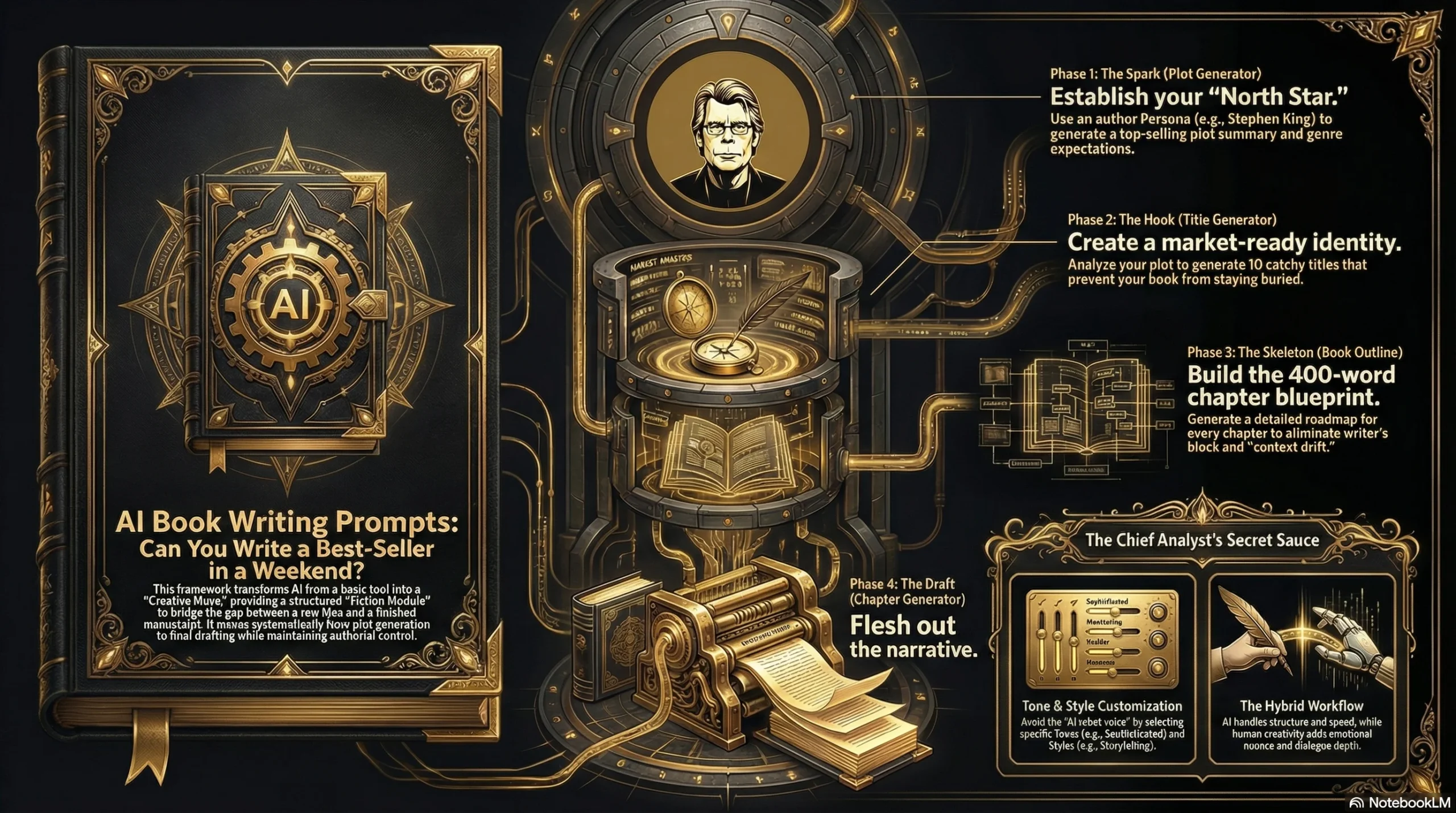
Phase 1: The Spark (The Plot Generator)
A great book dies without a great plot. You might have a cool character, but if they don’t have a problem, you don’t have a story.
The Plot Generator prompt is your story engine. Unlike basic prompts that give you generic ideas (“A boy finds a magic sword”), this prompt forces the AI to adopt a specific Persona (e.g., Stephen King, J.K. Rowling). It demands a “top-selling” structure.
Why it works: It establishes the genre expectations immediately. If you ask for a “suspense” plot, it builds tension. If you ask for “romance,” it builds conflict. It gives you the “North Star” for your entire book.
For more on story structure, you can reference resources like NaNoWriMo’s prep guides.
Prompt 1: Plot Generator
Copy and paste this into ChatGPT/Claude:
Prompt Template: Please ignore all previous instructions. You are {Persona} (example – a top selling author of horror, supernatural fiction, suspense, crime, science fiction, and fantasy novels). Please generate a book title and a plot summary for a top selling book. {Book Details} – (example – The book teaches the readers how to get better at marketing …). Do not write the book, please only write the plot summary of the book. Please respond only in the English language. Do not self-reference. Do not explain what you are doing. Please only provide the plot summary and nothing else.
Phase 2: The Hook (The Title Generator)
You judge a book by its cover, but you buy it because of the title. A boring title guarantees your book stays buried on Amazon.
Once you have your plot, feed it into the Book Title Generator prompt. This tool doesn’t just list words; it analyzes your plot summary and distills it into 10 catchy, market-ready hooks.
Tip: Don’t settle for the first list. Ask the AI to give you “Mystery” titles, then “Funny” titles, then “One-word” titles. The perfect title is usually hidden in the mix.
Prompt 2: Book Title Generator
Use the plot you just generated:
Prompt Template: Please ignore all previous instructions. You are {Persona} (example – a top selling author of horror, supernatural fiction, suspense, crime, science fiction, and fantasy novels). I will give you the plot summary for a book, and I want you to generate 10 catchy top selling titles for it. The titles should only be in the English language. Do not self-reference. Do not explain what you are doing. Please only provide the book titles nothing else. The plot summary is – “{Plot Summary}”
Phase 3: The Skeleton (The Book Outline)
This is the most critical step. “Pantsing” (writing by the seat of your pants) is fun, but “Plotting” finishes books.
The Book Outline Generator is designed to save you months of writer’s block. It takes your plot and breaks it down into chapters.
However, look closely at the prompt instruction: it asks for a 400-word summary of each chapter. This is the game-changer. It doesn’t just say “Chapter 1: Intro.” It details exactly what happens in Chapter 1. It gives you the roadmap so you never wake up wondering, “What do I write today?”
Prompt 3: Book Outline Generator
Build the blueprint:
Prompt Template: Please ignore all previous instructions. You are {Persona} (example – a top selling author of horror, supernatural fiction, suspense, crime, science fiction, and fantasy novels}. I will give you the plot summary for a book, and I want you to generate an outline for it. The outline should have chapters, with a title and a 400-word summary of the chapter. Do not write the book, please only generate the outline of the book. Please write only in the English language. Do not self-reference. Do not explain what you are doing. Please only provide the book outline and nothing else. The plot summary is – “{Plot Summary}”
Read this article: AI Blog Writing Prompts: 7 Steps to Viral Content (2026)
Phase 4: The Draft (The Chapter Generator)
Now, we write. Taking the detailed summary from Phase 3, you use the Book Chapter Generator to flesh it out.
We have two powerful approaches here, depending on your style.
Secret Sauce: Tone & Style
Before you run the prompt below, choose your “Voice.” Don’t settle for the default AI robot voice. Pick one Tone and one Writing Style from this menu and paste it into the {Tone/Style} brackets in the prompt.
Tone of Voice (Pick One):
(Default), Authoritative, Caring, Casual, Cheerful, Coarse, Conservative, Conversational, Creative, Dry, Edgy, Enthusiastic, Expository, Formal, Frank, Friendly, Fun, Funny, Humorous, Informative, Irreverent, Journalistic, Matter of Fact, Nostalgic, Objective, Passionate, Playful, Poetic, Professional, Provocative, Quirky, Respectful, Romantic, Sarcastic, Serious, Smart, Snarky, Sophisticated, Subjective, Sympathetic, Trendy, Trustworthy, Unapologetic, Upbeat, Witty.
Writing Style (Pick One):
(Default), Academic, Analytical, Argumentative, Conversational, Creative, Critical, Descriptive, Epigrammatic, Epistolary, Expository, Informative, Instructive, Journalistic, Metaphorical, Narrative, Persuasive, Poetic, Satirical, Storytelling, Technical.
Prompt 4: Book Chapter Generator
The drafting engine:
Prompt Template: Please ignore all previous instructions. You are {Persona} (example – a top selling author of horror, supernatural fiction, suspense, crime, science fiction, and fantasy novels). I will give you the book summary as well as the summary for a single chapter. I want you to write the entire chapter based on the chapter summary. Please write in a “{Tone}” tone of voice and a “{Style}” writing style. Do not write the entire book, please only generate the text of a single chapter. Please write only in the English language. Do not self-reference. Do not explain what you are doing. The plot summary is “{Plot Summary}”. The chapter summary is “{Chapter Summary}”
The Secret: By providing both the “Book Summary” (Context) and the “Chapter Summary” (Action), you ensure the AI knows the big picture and the immediate scene. This prevents “context drift,” where the AI forgets who the killer is halfway through the book.
Frequently Asked Questions
Can AI really write a good fiction book?
AI is excellent at structure, plotting, and description. However, it struggles with subtext and deep emotional nuance. The best workflow is Hybrid: use these prompts to generate the draft, then use your human creativity to rewrite the dialogue and add emotional depth.
Do I own the copyright to the book created with these prompts?
Generally, yes. Most AI platforms assign the rights of the output to the user. Therefore, you can sell your work. For monetization, Amazon KDP (Kindle Direct Publishing) is the gold standard for indie authors.
How do I keep the writing style consistent across chapters?
This is the hardest part. In the "Persona" field of the prompts, be very specific. Instead of just saying "Stephen King," say "Write in a gritty, fast-paced style with short sentences and internal monologues." Reuse this exact instruction for every single chapter prompt.
Can I use these prompts for non-fiction books?
Yes! While these are optimized for fiction (novels), you can easily tweak the "Persona" to "Expert Biographer" or "Business Guru" to generate outlines and chapters for self-help or business books.
What is the best way to monetize these books?
Once you have your manuscript, use AI to help write the blurb (using the Copywriting prompts!) and create a cover. Serialized fiction platforms like [suspicious link removed] or Radish are also great places to build an audience.
Read this article: Best 6 AI Tools for Academic Research
Read more articles
AI Book Writing Prompts: 4 Steps to a Best-Seller (2026)
AI Book Writing Prompts: Can You Write a Best-Seller in a Weekend? AI Book Writing…
AI Blog Writing Prompts: 7 Steps to Viral Content (2026)
The Ultimate AI Blog Writing Workflow: Are You Using the Right Prompts? AI Blog Writing…
Lullaby AI Story Generator Review: Turn Kids into Pixar Heroes?
Lullaby AI Story Generator: Can You Really Turn Your Child Into a Pixar Character? Imagine…
Inside the Moltbook AI Social Network: The Rise of the “Agent Internet” (2026 Review)
Moltbook AI Social Network: Are Your Agents Gossiping Behind Your Back? Imagine a world where…
Top Test Automation Tools 2026: Katalon, Applitools & ACCELQ Review
Top Test Automation Tools 2026: Katalon, Applitools & ACCELQ Review Top Test Automation Tools like…

Aibrary – AI Learning Companion Review: The End of Passive Learning? (2026)
Aibrary AI Learning Companion transforms static books into active debates. We tested the “Idea Twin”…


Leave a Reply