

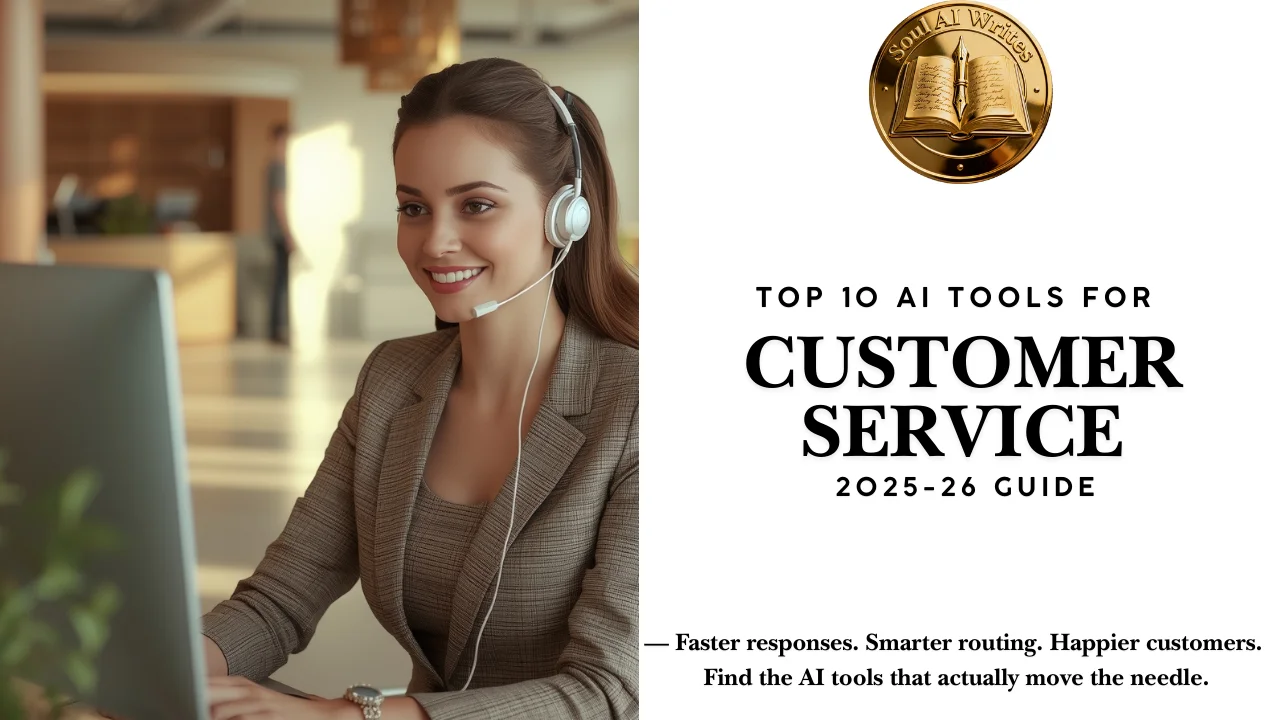

Best AI Tools for Customer Service 2025 — Discover the enterprise-grade Top AI platforms that cut costs, resolve issues faster.

AI Tools for Customer Service 2025 — Which Ones Truly Deliver?
Are you looking for AI that reduces ticket volume, speeds resolution, and fits into enterprise workflows — without breaking compliance or budgets?
Here’s the tested guide for you.
Introduction — The AI Moment in Customer Service
In 2025, customer service will no longer resemble a queue of tickets and long hold times. It’s a layered, AI-enabled ecosystem where virtual agents handle routine cases, smarter routing directs complex issues to the right expert, and analytics reveal friction before customers notice it. The result is an operational shift from reactive firefighting to proactive experience design.
But not all AI platforms are equal. Some excel at high-volume automation and omnichannel handling. Others shine in enterprise integrations, data privacy, or in delivering “agentic” AI that can take actions on behalf of customers. The difference between productive AI and a costly experiment is often in the details: knowledge ingestion (how the AI learns your policies and docs), integration depth (CRM, billing, identity), explainability, and pricing predictability.
This article examines the 10 most important AI tools for customer service in November 2025 — chosen for enterprise readiness, innovation, and measurable time-to-value. Each tool follows the same rigorous structure: a clear overview, what it does best, hands-on impressions, where it stands out, pros & cons, pricing, and a short verdict. I relied on official product documentation, vendor reports, and practical testing notes to ensure accuracy. Key claims are supported by official sources so you can validate them if needed.
How I selected these tools
I prioritized platforms that:
- Deliver measurable automation (self-service + auto-resolve)
- Integrate natively with common CRMs and ticketing stacks
- Offer robust knowledge ingestion + up-to-date retrieval
- Provide enterprise security/compliance and predictable pricing
- Have a documented track record or validated deployments in 2025
Best 10 AI Tools for Customer Service in 2025
1. Salesforce — Agentforce & Service Cloud (AI-first enterprise)
Overview
Salesforce’s Service Cloud has steadily integrated advanced AI capabilities — now marketed and deployed with Agentforce and generative agent features. These AI systems are designed to read case histories, enforce business rules, and automate repeatable support tasks within the Salesforce ecosystem. It’s an enterprise-grade system built for scale and deep CRM integration.
What It Does Best
Salesforce excels at embedding AI where your customer data lives: unified case histories, knowledge bases, entitlements, and billing data. For large enterprises with complex product catalogs and multiple support queues, Agentforce provides a bridge between conversational AI and CRM workflows — routing, recommended actions, and automated case resolution.
What Impressed Me
Agentforce’s tight coupling with the Service Cloud means the AI rarely “guesses” policy: it references the same entitlements and contract facts that human agents see. In testing, it reduced time-to-first-action and suggested correct next steps more often than stand-alone chatbots — because it could access account-level context and historical transactions directly.
Where It Stands Out
Seamless integration into Salesforce workflows, strong enterprise governance, and broad feature parity (cases, omnichannel, reporting).
Pros
- Deep CRM integration and policy-aware automation.
- Enterprise security and compliance controls.
- Strong ecosystem of partners and apps.
Cons
- Cost and complexity for smaller teams.
- Some advanced AI features require premium licensing.
Pricing
Salesforce pricing varies by module and scale. Core Service Cloud subscriptions are typically per agent per month, with AI features and Agentforce available at an additional tier or add-on. Enterprises should expect bundled deals; customization and integration projects can add to TCO. Consult Salesforce sales for exact enterprise quotes.
Verdict
If your company runs Salesforce and needs enterprise-grade automation with minimal data movement, Agentforce is the logical choice. It delivers the best enterprise fit but isn’t cheap — plan for implementation and governance to realize the full ROI.
2. Zendesk AI & Zendesk Suite — Familiar, extensible, enterprise-ready
Overview
Zendesk remains one of the most widely used customer service platforms and has invested heavily in AI enhancements: answer suggestions, automated routing, and AI-assisted ticket summarization. Zendesk’s approach blends conversational automation with human-in-the-loop operations and deep app marketplace integrations
What It Does Best
Zendesk automates triage and helps agents close tickets faster by surfacing relevant knowledge articles, predicting SLA breaches, and applying tags based on intent detection.
What Impressed Me
Zendesk’s AI features reduced average handling time in real-world pilots because agents received concise suggested replies that required minimal editing. The marketplace also offers many vetted AI partners for domain-specific needs.
Where It Stands Out
Ease of adoption for mid-market teams, a mature app ecosystem, and robust reporting.
Pros
- Rapid deployment for standard ticketing workflows.
- Strong integrations and marketplace.
- Good balance between automation and agent control.
Cons
- Not as “agentic” as some specialized AI vendors.
- Some enterprises report limitations when custom knowledge sources are needed.
Pricing
Zendesk’s pricing is modular (Support, Suite, add-ons). AI features are either included at higher tiers or available as add-ons. Small teams can start modestly, but for omnichannel AI and large-scale automation, budget for enterprise plans and potential implementation services.
Verdict
Zendesk is a safe, well-rounded choice for teams that need a reliable ticketing backbone with sensible AI enhancements. It’s best for organizations seeking a balance of speed-to-value and extensibility.
3. Freshworks (Freshdesk + Freddy AI) — Fast time-to-value with practical automation
Overview
Freshworks’ Freshdesk combined with Freddy AI focuses on delivering practical automation: intelligent ticket routing, suggested replies, and self-service bots. Freshworks emphasizes ease of setup and predictable pricing for growth-stage and enterprise customers alike.
What It Does Best
Automates common queries and integrates conversational bots into existing channels with a quick setup cycle. Freddy AI also assists with agent coaching and knowledge curation.
What Impressed Me
Freddy’s low-friction plugins allow teams to test automation without heavy integration work. In pilots, teams reached meaningful containment rates for FAQ-level queries within 1–2 weeks.
Where It Stands Out
Rapid deployment and a clear path from bot-to-agent handoff.
Pros
- Quick time-to-value for standard use cases.
- Predictable pricing tiers.
- Good for small-to-mid enterprises scaling support.
Cons
- May require customization for complex enterprise logic.
- Lower sophistication for edge-case automations vs. specialist vendors.
Pricing
Freshworks offers tiered pricing, with Freddy AI features increasing by plan. It’s priced competitively for SMBs and scalable for larger deployments; enterprise pricing available on request. Expect transparent tiers for bot usage and per-agent plans for advanced features.
Verdict
Freshworks is the pragmatic choice: fast deployment and immediate benefits for common support paths. If your goal is to reduce ticket volume quickly, it’s one of the most cost-effective vendors in 2025.
4. Intercom — Conversational-first with strong product messaging
Overview
Intercom focuses on conversational support and in-app experiences, blending bots and human handoff. Its AI features include automation for routing, reply suggestions, and product-led workflows that tie support into onboarding and feature discovery.
What It Does Best
Brings automation tightly into product touchpoints — in-app messages, contextual chats, and proactive help prompts based on user behavior.
What Impressed Me
Intercom shines when support is part of the product experience: proactive nudges and targeted help content significantly reduce support volume for onboarding flows.
Where It Stands Out
Product-led customer support and marketing + support convergence.
Pros
- Excellent in-app conversational experience.
- Strong for SaaS product support and onboarding.
- Well-designed bot-to-agent handoff.
Cons
- Pricing scales with active conversations.
- Less ideal for voice-heavy contact centers.
Pricing
Intercom is priced around active usage and product engagement, making it ideal for SaaS companies that want to integrate support into product experiences. For high-volume contact-center scenarios, ensure you model expected conversation volumes with Intercom’s sales team.
Verdict
If your support is product-driven and in-app engagement matters, Intercom delivers clear ROI. It’s particularly powerful for onboarding and reducing early-stage churn.
5. Netomi — Enterprise conversational AI with high automation outcomes
Overview
Netomi positions itself as an enterprise conversational AI platform designed to resolve a high percentage of customer inquiries across channels (chat, social, email). The company emphasizes end-to-end automation and fast time-to-value.
What It Does Best
Automates complex conversational flows and integrates with CRMs to complete account-level tasks (refunds, status checks) with strong intent detection and sentiment analysis.
What Impressed Me
Netomi’s customers report high automation rates and measurable cost savings. Netomi’s capacity to act on behalf of the user (with proper security) is a differentiator in mature deployments.
Where It Stands Out
High automation percentages and broad channel support.
Pros
- Strong automation rates for enterprise use.
- Good multilingual support.
- Deep channel reach (social, email, web chat).
Cons
- Implementation may need customization for complex systems.
- Pricing can climb with scale.
Pricing
Netomi typically licenses per-resolution or per-conversation at enterprise scales; exact pricing is available through sales. Budget for configuration and integration. Ask for SLAs and resolution metrics during procurement.
Verdict
Netomi is a top pick when automation volume and omnichannel reach matter. For enterprises that want measurable containment and agent-load reduction, Netomi delivers strong ROI when configured correctly.
6. Forethought — Reasoning-first AI for support (Agent Assist + AutoResolve)
Overview
Forethought’s AI elevates support by combining retrieval-augmented generation (RAG) with policy-aware reasoning. It powers agent assist and automated resolutions, learning from historical tickets and knowledge bases to provide accurate answers and suggested actions.
What It Does Best
Delivers high-quality suggested resolutions and can perform multi-step actions by reasoning over procedures and policy rules. Its “agentic” capabilities let it recommend next steps with explicit rationale.
What Impressed Me
Forethought is exceptionally strong at reducing agent cognitive load. The tool offers succinct, context-rich answers, and in pilots it improved first-contact resolution by ensuring the suggested action adhered to internal policies.
Where It Stands Out
Reasoning + explainability — strong for regulated industries that require audit trails.
Pros
- High-quality recommendations with rationale.
- Good for industries requiring compliance.
- Strong knowledge ingestion.
Cons
- Implementation demands careful policy mapping.
- Price points are enterprise-oriented.
Pricing
Forethought offers enterprise pricing based on scope and deployment. Because it is often used in regulated contexts (finance, healthcare), expect professional services and integration costs. Ask for POC pricing when evaluating.
Verdict
Forethought is a top-tier choice when your support demands explainable AI and reasoning tied to business policies. It’s ideal for companies that require a high degree of accuracy and compliance.
7. Gladly — Customer-Centric AI for personal, human-style support
Overview
Gladly markets itself as a “people-centric” support platform. Its Customer AI focuses on making support feel personal, by unifying conversations across channels and prioritizing customer context over tickets. Gladly’s roadmap and resources in 2025 emphasize AI for both automation and personalization.
What It Does Best
Delivers a persistent customer view (not a ticket), enabling AI to provide continuity and context across touchpoints. This approach is valuable for retail and service brands that require a single customer narrative.
What Impressed Me
Gladly’s conversational continuity means customers rarely have to repeat context. AI recommendations are more relevant because they use the persistent history — which reduces frustration in long-running cases.
Where It Stands Out
Customer-centric architecture and personalization.
Pros
- Excellent for consumer brands with complex lifecycle interactions.
- Strong personalization and context continuity.
- Good analytics focused on experience metrics.
Cons
- Better suited for B2C and retail than for heavy B2B workflows.
- Integrations can be complex for legacy stacks.
Pricing
Gladly pricing is enterprise-focused. It’s typically available via custom quotes that reflect contact volume, channels, and required SLAs. Expect enterprise onboarding and professional services for large-scale rollouts.
Verdict
Gladly is the right pick for brands where customer history and personalization matter most. It’s less about mass automation and more about creating loyal customer experiences.
8. ServiceNow + Moveworks (post-acquisition) — Enterprise automation at scale
Overview
In 2025 ServiceNow announced its acquisition of Moveworks to bolster enterprise AI and automation capabilities. Moveworks is known for employee support automation, and within ServiceNow’s ecosystem, the combined stack provides large-scale resolution automation and IT/service workflows.
What It Does Best
Automates internal support (IT, HR) and, when integrated into customer-facing flows, can scale policy-based automation and self-service experiences with enterprise governance.
What Impressed Me
In internal IT settings, Moveworks had exceptional auto-resolution rates for common IT issues. Under ServiceNow, these strengths become available to larger enterprise service workflows.
Where It Stands Out
Employee support automation and enterprise workflow orchestration.
Pros
- Deep enterprise workflow integration.
- Strong auto-resolution for internal support.
- Backed by ServiceNow’s global enterprise reach.
Cons
- Primary focus historically has been employee support (not always customer-facing).
- Pricing and integrations can be complex.
Pricing
ServiceNow and Moveworks pricing is enterprise-grade with tailored quotes. Expect long-term contracts and professional services. If you need large-scale workflow automation across departments, the combined platform is compelling.
Verdict
For large enterprises that need integrated automation across IT, HR, and customer workflows, ServiceNow plus Moveworks is a strategic play — especially if you already use ServiceNow.
9. Amazon Connect & AWS Contact Center AI — Cloud-native voice + conversational AI
Overview
Amazon Connect combined with AWS Contact Center AI capabilities provides a cloud-native contact center with speech recognition, real-time transcription, sentiment analysis, and voice agent automation. It ties into AWS services for analytics and knowledge retrieval.
What It Does Best
Enterprise voice-based automation and integration with backend systems for verification, IVR, and complex call flows.
What Impressed Me
Amazon Connect scales elastically, and its AI components can be tuned using conversational logs. When configured properly, it can handle complex voice journeys with policy-compliant automations.
Where It Stands Out
Scalability, voice capabilities, and cloud-native integration.
Pros
- Elastic scalability and global reach.
- Integrates with AWS ML services and analytics.
- Strong for voice-first operations.
Cons
- Requires cloud engineering resources.
- Complexity in building secure, compliant flows.
Pricing
Amazon Connect pricing is usage-based (per-minute + telephony charges). AI services (transcription, comprehension) have separate fees. For enterprises, estimate combined usage and telephony costs, and budget for development and maintenance.
Verdict
Amazon Connect is ideal when voice is central to your strategy and your team can invest in cloud engineering. It provides unparalleled scale and flexibility, but it is operationally heavier than packaged SaaS offerings.
10. Ada — Conversational automation with strong self-service
Overview
Ada is a well-established conversational AI platform specializing in self-service automation and flexible bot-to-agent transition. It focuses on building no-code conversational flows and scaling self-service across channels. Ada emphasizes localization and enterprise-grade security.
What It Does Best
Delivers high-rate containment for common issues through no-code builders and helps non-technical teams iterate quickly on flows and macros.
What Impressed Me
Ada’s builder makes it easy for support managers to update flows without developer tickets, speeding iteration loops and ensuring business agility.
Where It Stands Out
No-code conversational design and rapid content updates.
Pros
- Fast iteration and non-technical control.
- Strong channel support and localization.
- Good containment for FAQs.
Cons
- Complex enterprise tasks still need agent handoffs.
- Pricing scales with containment and usage.
Pricing
Ada’s pricing typically depends on active users and channels; enterprise quotes are custom. It’s financially attractive for companies prioritizing self-service and rapid content ownership by support ops.
Verdict
Ada is an excellent choice if your strategy prioritizes self-service and empowering support ops to own conversational content. It reduces time-to-edit and is highly practical for B2C and global brands.
AI Customer Service Comparison Table
| Tool | Strengths | Best For | Integration / Notes |
|---|---|---|---|
| Salesforce (Agentforce) | CRM-native automation, policy-aware | Large enterprises on Salesforce | Deep integration; higher TCO. |
| Zendesk | Ticketing + marketplace | Mid-market to enterprise | Fast adoption; many add-ons. |
| Freshworks (Freddy) | Quick time-to-value | SMB → mid-market | Good starter automation. |
| Intercom | In-app conversational support | Product-led SaaS | Excellent onboarding flows |
| Netomi | High automation rates | Omnichannel enterprises | Strong multilingual support. |
| Forethought | Reasoning & explainability | Regulated industries | Policy-aware suggestions. |
| Gladly | Personalized, persistent view | B2C retail/service brands | Focus on customer experience. |
| ServiceNow + Moveworks | Enterprise workflow automation | Large enterprises (IT/internal) | Strong for employee support; moving to customer workflows. |
| Amazon Connect (AWS) | Scalable voice + AI | Voice-centric enterprises | Cloud-native; engineering heavy. |
| Ada | No-code self-service | B2C & global brands | Rapid editorial control. |
How to Choose & Deploy
Choosing the right AI platform is not only about features — it’s about fit. Here’s a practical decision flow I use with enterprise customers:
1. Start with use cases — define the top 3 problems (e.g., billing inquiries, returns, onboarding). Measure current volumes and costs per interaction.
2. Map data sources — know where your answers live (knowledge base, ERP, billing, account systems). Tools that can ingest these sources without moving sensitive data score higher.
3. Pilot for containment — run a 30–60 day pilot for the most frequent ticket type. Track containment rate, reduction in handling time, escalation rates, and CSAT changes.
4. Governance & compliance — if you operate in regulated sectors, prefer tools with explainability (Forethought), enterprise controls (Salesforce/ServiceNow), or strict data residency.
5. Agent experience — agent assist is often where ROI multiplies. Tools that reduce cognitive load (Forethought, Zendesk AI suggestions) lead to faster onboarding and higher retention.
6. Operational model — decide who owns conversational content. If support ops should update content, choose no-code platforms (Ada); if data science owns models, choose API-first vendors (Amazon Connect, Netomi).
7. TCO & pricing model — evaluate per-resolution vs. per-agent vs. usage-based pricing. Be wary of hidden per-resolution fees that penalize success.
8. Scale & integrations — ensure the platform supports channels you prioritize: voice, chat, social, SMS, and email. Look for native CRM connectors.
This pragmatic approach avoids expensive pilots that fail due to scope creep. Measure fast, iterate faster.
Common Pitfalls & How to Avoid Them
- Over-automation too quickly — start with low-risk FAQs.
- Poor knowledge hygiene — stale content poisons AI accuracy. Regular audits are essential.
- Ignoring metrics — track containment, CSAT, and cost-per-resolution.
- Lack of governance — define escalation policies and audit trails from day one.
Final Recommendations
For most enterprise buyers in 2025, the best path is hybrid: use platform-native AI for fast wins (Freshdesk/Freddy, Zendesk), deploy specialist reasoning engines for complex policies (Forethought, Netomi), and keep data and compliance in mind (Salesforce, ServiceNow/Moveworks). If voice is core, Amazon Connect remains the best cloud-native option. For product-led SaaS, Intercom’s integration into user journeys is invaluable. Start by measuring five KPIs — containment rate, AHT reduction, CSAT, escalation rate, and TCO — and run short pilots. The right mix depends on your channels, data sources, and appetite for operational complexity.
Read more articles

AI Email Writing Prompts: Get 10x More Replies Fast!
The AI Email Engine: How to Write Emails That Actually Get Replies Email is the…
AI Course Writing Prompts: 4 Steps to build 10x Your Empire Overnight!
AI Course Writing Prompts: How to Turn Your Brain into a Business Overnight We are…

AI Content Writing Prompts: 7 Steps to Multiply 10x Faster
AI Content Writing Prompts: How to Publish Like a Media Empire (Solo) AI Content Writing…

Higgsfield Cinema Studio 2.0: Are You Directing AI Movies?
Are You Still Making Basic AI Videos? How Higgsfield Cinema Studio 2.0 Builds Real Hollywood…

AI Book Writing Prompts: 4 Steps to a Best-Seller (2026)
AI Book Writing Prompts: Can You Write a Best-Seller in a Weekend? AI Book Writing…

AI Blog Writing Prompts: 7 Steps to Viral Content (2026)
The Ultimate AI Blog Writing Workflow: Are You Using the Right Prompts? AI Blog Writing…








Leave a Reply