


The AI Store Manager: How to Write 1,000 Product Descriptions Without Losing Your Mind
Running an online store frequently feels like feeding a endlessly hungry beast. The beast demands content. You launch a new collection of 50 items. Consequently, that means you absolutely need 50 unique product descriptions, 50 catchy titles, and 50 optimized meta tags. If you do not execute this, Google entirely ignores you. Furthermore, if you do it poorly, customers ignore you.
Most store owners take a tragic shortcut: they simply copy the manufacturer’s generic description. This is undeniably SEO suicide. Search engines consistently flag it as “duplicate content” and mercilessly bury your store on Page 10. Industry leaders at Shopify heavily emphasize that completely original, benefit-driven product copy is the primary driver of organic retail traffic.
You certainly do not need a massive team of expensive copywriters; rather, you desperately need a highly efficient system. Today, I am handing you the specialized “Ecommerce Module” of our prompt library. These 4 AI Ecommerce SEO Prompts are meticulously designed to seamlessly turn your store into a reliable conversion asset. In the meantime, we are going to securely automate the tedious work (bulk meta tags) and dramatically elevate the sales copy (product descriptions).
Ready to open for business? Let’s stock the shelves.
Tone & Style Configuration
Before executing these highly effective frameworks, choose your distinct voice to completely avoid robotic AI outputs. Pick one Tone and one Writing Style from this menu and paste it directly into the {Tone} and {Style} brackets within the prompts below.
- Tone of Voice (Pick One): (Default), Authoritative, Caring, Casual, Cheerful, Coarse, Conservative, Conversational, Creative, Dry, Edgy, Enthusiastic, Expository, Formal, Frank, Friendly, Fun, Funny, Humorous, Informative, Irreverent, Journalistic, Matter of Fact, Nostalgic, Objective, Passionate, Poetic, Playful, Professional, Provocative, Quirky, Respectful, Romantic, Sarcastic, Serious, Smart, Snarky, Sophisticated, Subjective, Sympathetic, Trendy, Trustworthy, Unapologetic, Upbeat, Witty.
- Writing Style (Pick One): (Default), Academic, Analytical, Argumentative, Conversational, Creative, Critical, Descriptive, Epigrammatic, Epistolary, Expository, Informative, Instructive, Journalistic, Metaphorical, Narrative, Persuasive, Poetic, Satirical, Storytelling, Technical.
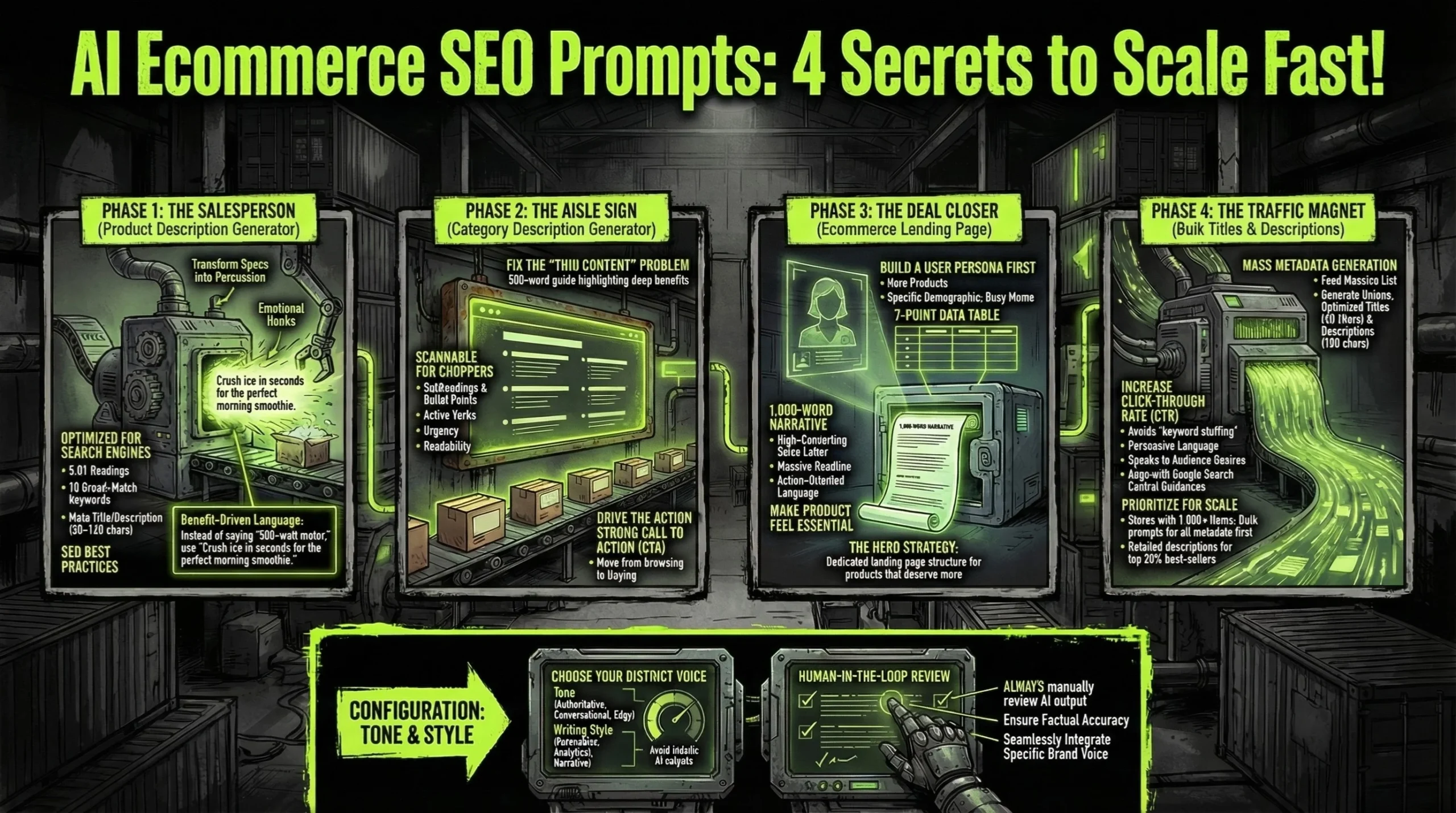
Phase 1: The Salesperson (Product Description Generator)
A product description is definitely not just a boring list of specifications; meanwhile, it must be a highly persuasive sales pitch. It critically needs to tell the customer exactly why they need this item right now.
The Product Description Generator prompt operates as your 24/7 digital salesperson.
The Structure: It does not merely write a block of heavy text. Moreover, it actively creates three unique content sections with eye-catching subheadings.
The “Emotional” Hook: It explicitly instructs the AI to use emotional language and highly creative reasoning. Instead of blandly saying “This blender has 500 watts,” it vibrantly says “Crush ice in seconds for the perfect morning smoothie.” Furthermore, it generates a robust list of H1 headings and broad-match keywords, rigorously ensuring your product page is perfectly optimized for search engines according to Search Engine Journal’s best practices.
Prompt 1: Product Description Generator
Prompt Template: Please ignore all previous instructions. Please respond only in the English language. You are an E-commerce SEO expert copywriter who writes product descriptions that compel users to purchase the products. Please write in a “{Tone}” tone of voice and a “{Style}” writing style. Do not self-reference. Do not explain what you are doing. In this task, you will craft a compelling product description for an e-commerce item that I will provide. Your goal is to create three unique content sections for the product description, each focusing on a different set of relevant keywords. Be sure to label each section with an eye-catching subheading that accurately summarizes its content. Your product description should be keyword-rich, informative, and engaging, with a word count of under 1000 words. Your objective is to use emotional language and creative reasoning to persuade potential buyers to purchase the product. Once you have written the product description, please create a bulleted list of 5 possible H1 headings for the product page. Provide a bulleted list of 10 broad match keywords that you used to create the product description. To further enhance the product page marketing appeal, create a persuasive and professional sounding meta title and description that incorporates similar language to that of the new product summary. The meta title should be between 50 and 60 characters long. The meta description should be between 140 to 150 characters long. This is the e-commerce item – “{Product Description}”
Read this article: Best AI Keyword Research Prompts: 4 Steps to Rank #1!
Phase 2: The Aisle Sign (Category Description Generator)
Category pages (like “Men’s Hiking Boots”) are frequently the absolute biggest traffic drivers for an entire store; however, most people shockingly leave them completely empty.
The Category Description Generator prompt efficiently fixes this devastating “Thin Content” problem.
The Goal: It generates a highly compelling 500-word guide that masterfully highlights the deep benefits of the category, not just the surface-level features. Consequently, it forces the AI to heavily use subheadings and bullet points, making the dense text highly skimmable. It securely ends with a strong Call to Action (CTA) to effectively push the visitor from merely “browsing” directly to “buying”.
Prompt 2: Category Description Generator
Prompt Template: Please ignore all previous instructions. Please respond only in the English language. You are an E-commerce SEO expert copywriter. Please write in a “{Tone}” tone of voice and a “{Style}” writing style. Do not self-reference. Do not explain what you are doing. Your task is to create a compelling 500-word product category description in flawless English based on the category name that I provide. Your focus should be on highlighting the benefits of the products within the category, rather than just listing their features. Avoid using the passive voice and instead use active verbs to create a sense of urgency and excitement. Your goal is to create a category description that engages potential customers and inspires them to make a purchase. Make sure that your description flows smoothly and is easy to understand. It should be written in one line, which means you should avoid long paragraphs and instead break up your text with subheadings and bullet points. At the end of your category description, include a strong call to action that encourages customers to explore the products within the category and make a purchase. This will help to boost engagement and conversions. Overall, your objective is to create a category description that is informative, engaging, and persuasive. By highlighting the benefits of the products within the category and using active language to create a sense of urgency, you can attract and convert potential customers, driving sales and boosting the success of the e-commerce store. Category Name: “{Category}”
Phase 3: The Deal Closer (Ecommerce Landing Page)
Sometimes you possess a true “Hero Product” that absolutely deserves significantly more than a standard product page. You urgently need a dedicated Sales Page.
The Landing Page Generator prompt meticulously builds a high-converting sales letter specifically tuned for physical products.
The Persona First: Notice that it smartly starts by generating a User Persona. It accurately figures out exactly who buys this product (e.g., “Busy Moms”) and then writes the persuasive copy exclusively for them.
The Flow: It creates a massive headline that rapidly grabs attention and body copy that utilizes highly active language. It firmly builds a compelling narrative that effectively makes the product feel absolutely essential to the reader’s daily life.
Prompt 3: Landing Page Generator
Prompt Template: Please ignore all previous instructions. Please respond only in the English language. Do not self-reference. Do not explain what you are doing. You are an E-commerce SEO expert copywriter. Please write in a “{Tone}” tone of voice and a “{Style}” writing style. Your task is to generate a detailed USER PERSONA for a business that sells “{Product}”. First write “User Persona creation for {Product}” as the heading. Now create a subheading called “Demographics”. Below, you need to create a table with the 2 columns and 7 rows with the following format: Column 1 = Data points (Name, Age, Occupation, Annual income, Marital status, Family situation, Location), Column 2 = Answers for each data point in Column 1. Now create a subheading called “Landing page for selling {Product} to the above persona”. Below this generate landing page text of around 1000 words using this persona. The landing page needs a headline that grabs attention, highlights the product’s value proposition, and entices visitors to learn more. Use action-oriented language, such as “Discover”, “Transform” or “Experience.” The landing page copy should be persuasive and informative and highlight the product’s benefits and features. Use short paragraphs, bullet points, and subheadings to make it easy to read and scan. Use persuasive language that speaks to your audience’s emotions and desires. End the landing page with a clear and prominent CTA to click to purchase product. Call To Action: Click to Purchase a product.
Phase 4: The Traffic Magnet (Bulk Titles & Descriptions)
This is undeniably the ultimate time-saver. If you actively manage 100 products, writing 100 Meta Titles and Descriptions manually is pure torture.
The Bulk Titles and Descriptions prompt powerfully allows you to feed a massive list of products directly to the AI.
The Output: It rapidly generates a highly unique, properly optimized Title (up to 60 characters) and Description (up to 160 characters) for every single item in one seamless go.
The Psychology: It does not just lazily stuff keywords; moreover, it strictly demands persuasive language that speaks directly to the audience’s deep desires. Consequently, this heavily increases your CTR (Click-Through Rate) from the search results, securely aligning with Google Search Central guidelines to bring you vastly more free traffic.
Prompt 4: Bulk Titles and Descriptions
Prompt Template: Please ignore all previous instructions. Please respond only in the English language. You are an E-commerce SEO expert copywriter. Please write in a “{Tone}” tone of voice and a “{Style}” writing style. Do not self-reference. Do not explain what you are doing. Generate compelling meta titles and meta descriptions for a list of e-commerce products that I will give you. One meta title and one meta description should be generated for every product in the list that I give you. The meta title should not be more than 60 characters long. The meta descriptions should not be longer than 160 characters long. The meta title and meta description should have the product keywords in them. The meta title and meta description should use persuasive language that speaks to the audience’s emotions and desires and makes them want to purchase the product. Here are the e-commerce products – “{Products}”.
Frequently Asked Questions
Can Google heavily penalize AI-written product descriptions?
Google primarily cares about user quality, not strict authorship. If your descriptions are genuinely helpful, completely unique, and highly valuable to the user, they will securely rank. The vital key is to entirely avoid generic AI fluff. Use these precise AI Ecommerce SEO Prompts to inject specific emotional hooks and highly unique benefits.
Should I manually edit the AI-generated descriptions?
Yes. AI is undeniably phenomenal at producing the "First Draft". However, you should always manually review the final output to ensure strict factual accuracy (e.g., make completely sure it did not invent a feature your physical product does not actually possess) and to seamlessly add your brand's specific tone.
Why do I desperately need detailed descriptions for Category pages?
Category pages frequently rank for massive, high-volume keywords (e.g., "Best Running Shoes"). If you possess absolutely no text on that page, Google has nothing to effectively crawl. In the meantime, adding 300-500 words of deeply helpful content directly helps search engines understand exactly what your category is about, drastically boosting your organic ranking.
Can I successfully use these frameworks for Amazon listings?
Absolutely. The core principles of human persuasion are entirely the same. You can easily tweak the initial prompt to specifically ask for "5 Bullet Points" (the required standard Amazon format) instead of "3 Content Sections."
How do I efficiently handle thousands of products at once?
For massive retail stores (1,000+ items), exclusively use the Bulk Titles prompt for your metadata first. For deep descriptions, strictly focus on your top 20% "Best Sellers" initially using the detailed Product Description prompt. Then, systematically work your way down the inventory list.
Read this article: Best AI Sales Writing Prompts: 3 Steps to Close More Deals!
Best AI Ecommerce SEO Prompts: 4 Secrets to Scale Fast!
The AI Store Manager: How to Write 1,000 Product Descriptions Without Losing Your Mind Running…
Best AI Keyword Research Prompts: 4 Steps to Rank #1!
The AI SEO Strategist: How to Rank #1 Without Spending Hours on Research SEO (Search…
Best AI Sales Writing Prompts: 3 Steps to Close More Deals!
The AI Sales Strategist: How to Sell Ice to Eskimos (Without Being Sleazy) There is…
Best AI Marketing Prompts: 4 Secrets to Skyrocket Your Sales!
The AI Persuasion Kit: How to Hack Human Psychology (Ethically) Marketing is not just about…
Best AI Landing Page Prompts: 4 Steps to 10x Your Sales!
The AI Conversion Architect: How to Build Landing Pages That Actually Sell You have clicked…
AI Email Writing Prompts: Get 10x More Replies Fast!
The AI Email Engine: How to Write Emails That Actually Get Replies Email is the…



Leave a Reply