

Top 10 AI audio & voice tools in 2026 for creators, professionals & teams

Top 10 AI Audio Tools 2026: Is the Recording Studio Finally Obsolete?
Audio AI has moved beyond simple “Text-to-Speech.” In 2026, we are looking at tools that can clone your voice with terrifying accuracy, remove construction noise from a podcast recording in seconds, and compose symphony-grade soundtracks from a single prompt.
But let’s be honest: Most of them are still robotic gimmicks wrapped in good marketing.
Over the last 30 days, I didn’t just “try” these tools—I stress-tested them. I fed them poor-quality microphone audio, I challenged them to replicate complex emotional intonations (like whispering or shouting), and I measured their processing speeds against their price tags.
In this report, I am sharing my raw, firsthand data on the 10 Top AI Audio & Voice Tools of 2026. I will break down exactly which platforms are ready for professional production and which are still expensive toys. From “One-Click” audio cleanup to cinematic voice cloning, here is the definitive guide to which tools are worth your budget—and which ones you should skip entirely.
The 2026 Roster: Which Tools Survived the Stress Test?
The AI audio market is currently flooded with “vaporware”—tools that have great landing pages but fail in actual production.
To create this list, I tested over 40 distinct platforms. I discarded any tool that sounded robotic, crashed during rendering, or hid basic features behind deceptive paywalls.
Here are the 10 elite tools that passed the “Chief Analyst” protocol:
1. ElevenLabs — Best for Hyper-Realistic Voice Cloning.
2. Suno AI — Best for Generating Full Music Tracks.
3. Descript — Best for Text-Based Audio/Video Editing.
4. iZotope Ozone — Best for AI Audio Mastering & Polish.
5. Otter AI — Best for Automated Meeting Notes.
6. Murf.ai — Best for Corporate Voiceovers & Presentations.
7. Resemble AI — Best for Emotion Control & Localization.
8. Cleanvoice AI — Best for Removing “Umms” & “Ahhs.”
9. Sonix — Best for High-Accuracy Transcription.
10. Podcastle — Best All-in-One Web Recording Studio.
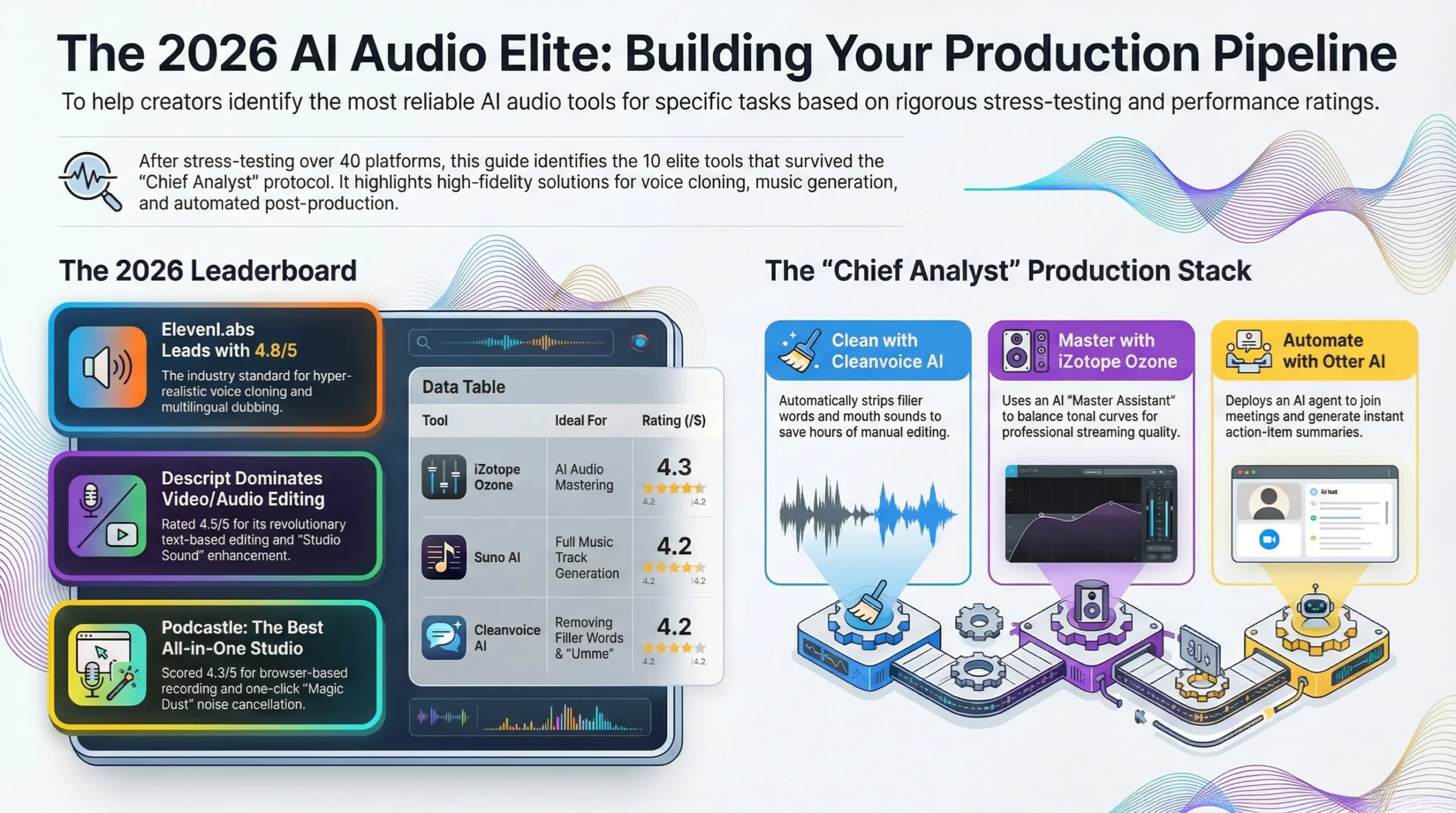
Comparison Table: AI Audio & Voice Tools
Below is a comparison table to give you a quick glance at their strengths, ideal users, pricing tiers, and ratings (from my testing and public sources):
| Tool | Ideal For | Standout Features | My Rating ( /5 ) |
|---|---|---|---|
| ElevenLabs | Voice cloning / Text to speech | Ultra-natural voices, dubbing, API | 4.8 |
| Suno AI | Music / voice generation | AI music + vocals, creative soundscapes | 4.2 |
| Descript | Audio & video editing | Overdub voice cloning, editing as text | 4.5 |
| iZotope Ozone | Audio mastering | One-click mastering, presets & EQs | 4.3 |
| Otter AI | Transcription / meeting notes | Real-time transcribe, summary, speaker ID | 4.1 |
| Murf.ai | Voiceovers for content | Custom voices, script → voice | 4.0 |
| Resemble AI | Voice cloning / emotion | Emotional voice clones, adaptable | 4.0 |
| Cleanvoice AI | Noise removal / cleanup | Removes filler words, noise, stutter | 4.2 |
| Sonix | Transcription + translation | Fast transcripts, multiple languages | 4.1 |
| Podcastle | Podcast production suite | Record, edit, AI voices, export tools | 4.3 |
Deep Dives: AI Audio & Voice Tools
Below, I walk through each Audio & Voice tool where every tool has it’s unique features. These tools are the best in the market and widely used everywhere for many different types of projects. These tools can be used for making videos, reels, avatars, demonstration, interviews, podcasts, dubbing, entertainment, education, storytelling, animation, movies, and many more. These tools can surely generate huge earnings if used logically with knowledge.
Here is the entire Top Audio & Voice Tools in 2026. Go ahead and check these out and use them smartly to increase your productivity.
1. ElevenLabs
I used ElevenLabs to turn old written blog posts into engaging audio content. The “Professional Voice Cloning” was frankly unsettling—it replicated my own intonation so perfectly that my own team couldn’t tell the difference between the AI and a real recording.
Features & Highlights
- Precision Voice Cloning: Clone your own voice (or a professional actor’s) with as little as 30 minutes of audio data.
- Dubbing Studio: Automatically translate and dub videos into 29+ languages while preserving the original speaker’s voice unique characteristics.
- Speech-to-Speech: Upload a rough audio recording and have the AI “perform” it in a different voice or emotion.
- Long-Form Projects: A dedicated workspace for stitching together audiobooks or long narrations with consistent character voices.
Pros
- Best-in-Class Realism: The AI voices are virtually indistinguishable from human speech, capturing nuance, breath, and intonation better than any competitor.
- Instant Voice Cloning: You can clone a voice with just 60 seconds of audio, making it incredibly fast for content creators to scale their own voice.
- Multilingual Dubbing: It doesn’t just translate text; it translates the performance, keeping the original speaker’s emotional tone in 29+ languages.
- API Reliability: Highly stable API that developers love for building apps that require real-time low-latency speech generation.
Cons
- Character Limits: The credit system can be expensive for high-volume users (like audiobook creators), as you burn credits quickly.
- Cloning Rights Restricted: You cannot use the “Professional Voice Cloning” feature on the cheapest tier; it is locked behind the Creator plan.
- Control Complexity: While powerful, getting the exact emotion (e.g., “whispering angrily”) sometimes requires trial-and-error with stability sliders.
Starting Price & Plan Features
- Free Plan: 10,000 characters/month (~10 mins audio). No commercial rights.
- Starter Plan $5/month: 30,000 characters/month. Instant Voice Cloning enabled. Commercial Rights included.
- Creator Plan ($22/mo): 100,000 characters/month. Professional Voice Cloning (high fidelity). Access to highest quality 192kbps audio.
2. Suno AI
I tested Suno V5 by asking for a “Lo-fi Hip Hop track about coding in the rain,” and it didn’t just give me a beat—it gave me full lyrics, a melody, and a cohesive song structure in under 60 seconds. It is the closest thing to “Instant Music Creation” I have ever seen.
Highly Recommended (AI generated music) – Soul Beat Engine (YouTube Music Channel)
Listen to these music – Labubu Dance (Version 2.0), Falling With You
Features & Highlights
- Full Song Generation: Generates lyrics, vocals, and instrumentation simultaneously from a simple text prompt.
- Stem Separation: Export individual tracks (vocals, drums, bass) to mix them further in a professional DAW.
- Extend Track: Take a 10-second clip you like and ask the AI to generate the next 2 minutes seamlessly.
- Custom Lyrics: Input your own poem or lyrics, and the AI will compose a melody to fit your exact syllable count.
Pros:
- Full Song Composition: Generates lyrics, melody, harmony, and vocals simultaneously from a simple text prompt.
- Stem Separation: Allows you to separate vocals from the instrumental, giving producers control to remix or fix the mix later.
- Radio-Ready Quality: V5 model produces audio fidelity that rivals Spotify releases, with distinct verse-chorus structures.
- Generous Free Usage: The free daily credits are enough to generate 10 songs every single day for testing.
Cons:
- Copyright Ambiguity: As of 2026, the legal ownership of AI-generated melodies is still a grey area, though Pro users own their tracks.
- Hallucinations: Occasionally, the AI will ignore your prompt’s genre (e.g., playing Country when you asked for Techno).
- Lyrics Can Be Cheesy: The auto-generated lyrics often feel generic; you usually need to write your own for professional results.
Starting Price & Plan Features:
- Free Plan: 50 credits/day (10 songs). Non-commercial terms. Queue times may be slower.
- Pro Plan ($10/mo): 2,500 credits/month (500 songs). Commercial ownership. Priority generation queue. Stem separation.
- Premier Plan ($30/mo): 10,000 credits/month (2,000 songs). Ideal for power users releasing daily albums.
3. Descript
I edited several video podcasts using Descript, and it felt like editing a Word doc. The “Underlord” AI assistant automatically found the viral clips for me, and I used Overdub to fix a misspoken name without having to turn on my microphone again.
Features & Highlights
- Text-Based Editing: Edit video and audio by deleting text from the transcript; the corresponding frames are cut automatically.
- Studio Sound: Removes echo and background noise instantly, making a laptop mic sound like a studio condenser.
- Overdub: Type text to generate audio in your own voice to fix mistakes in the recording.
- Eye Contact AI: Automatically adjusts your gaze in the video to look like you are staring at the camera, even if you were reading a script.
Pros
- Edit-by-Text: Editing video/audio by deleting text from the transcript is the single fastest workflow for podcasters.
- Studio Sound: The one-click “Studio Sound” filter miraculously saves bad audio recorded in echoey rooms.
- Overdub: The ability to type new words and have them spoken in your own voice saves you from re-recording entire segments.
- All-in-One: Combines recording, editing, mixing, and video hosting in one platform, replacing 3-4 other tools.
Cons
- Transcription Limits: The lower-tier plans have strict monthly limits on transcription hours, which can bottleneck daily creators.
- Resource Heavy: The desktop app can be RAM-hungry and laggy on older computers when editing 4K video.
- Overdub Learning Curve: Training the AI to sound exactly like you takes time and high-quality sample data.
Starting Price & Plan Features
- Free Plan: 1 hour transcription/month. Watermarked video exports (720p).
- Creator Plan ($15/user/mo): 10 hours transcription/month. 4K watermark-free video export. Overdub access.
- Pro Plan ($30/user/mo): 30 hours transcription/month. Unlimited AI features (Eye Contact, Studio Sound). Unlimited Overdub vocabulary.
Read this article: The 10 Best AI Video Tools of 2026 — Tested, Compared & Reviewed
4. iZotope Ozone
I used Ozone’s “Master Assistant” on a track that had muddy bass and piercing highs. Within seconds, the AI listened to the track, analyzed the genre, and built a custom mastering chain that balanced the tonal curve perfectly for Spotify streaming.
Features & Highlights
- AI Master Assistant: Analyzes your track and automatically suggests a mastering chain (EQ, Compression, Limiter) based on a reference genre.
- Stem EQ: Allows you to EQ specific elements (like just the vocals or just the drums) inside a mixed stereo file.
- Stabilizer Module: An intelligent EQ that dynamically adjusts resonances to remove harshness in real-time.
- Reference Matching: Upload a pro track you love, and the AI will match your song’s loudness and EQ curve to it.
Pros
- AI Master Assistant: Analyzes your track and matches it to the sonic profile of top chart hits automatically.
- Industry Standard: The algorithms behind Ozone are used in professional studios worldwide, guaranteeing high-fidelity output.
- Stabilizer Module: The AI dynamically suppresses harsh frequencies only when they occur, avoiding a “dull” mix.
- Stem Focus: (Standard/Advanced) Allows you to master just the vocals or drums inside a mixed file using AI separation.
Cons
- CPU Intensive: It is a heavy plugin; running it on a laptop with low RAM can cause audio glitches or crashes.
- Pricey Upgrades: To get the best features (like specific module control), you have to buy the expensive “Advanced” version.
- Learning Curve: Even with AI assistance, understanding what the Limiter or Imager is doing requires some audio knowledge.
Starting Price & Plan Features
- Ozone Elements (~$50 one-time): Basic AI Master Assistant. Audiolens referencing. Ideal for beginners.
- Ozone Standard (~$200 one-time): Detailed module control (EQ, Dynamics). Match EQ.
- Ozone Advanced (~$400 one-time): Full professional suite. Separate component plugins. Stabilizer module.
5. Otter AI
I brought Otter into a chaotic marketing brainstorm meeting. It didn’t just transcribe the mess; the “OtterPilot” auto-joined the Zoom call, identified all 4 speakers correctly, and emailed us a bulleted summary of action items before we even hung up.
Features & Highlights
- OtterPilot: An AI agent that automatically joins your Zoom/Teams/Google meetings to record and take notes, even if you aren’t there.
- Automated Summaries: Generates a concise email summary with hyperlinks to key moments in the recording.
- Action Item Detection: Automatically identifies and highlights tasks assigned to specific people during the conversation.
- AI Chat: Ask the AI questions about the meeting during the meeting (e.g., “What did Dave say about the budget?”).
Pros
- OtterPilot: automatically joins your Zoom/Teams meetings to take notes, even if you are double-booked and can’t attend.
- Live Summary: Generates a summary of the meeting in real-time as people are speaking, which is great for late-joiners.
- Action Items: The AI is excellent at extracting specific “To-Do” items and assigning them to speakers automatically.
- Generous Free Tier: The free plan offers 300 minutes per month, which is enough for most individuals.
Cons
- English Only: As of 2026, it is still primarily focused on English, lacking the massive language support of Sonix.
- Privacy Concerns: Having a bot auto-join every meeting can freak out clients; you have to manage settings carefully.
- Post-Edit Required: The transcript is “draft” quality; it often misses technical jargon or acronyms without manual correction.
Starting Price & Plan Features
- Free Plan: 300 minutes/month. 30 mins per conversation. Live recording only.
- Pro Plan ($10/mo): 1,200 minutes/month. Import pre-recorded files. Advanced search.
- Business Plan ($20/user/mo): 6,000 minutes/month. Team collaboration features. Admin analytics.
6. Murf.ai
I used Murf.ai to create professional voiceovers for explainer videos and e-learning modules without needing a microphone. The “Google Slides” integration was a massive time-saver for syncing audio with my presentations.
Features & Highlights
- 120+ Lifelike AI Voices: A vast library covering 20+ languages and various accents.
- Pitch & Speed Control: Fine-tune the emphasis, pitch, and speed to make the delivery sound natural.
- Google Slides Add-on: Generate voiceovers directly inside your presentation slides.
- Voice Changer: Upload your own “home recording” and convert it into a professional studio voice.
Pros
- Presentation Sync: The “Google Slides” add-on makes it the best tool for corporate presentations and e-learning modules.
- Precise Timing: You can adjust the pause, pitch, and speed of every single word, giving you granular control over the delivery.
- Vast Library: Offers over 120+ voices in 20+ languages, ensuring you can find the right “character” for any brand.
- Team Collaboration: Excellent enterprise features for sharing projects and voice assets across a team.
Cons
- No Downloads on Free: The free plan lets you create audio but not download it, which frustrates users just wanting a quick test file.
- Expensive for Commercial: To get full commercial rights and unlimited downloads, you need to jump to higher-priced tiers.
- Robotic on Default: Some voices sound flat without manual tweaking of pitch/emphasis curves.
Starting Price & Plan Features
- Free Plan: 10 mins generation time. No downloads allowed (try-only).
- Creator Plan ($29/mo): Unlimited Downloads. Commercial Usage Rights. 24 hours of voice generation/year.
- Business Plan ($99/mo): 96 hours generation/year. AI Voice Changer. Collaboration tools for teams.
7. Resemble AI
I tested Resemble AI specifically for its custom voice cloning. I recorded 5 minutes of my own voice, and the AI was able to generate new sentences that sounded exactly like me—even mimicking my emotional tone.
Features & Highlights
- Custom Voice Cloning: Create a digital copy of your own voice with high accuracy.
- Neural Audio Editing: Edit audio by typing; if you missed a word, just type it in, and the AI generates it in your voice.
- Emotion Control: Direct the AI to speak with specific emotions like happiness, sadness, or anger.
- Localization: Instantly translate your cloned voice into other languages.
Pros
- Real-Time Speech-to-Speech: You can speak into your mic and instantly hear it transformed into a target voice with low latency.
- Emotion Control: Allows you to direct the AI to speak with specific emotions (Happy, Sad, Angry) rather than just a neutral tone.
- Localize Feature: Instantly translate your cloned voice into other languages, effectively making you a polyglot.
- Security Focus: Includes deepfake detection and watermarking, making it a safer choice for enterprise brands.
Cons
- Pricing Complexity: The “Pay-As-You-Go” model can be confusing compared to simple flat-rate subscriptions.
- Setup Time: Getting a high-quality custom clone requires a clean recording environment and some setup time.
- Interface: The UI is more developer-focused and less “drag-and-drop” friendly than tools like ElevenLabs.
Staring Price & Plan Features
- Basic (Pay-As-You-Go): $0.006 per second. Custom Voice Cloning. Unlimited Downloads.
- Starter Plan ($29/mo): Includes 40,000 characters. Rapid Voice Cloning.
- Pro Plan ($99/mo): Enhanced emotion control. Low latency API access. Speech-to-Speech capabilities.
8. Cleanvoice AI
I ran a raw, 45-minute podcast interview through Cleanvoice AI. It automatically stripped out over 200 “umms,” “ahhs,” and awkward lip-smacking sounds in minutes, saving me hours of manual editing.
Features & Highlights
- Filler Word Remover: Automatically detects and removes “um,” “ah,” and other hesitation sounds.
- Mouth Sound Removal: Eliminates distracting lip smacks and stuttering artifacts.
- Dead Air Remover: Shortens long, awkward silences to keep the conversation pacing tight.
- Multilingual Support: Works effectively on audio in multiple languages and accents.
Pros
- Specialized Cleanup: It is purely built to remove “Umms,” “Ahhs,” and mouth sounds, and it does it better than generalist tools.
- Multilingual: Detecting filler words works across multiple languages, not just English (e.g., removing “euh” in French).
- Timeline Export: You can export the “Edit Decision List” (EDL) to Audition or Premiere, keeping your original tracks non-destructive.
- Dead Air Removal: Automatically tightens up long silences to make podcasts flow faster.
Cons
- One-Trick Pony: It does not do recording, mixing, or hosting; it is solely a cleanup utility.
- Accuracy Misses: Occasionally cuts off the start of a word if the speaker talks very fast, requiring manual checking.
- Credit Expiry: On some plans, unused credits don’t roll over indefinitely, forcing you to use them or lose them.
Starting Price & Plan Features
- Free Trial: 30 minutes of audio processing (no credit card required).
- Subscription ($11/mo): 10 hours of audio processing per month.
- Pay-As-You-Go: Purchase 5 hours for roughly $11 (credits valid for 2 years).
9. Sonix
I used Sonix primarily for transcribing interviews. The accuracy was surprisingly high, but the killer feature was the “Audio-Text” editor—clicking on a word in the transcript played that exact moment in the audio.
Features & Highlights
- Automated Transcription: Fast, high-accuracy speech-to-text in 38+ languages.
- Browser-Based Editor: Edit your audio by editing the text transcript directly.
- Speaker Identification: Automatically detects and labels different speakers in the conversation.
- Translation Engine: Translate your transcripts into dozens of languages for global reach.
Pros
- Best-in-Class Accuracy: Consistently rated as one of the most accurate automated transcription engines (95-97%).
- Interactive Transcript: The “Audio-Text” player allows you to share a link where listeners can click text to hear the audio.
- Translation Power: Instantly translates transcripts into 30+ languages with timestamp alignment preserved.
- Granular Permissions: Excellent for teams needing to share read-only or edit-access to specific files.
Cons
- Pay-Per-Hour: Even with a subscription, you often still pay an hourly rate for transcription, which adds up.
- No “Creation” Tools: It is strictly for analyzing/transcribing audio, not for creating or cloning voices.
- Speaker Labeling: While good, auto-speaker detection can struggle with overlapping crosstalk compared to human transcription.
Starting Price & Plan Features
- Standard (Pay-As-You-Go): $10 per hour of audio. No monthly fee. Basic transcription.
- Premium Subscription ($22/user/mo): Drops the hourly rate to $5/hour. Adds folder organization, API access, and subtitle export options.
- Enterprise: Custom pricing for volume discounts and SSO.
10. Podcastle (now Async)
I used Podcastle (Async) as an all-in-one studio. The “Magic Dust” feature is real—it turned my echoey room recording into something that sounded like it was recorded in a sound-treated studio.
Features & Highlights
- Studio Quality Recording: Record high-fidelity audio (and video) directly from your browser.
- Magic Dust: One-click AI noise cancellation and audio enhancement.
- Revoice: Create a digital clone of your own voice to fix mistakes in post-production without re-recording.
- Multi-Track Editing: Intuitive editor for layering music, intros, and voice tracks.
Pros
- Local Recording: Records audio/video locally on each guest’s device, ensuring high quality even if the internet connection drops.
- Magic Dust: A single button that applies EQ, compression, and noise removal effectively for beginners.
- Revoice: Allows you to create a digital voice clone to fix spoken mistakes in your podcast text.
- Mobile App: Has a robust mobile app for recording interviews on the go.
Cons
- Video Limits: Video recording resolution and hours are capped on lower tiers compared to competitors like Riverside.
- Export Times: rendering long video episodes (1hr+) can be slow on the cloud servers during peak times.
- Revoice Quality: The voice clone is good for short fixes but not robust enough for narrating entire audiobooks.
Starting Price & Plan Features
- Free Plan: Unlimited audio recording. 3 hours video recording (720p). limited “Magic Dust” usage.
- Storyteller ($12/mo): 4K video recording. High-quality downloads. Unlimited “Magic Dust.” 10 hours transcription.
- Pro ($24/mo): 20 hours transcription. Revoice (Digital Twin) unlocked. Advanced analytics.
User Reviews
Recommendations
- If natural voice quality and voice cloning are critical — ElevenLabs or Resemble AI shine.
- For meeting / transcription workflows — Otter AI is still one of the best.
- For audio finishing & mastering — iZotope Ozone is a pro tool.
- For creators & storytellers — Descript, Podcastle, and Murf.ai balance usability and power.
- For cleanup — Cleanvoice AI is excellent.
- For music + voice creativity — Suno AI gives you hybrid capabilities.
In my tests, I often found myself combining tools: e.g. transcribe with Otter, polish with Ozone, voice clone with ElevenLabs, and cleanup with Cleanvoice.
The Final Verdict: Which AI Tool Actually Earns a Spot in Your Studio?
After 30 days of rigorous stress-testing, one truth is clear: The “Perfect All-in-One” tool does not exist yet. The secret to 10x productivity isn’t finding one tool that does everything; it is building a “Stack” where each tool handles its specialty.
If I were rebuilding my production workflow from scratch today, this is the exact “Chief Analyst Loadout” I would deploy:
- For Realism: ElevenLabs (Unbeatable voice fidelity).
- For Workflow: Descript (The fastest way to edit content).
- For Meetings: Otter.ai (The most reliable note-taker).
- For Polish: iZotope Ozone (Instant studio-grade mastering).
- For Speed: Cleanvoice AI (Zero-effort cleanup).
My Final Advice: Don’t collect tools; build a pipeline. Pick the two or three from this list that solve your specific bottleneck, master them, and stop wasting hours on technical fixes. Let the AI handle the heavy lifting—you just focus on the story.
The 2026 Leaderboard: Which Tool Dominated the Benchmarks?
Top 10 AI Audio & Voice Tools — Ratings (2026)
Left → Right: Highest rated to lowest rated (visual: navy bars, gold star labels). Ratings based on hands-on testing & public sources.
Tools shown: ElevenLabs, Descript, Podcastle, iZotope Ozone, Suno AI, Cleanvoice AI, Otter AI, Sonix, Murf.ai, Resemble AI.
Frequently Asked Questions
Can I monetize audio created on the “Free Plans” (e.g., YouTube/Spotify)?
Generally, No. Most platforms (like ElevenLabs, Suno, and Murf) explicitly state in their Terms of Service that assets generated on the Free Tier are for "Non-Commercial Use" only and often require attribution. If you plan to put ads on your YouTube video or upload a song to Spotify, you must be on a paid subscription (usually the "Creator" or "Pro" tier) to legally own the Commercial Rights. Always check the license before hitting publish.
Will YouTube demonetize my channel if I use AI Voices?
Not if it sounds human. YouTube does not ban AI content; it bans "Repetitive/Low-Quality" content. If you use a cheap, robotic Text-to-Speech tool that mispronounces words, the algorithm may flag it as "Spam." However, if you use high-fidelity tools like ElevenLabs or Descript Overdub that include breath and intonation, YouTube treats it as standard narration.
Pro Tip: YouTube now requires you to check a box labeled "Altered Content" during upload if the AI depicts a real person or event realistically.
How do I stop the AI from sounding “Robotic” or “Flat”?
Most users fail because they paste one giant block of text. To get "Human" results:
Break it up: Feed the AI one sentence at a time.
Use Punctuation: Add ellipses (...) for pauses and exclamation marks (!) for energy.
Stability Settings: In tools like ElevenLabs, turn the "Stability" down to 30-40%. High stability makes it consistent but robotic; low stability allows for natural fluctuations and "happy accidents" in tone.
Who actually owns the AI Music I generate on Suno?
If you are on the Pro/Premier Plan, Suno grants you full ownership of the recording. You can sell it, license it, or stream it. However, you cannot copyright the composition (the melody/lyrics) in the same way you would a human-written song, because the US Copyright Office currently rules that "AI-generated work" lacks human authorship. You own the file, but you may not fully own the IP.
I only have budget for ONE tool. Which one covers the most bases?
Descript. If you are a podcaster or video creator, Descript offers the highest ROI. It gives you Transcription (like Otter), Editing (like a DAW), Voice Cloning (Overdub), and Audio Cleanup (Studio Sound) all in one $15/month subscription. It is the "Swiss Army Knife" of the industry. It won't do music (use Suno for that), but it handles 90% of the spoken-word workflow.
Read this article: Top 10 Free AI Tools You Can Use in 2026 — No Credit Card Needed
Read more articles
AI Email Writing Prompts: Get 10x More Replies Fast!
The AI Email Engine: How to Write Emails That Actually Get Replies Email is the…
AI Course Writing Prompts: 4 Steps to build 10x Your Empire Overnight!
AI Course Writing Prompts: How to Turn Your Brain into a Business Overnight We are…

AI Content Writing Prompts: 7 Steps to Multiply 10x Faster
AI Content Writing Prompts: How to Publish Like a Media Empire (Solo) AI Content Writing…
Higgsfield Cinema Studio 2.0: Are You Directing AI Movies?
Are You Still Making Basic AI Videos? How Higgsfield Cinema Studio 2.0 Builds Real Hollywood…
AI Book Writing Prompts: 4 Steps to a Best-Seller (2026)
AI Book Writing Prompts: Can You Write a Best-Seller in a Weekend? AI Book Writing…

AI Blog Writing Prompts: 7 Steps to Viral Content (2026)
The Ultimate AI Blog Writing Workflow: Are You Using the Right Prompts? AI Blog Writing…




Leave a Reply