



Which Claude AI Models Should You Pick: Opus 5.5, Fable 5.1, Sonnet 5.5 or Haiku 5.5?
What if I told you that picking the wrong one of the Claude AI Models is costing you up to a hundred times more than you need to spend? It is true, because Haiku 5.5 starts at $0.10 per million input tokens while Fable 5.1 costs $10, and both sit in the same menu. Let me walk you through each model, its real strengths, its token costs and the projects it suits, step by step, so you save your energy, your time and your money on every task.
Claude AI Models now come in four tiers, and each one is built for a different kind of work. However, most people never open the model picker, so they run a quick email rewrite on the most expensive brain or ask the fastest model to plan a full app.
Both choices waste something. The first wastes money, and the second wastes hours of fixing. This entire two part series was produced with Opus 5.5 inside my own Claude Project, which gave me a close look at where each tier fits.
This is Part 2 of the series. Part 1 covered every Claude feature, from Projects to Scheduled Tasks. Here you learn what each of the Claude AI Models does best, what tokens and context windows mean in plain language, what a real job costs on each model, and which project fits which brain.
Every price, date and specification below was checked on 9 November 2026 against Anthropic’s official pages and documentation.
Read this article: Claude AI Tutorial: Are You Using Every Feature Right? (Part 1 of this series)
What Are Claude AI Models and How Does the Family Work?
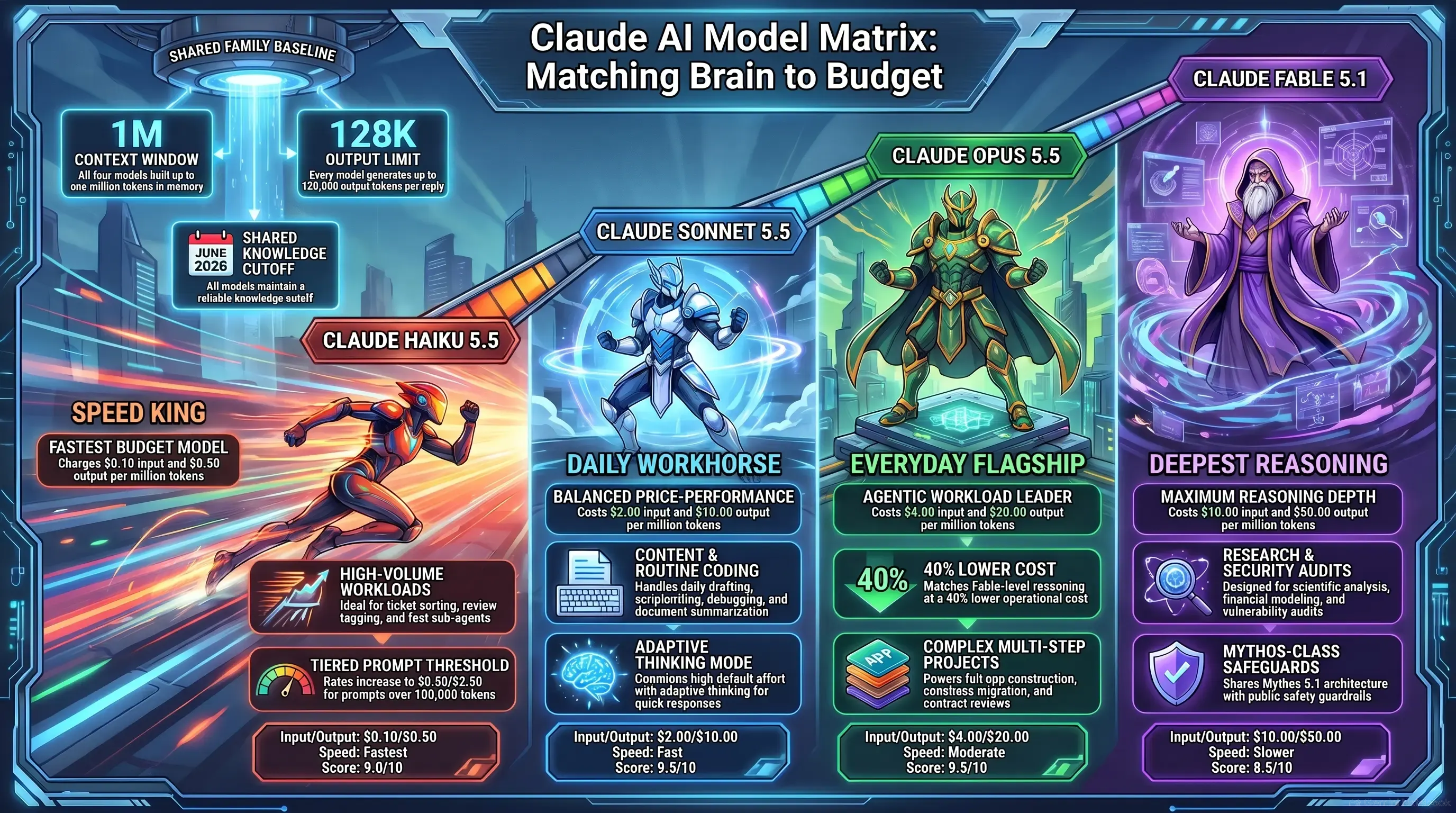
A model is the brain behind every Claude reply, and Claude AI Models differ in how deeply that brain thinks. The current lineup, according to the official Claude models documentation, has four generally available models. Fable 5.1 launched on 1 September 2026, Opus 5.5 on 22 September, Sonnet 5.5 on 28 September and Haiku 5.5 on 7 October.
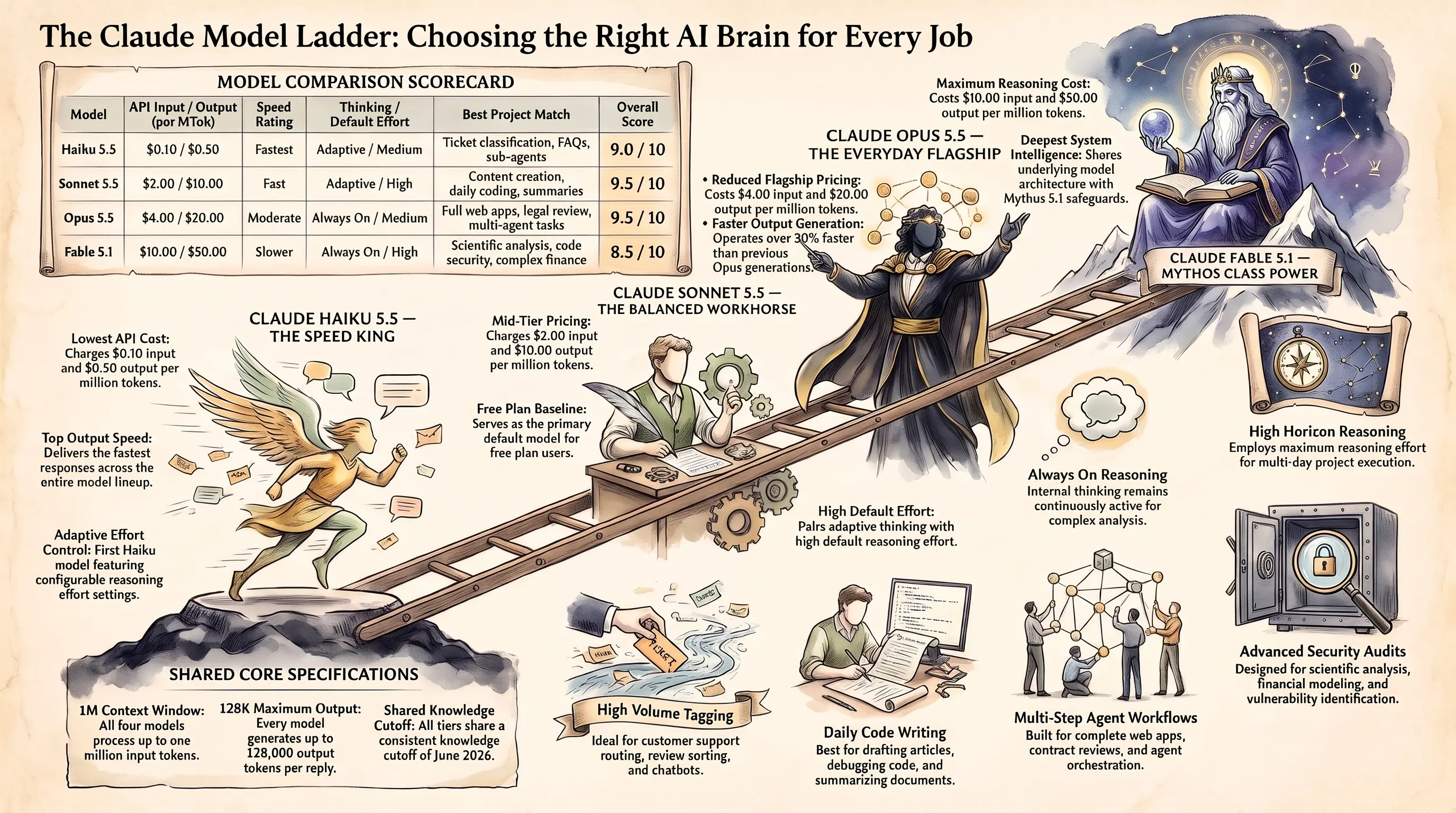
Moreover, all four share three specifications: a context window of 1 million tokens, a maximum output of 128,000 tokens per reply and a reliable knowledge cutoff of June 2026.
What separates them is depth, speed and price. For example, Fable 5.1 thinks the longest and costs the most. Opus 5.5 delivers near Fable results at a lower price. Sonnet 5.5 balances quality and speed for daily work, and Haiku 5.5 answers fastest at the lowest cost.
Therefore, the smart habit is to match the model to the job, the same way you would not hire a senior architect to paint a fence or ask a trainee to design a bridge.
What Is a Token, and Why Does It Decide Your Bill?
A token is a small chunk of text that the model reads or writes, often a short word or part of a longer word. Prices are quoted per million tokens, written as MTok. Input tokens are everything you send, including your message, attached files and earlier chat history.
Output tokens are everything Claude writes back. However, output always costs more than input. For example, Sonnet 5.5 charges $2 per million input tokens and $10 per million output tokens.
Additionally, three more terms matter. The context window is the total amount of text a model holds in view at once, and 1 million tokens fits several long books or a large codebase. Prompt caching stores repeated input, such as your style guide, and charges a much lower rate when Claude reads it again.
Additionally, the Batch API gives a 50% discount on input and output for jobs that do not need an instant reply. If you use the Claude app on a subscription, you do not pay per token, but heavier models and longer tasks draw more from your plan’s usage limit.
Adaptive Thinking and Effort: The Hidden Settings
Every current model supports adaptive thinking, which means Claude decides how long to reason before it answers. On Fable 5.1 and Opus 5.5, thinking is always on. On Sonnet 5.5 and Haiku 5.5, thinking stays adaptive, so simple prompts get quick replies.
Alongside thinking sits the effort setting, which tells the model how much work to put into a task. According to the documentation, the default effort is high on Fable 5.1 and Sonnet 5.5, and medium on Opus 5.5 and Haiku 5.5.
Here is why that matters. In fact, higher effort usually means better answers on hard problems, but it also means more output tokens and more waiting. Lower effort saves tokens on routine work.
For example, a developer asking Haiku 5.5 to label 10,000 customer reviews keeps effort low, while a founder asking Opus 5.5 to review a complex contract leaves effort at its default or raises it.
Note: Haiku 5.5 is the first Haiku model with an effort setting, which gives the budget tier far more control than before.
Claude Opus 5.5: The Everyday Flagship
What Makes Opus 5.5 Special?
Opus 5.5 is the first model of the 5.5 family and the default choice for serious work. According to Anthropic’s Opus 5.5 announcement, it performs at the level of Fable 5.1 on most work and costs 40% less to run than Opus 5 on typical workloads.
On Anthropic’s agentic coding tasks, Opus 5.5 matched Opus 5 quality in about half the turns, time and output tokens. Moreover, it generates output more than 30% faster than Opus 5, and customers note that it delegates to sub agents well and checks its own work.
Consequently, the price reflects that efficiency. As reported by Yahoo Finance, Opus 5.5 costs $4 per million input tokens and $20 per million output tokens, down from $5 and $25 on Opus 5. Cache reads cost $0.20 per million tokens.
In the app, Opus 5.5 is available on Pro, Max, Ultra, Team and Enterprise plans, and developers reach it through the Claude API as claude-opus-5-5, or through Amazon Web Services, Google Cloud and Microsoft Azure.
What Projects Fit Opus 5.5 Best?
Choose Opus 5.5 when the task has many steps and a wrong answer is expensive. It suits building a complete web app or an Android app from a plan, migrating an old codebase, drafting a long research report with citations, reviewing contracts against a checklist and running agents that split work across sub agents.
For example, a startup founder asks Opus 5.5 to build a price tracker website that compares the iPhone 18 Pro across Indian retailers, with a database, a clean interface and alerts.
Similarly, Opus 5.5 handles long professional writing well. This article series, with its research, verification, tables and FAQs, was produced on Opus 5.5 inside my SoulAI Writes Project.
Pro Tip: Keep the default medium effort for most Opus work, and raise it only for complex reasoning. Since thinking is always on, Opus already reasons before it answers, so higher effort mainly helps on the hardest problems.
Read this article: Claude Project R8 Music Player Review: Did AI Build This Hi Fi App?
Claude Fable 5.1: Mythos Class Power With Safeguards
What Is Fable 5.1 and How Is It Different From Mythos?
Fable 5.1 is the most capable model that anyone is able to use today. According to Anthropic’s Fable 5.1 announcement, Fable 5.1 and Mythos 5.1 are the same underlying model with different safeguard levels.
Fable 5.1 is generally available, while Mythos 5.1 is restricted to vetted cybersecurity and life sciences organisations through trusted access programs. In Anthropic’s published benchmarks, Fable 5.1 scored 52.6% on Terminal Bench Science 0.1, compared with 29.0% for Opus 5.
Fable 5.1 costs $10 per million input tokens and $50 per million output tokens. However, its cache reads dropped to $0.25 from $1.00 on Fable 5, a 75% cut that VentureBeat highlighted at launch.
Anthropic says this lowers the cost of typical workloads by about 25%, and up to 45% on highly agentic work. In the app, Fable 5.1 runs on Pro through pay as you go usage credits, and on Max and Ultra for up to half of the weekly limit.
What Projects Fit Fable 5.1 Best?
Pick Fable 5.1 for long horizon work where hours of careful reasoning pay off. It suits scientific data analysis, multi day software projects, complex financial models, large contract redlining and security reviews of your own code.
Anthropic states that Fable 5.1 now identifies software vulnerabilities in source code, though its safeguards stop it from developing exploits. Additionally, its updated cyber safeguards trigger about 60% fewer interventions per Claude Code session than those on Fable 5.
However, Fable 5.1 is slower than the other models, so it is not the right pick for quick questions or chat.
Why this works: On a short task, Fable’s extra reasoning adds cost without a better answer, while on a long task the same reasoning prevents expensive mistakes. Text generated by Fable 5.1 also carries invisible watermarking, which Anthropic added to meet European Union rules. Therefore, reserve Fable for the few projects where depth matters more than speed or price.
Claude Sonnet 5.5: The Balanced Workhorse
Why Do Most People Use Sonnet 5.5 Every Day?
Sonnet 5.5 offers the best mix of speed and intelligence in the family. It costs $2 per million input tokens and $10 per million output tokens, the same as Sonnet 5, while cache reads dropped to $0.10.
It runs fast, its default effort is high, and it uses adaptive thinking, so quick prompts stay quick. Most importantly, Sonnet 5.5 is available on the Free plan alongside Haiku 5.5, which makes it the model most people meet first.
In practice, Sonnet 5.5 handles the bulk of daily professional work. It writes blog drafts, YouTube scripts, emails and reports, it debugs code and builds small tools, and it reads long PDFs with its 1 million token window.
For example, a content creator uses Sonnet 5.5 to turn an iPhone 18 Pro unboxing transcript into a description, chapters and five Shorts scripts in one pass. Similarly, a student uses it to summarise a 300 page textbook and build a revision quiz.
What Projects Fit Sonnet 5.5 Best?
Choose Sonnet 5.5 when you need good quality many times a day. It suits content calendars, social media captions, customer support drafts, landing page copy, spreadsheet analysis and everyday coding.
Moreover, developers like it for agents that run many steps, since the price is half of Opus. On the Batch API, Sonnet 5.5 costs 50% less again, which makes overnight jobs such as rewriting 2,000 product descriptions affordable.
Pro Tip: Start every new kind of task on Sonnet 5.5. If the result misses the mark after a clear brief, move up to Opus 5.5. If it is more than good enough and you repeat it thousands of times, move down to Haiku 5.5. This simple ladder keeps quality high and bills low.
Claude Haiku 5.5: The Speed King on a Budget
What Changed With Haiku 5.5?
Haiku 5.5 is the fastest and cheapest model in the family, and it received the biggest upgrade. Its context window grew to 1 million tokens from 200,000 on Haiku 4.5, and its maximum output grew to 128,000 tokens from 64,000.
It supports adaptive thinking, vision and, for the first time on a Haiku, an effort setting. Haiku 5.5 is also available on every Claude plan, including Free.
However, its pricing has two tiers. For prompts up to 100,000 tokens, Haiku 5.5 costs $0.10 per million input tokens and $0.50 per million output tokens, which is 90% less per token than Haiku 4.5 at $1 and $5. For prompts above 100,000 tokens, the rate rises to $0.50 and $2.50.
As a result, Haiku shines on many short requests, while long prompts are often better value on Sonnet.
What Projects Fit Haiku 5.5 Best?
Pick Haiku 5.5 for high volume, speed sensitive work. It suits sorting support tickets, tagging thousands of reviews after a festive sale, extracting fields from invoices, routing chat messages to the right team, running a shop’s FAQ chatbot and acting as a fast sub agent inside a bigger workflow.
For example, an online store owner sends 10,000 customer reviews through Haiku 5.5 to label each as praise, complaint or question, then hands only the complaints to Sonnet for detailed replies.
On the other hand, Haiku is not built for deep reasoning. Complex coding, long legal analysis and multi step planning belong on Sonnet, Opus or Fable.
Note: Keep your Haiku prompts under 100,000 tokens whenever possible, because the higher tier applies to the whole request, including cached input, once you cross that line.
Claude AI Models Comparison Table
| Model | What It Does | Standout Features | Strength / Weakness | Best For | Target Audience |
|---|---|---|---|---|---|
| Fable 5.1 | Deepest reasoning for long horizon work | Same model as Mythos 5.1, $0.25 cache reads, watermarking | Strength: top benchmark results. Weakness: slowest, $10 / $50 | Science, complex code, finance models | Researchers, Engineers, Enterprises |
| Opus 5.5 | Flagship for agents and professional work | Near Fable results, 40% cheaper than Opus 5, 30% faster output | Strength: quality per dollar. Weakness: costs twice Sonnet | Apps, long reports, agents | Developers, Founders, Agencies |
| Sonnet 5.5 | Balanced daily model | Fast, high default effort, on Free plan | Strength: speed and quality. Weakness: below Opus on hardest tasks | Writing, coding, analysis | Creators, Students, Professionals |
| Haiku 5.5 | Fastest and cheapest model | 1M context, first Haiku with effort, from $0.10 / $0.50 | Strength: cost and speed. Weakness: higher rate above 100K prompts | Classification, chatbots, sub agents | Businessmen, Support Teams, App Builders |
| Specification | Fable 5.1 | Opus 5.5 | Sonnet 5.5 | Haiku 5.5 |
|---|---|---|---|---|
| API name | claude-fable-5-1 | claude-opus-5-5 | claude-sonnet-5-5 | claude-haiku-5-5 |
| Input / output per MTok | $10 / $50 | $4 / $20 | $2 / $10 | $0.10 / $0.50 (up to 100K prompt) |
| Cache read per MTok | $0.25 | $0.20 | $0.10 | $0.01 (up to 100K prompt) |
| Context / max output | 1M / 128K | 1M / 128K | 1M / 128K | 1M / 128K |
| Speed | Slower | Moderate | Fast | Fastest |
| Thinking / default effort | Always on / high | Always on / medium | Adaptive / high | Adaptive / medium |
| App plans | Pro (credits), Max, Ultra | Pro and above | All plans | All plans |
Free Download: Claude AI Models Selection Guide Slide Deck (PDF)
Want every model, price and best use case on a few clean slides? I turned this comparison into a 14 slide presentation, the Claude AI Models Selection Guide, so you can pick the right brain in seconds.
It is a lightweight PDF of under 2 MB, so it opens quickly on your laptop or phone. Keep it beside you when you open the model picker, or share it with your team before your next project.
How Many Tokens Will Your Project Use? Real Cost Examples
Let us price three real jobs for the Claude AI Models on the API rates above, without caching or batch discounts.
Job 1 is a typical work request with 20,000 input tokens, such as a long brief plus a document, and 2,000 output tokens. It costs about $0.30 on Fable 5.1, $0.12 on Opus 5.5, $0.06 on Sonnet 5.5 and $0.003 on Haiku 5.5. In fact, you run Haiku a hundred times for the price of one Fable reply.
Job 2 is a festive sale catalogue with 1,000 product descriptions, each using 500 input tokens and 300 output tokens, so 500,000 input and 300,000 output in total. It costs about $20 on Fable 5.1, $8 on Opus 5.5, $4 on Sonnet 5.5 and $0.20 on Haiku 5.5, and the Batch API halves each figure.
Job 3 is one large codebase review with 400,000 input tokens and 20,000 output tokens. It costs about $5 on Fable 5.1, $2 on Opus 5.5, $1 on Sonnet 5.5 and $0.25 on Haiku 5.5, because Haiku’s higher tier applies above 100,000 tokens.
Step by Step: How to Switch Between Claude AI Models
- In the Claude app, open a new chat and click the model picker below the message box.
- Choose the model that fits the job, using the ladder: Haiku for volume, Sonnet for daily work, Opus for complex work, Fable for the deepest problems.
- Watch your limits in Settings > Usage, since longer tasks on bigger models draw more from your plan.
- On the API, create a key in the Claude Console and pass the model name, such as
claude-sonnet-5-5, in each request. - Cut costs with prompt caching for repeated instructions and the Batch API for jobs that wait until later.
The Secret: Mix models inside one workflow. Let Haiku sort the incoming work, Sonnet handle the bulk and Opus or Fable take only the hardest cases. As a result, you pay flagship prices only where flagship thinking pays off.
Read this article: Higgsfield Cinema Studio 2.0: Are You Directing AI Movies?
Are Claude AI Models Safe to Use for Business?
Anthropic states that the 5.5 models went through extensive alignment testing, external evaluations and safeguards for high risk areas such as cybersecurity and biology. Because Opus 5.5 is comparable to Mythos 5.1 in those areas, Anthropic deploys it with safeguards similar to those on Fable 5.1.
Moreover, Opus 5.5 blocks API users from editing earlier context to extract its reasoning. For sensitive work, use Incognito chats in the app, keep client data inside Projects, and review any output that goes to customers.
Note: No model replaces a qualified lawyer, doctor or financial advisor, so verify those decisions with a professional.
Why Claude AI Models Win Where One Size Fits All Fails
Meanwhile, many AI tools push one default model for every task. Claude gives you a clear ladder with the same 1 million token window on every rung, so moving between models never breaks your workflow.
On the other hand, the choice adds a small learning curve, and Fable’s best features sit behind higher plans or credits. Therefore, learn the ladder once, and every project gets the right brain at the right price.
My Honest Score Card
| Model | Intelligence | Speed | Value for Money | Ease of Access | Overall Score |
|---|---|---|---|---|---|
| Fable 5.1 | 10/10 | 7/10 | 7.5/10 | 7/10 | 8.5/10 |
| Opus 5.5 | 9.5/10 | 8.5/10 | 9.5/10 | 9/10 | 9.5/10 |
| Sonnet 5.5 | 9/10 | 9.5/10 | 9.5/10 | 10/10 | 9.5/10 |
| Haiku 5.5 | 7.5/10 | 10/10 | 10/10 | 10/10 | 9/10 |
Fable 5.1 earns the top intelligence score but loses points on speed and price. Opus 5.5 and Sonnet 5.5 share the best overall score, Opus for complex work and Sonnet for daily work, while Haiku 5.5 wins on cost and speed but trails on reasoning depth.
Frequently Asked Questions About Claude AI Models
Here are clear answers to the questions readers ask most about Claude AI Models, their prices and their best uses.
Which Claude model is best for coding in 2026?
For most developers, Sonnet 5.5 is the best daily coding model, because it is fast, costs $2 and $10 per million input and output tokens, and handles debugging, small features and code review well. For large projects with many steps, such as building a full app or migrating an old codebase, Opus 5.5 is the stronger choice, and Anthropic reports that it matched Opus 5 quality on agentic coding in about half the turns and output tokens. Fable 5.1 suits the hardest long horizon engineering work, while Haiku 5.5 works best as a fast sub agent for simple, repetitive code tasks.
What is the difference between Claude Fable 5.1 and Claude Mythos 5.1?
They are the same underlying model with different levels of safeguards. Fable 5.1 is generally available to everyone through the Claude app, the Claude API and major cloud platforms, and it includes safeguards that limit its performance in risky cybersecurity and biology tasks. Mythos 5.1 offers more permissive safeguards and is available only to verified organisations through programs such as Anthropic's Cyber Verification Program. Both share the same specifications and pricing, $10 and $50 per million input and output tokens, with a 1 million token context window and up to 128,000 output tokens.
How much does the Claude API cost per million tokens?
As of 9 November 2026, Fable 5.1 costs $10 per million input tokens and $50 per million output tokens. Opus 5.5 costs $4 and $20, Sonnet 5.5 costs $2 and $10, and Haiku 5.5 costs $0.10 and $0.50 for prompts up to 100,000 tokens, rising to $0.50 and $2.50 above that. Cache reads cost $0.25, $0.20, $0.10 and $0.01 respectively for short Haiku prompts. The Batch API gives a 50% discount on input and output for every model. Subscribers in the Claude app pay a monthly plan price instead of per token rates.
Which Claude models are available on the free plan?
The Free plan includes Sonnet 5.5 and Haiku 5.5. Opus 5.5 requires Pro, Max, Ultra, Team or Enterprise. Fable 5.1 runs on Pro through pay as you go usage credits, and Max and Ultra include it for up to half of the weekly limit. Team Premium seats also include Fable within a share of the weekly limit, while Team Standard seats reach it through usage credits. If your daily work involves long documents, client research or multi step coding, Pro gives you Opus 5.5, which is the biggest jump in quality for the price.
Do all Claude 5.5 models have a 1 million token context window?
Yes. Fable 5.1, Opus 5.5, Sonnet 5.5 and Haiku 5.5 all list a context window of 1 million tokens and a maximum output of 128,000 tokens per reply. Opus 5.5 and Sonnet 5.5 include the full window at their standard prices with no long context surcharge. Haiku 5.5 also supports 1 million tokens, but any prompt longer than 100,000 tokens moves to its higher rate of $0.50 and $2.50 per million tokens. Fable 5.1 keeps one flat rate across the full window. This shared window means you switch models without trimming your documents.
Climb the Ladder Wisely and Let Every Model Earn Its Seat
You now know what each of the four Claude AI Models does, what it costs and where it shines. Therefore, start this week with a simple rule. Give your daily writing and coding to Sonnet 5.5, hand repetitive bulk jobs to Haiku 5.5, call Opus 5.5 for projects with many steps, and save Fable 5.1 for the rare problem that deserves hours of deep thinking.
Test each model on one real task from your own work, compare the results and keep notes. In fact, the right model choice often matters more than the perfect prompt.
Get creative, mix models in one workflow, and protect both your time and your money.
Priyanshu Khatri Founder & Chief AI Analyst, SoulAI Writes
Read more articles

Claude AI Models: Opus, Fable, Sonnet or Haiku, Which Wins?
Which Claude AI Models Should You Pick: Opus 5.5, Fable 5.1, Sonnet 5.5 or Haiku…

Claude AI Tutorial: Are You Using Every Feature Right?
Are You Only Chatting With Claude AI When It Is Ready to Run Your Entire…

Claude AI Video Editing: Is This the Smartest Reel Workflow?

Claude Project – R8 Music Player Review: Did AI Build This Hi Fi App?
Is R8 Music Player the Ad Free Hi Fi Android App Your Phone Has Been…

25 Best AI Prompts for Professionals! Save Hours of Work!
The AI Professional Suite: How to Build a C-Suite Team for $0 In the professional…

Best AI Productivity Prompts: 14 Hacks to Work 10x Faster!
The AI Productivity Suite: How to Do a Week’s Work in One Afternoon We all…













Leave a Reply