


Claude Fable 5.2 vs Gemini 4 Carbon: Which Frontier AI Model Wins Your Work and Your Wallet?
Claude Fable 5.2 vs Gemini 4 Carbon: which model would you hire: the one that tops every independent leaderboard, or the one that does almost the same job for a quarter of the token price? That exact choice landed on every developer’s desk this week, because Anthropic shipped Claude Fable 5.2 on November 9 and Google opened Gemini 4 Carbon to the public one day later.
Behind the headline numbers sits a cost twist that most comparison tables ignore, and it flips the answer for many teams. Stay with me, and I will walk you through every benchmark, price and workflow, step by step, so you save your energy, your time and your money on every AI task you run.
Claude Fable 5.2 vs Gemini 4 Carbon is the most important AI model matchup of November 2026. Both models arrived within twelve days of each other, and both target long horizon agentic work, which means an AI that keeps working on a big task for hours without losing the thread.
However, the two labs built them with different priorities. Anthropic chased raw intelligence, coding depth and reliability. Google chased cybersecurity strength, richer multimodal input and a far lower price per token. As a result, the best model for you depends on what you build, how much you spend and how fast you need answers.
This guide pulls together both official launch posts, the developer documentation and independent Artificial Analysis results. In this Claude Fable 5.2 vs Gemini 4 Carbon breakdown, you get plain language explanations of every term, a side by side feature table, a real pricing calculation, step by step setup guides for both models and practical prompts for the Black Friday rush.
Moreover, you get an honest score card that names weaknesses on both sides. No hype, only verified facts as of November 11, 2026.
Round 1: What Is Claude Fable 5.2?
Claude Fable 5.2 is Anthropic’s most capable generally available model, released on November 9, 2026. According to the official Anthropic launch announcement for Claude Fable 5.2 and Mythos 5.2, both models share the same underlying brain. However, the difference is access.
Fable carries extra safeguards for cybersecurity and biology, so every paying user gets it. In contrast, Mythos runs with lighter safeguards and goes only to vetted organizations. In simple words, Fable is the public version of Anthropic’s strongest model, with guardrails on the two most sensitive subjects.
What changed from Fable 5.1 to Fable 5.2?
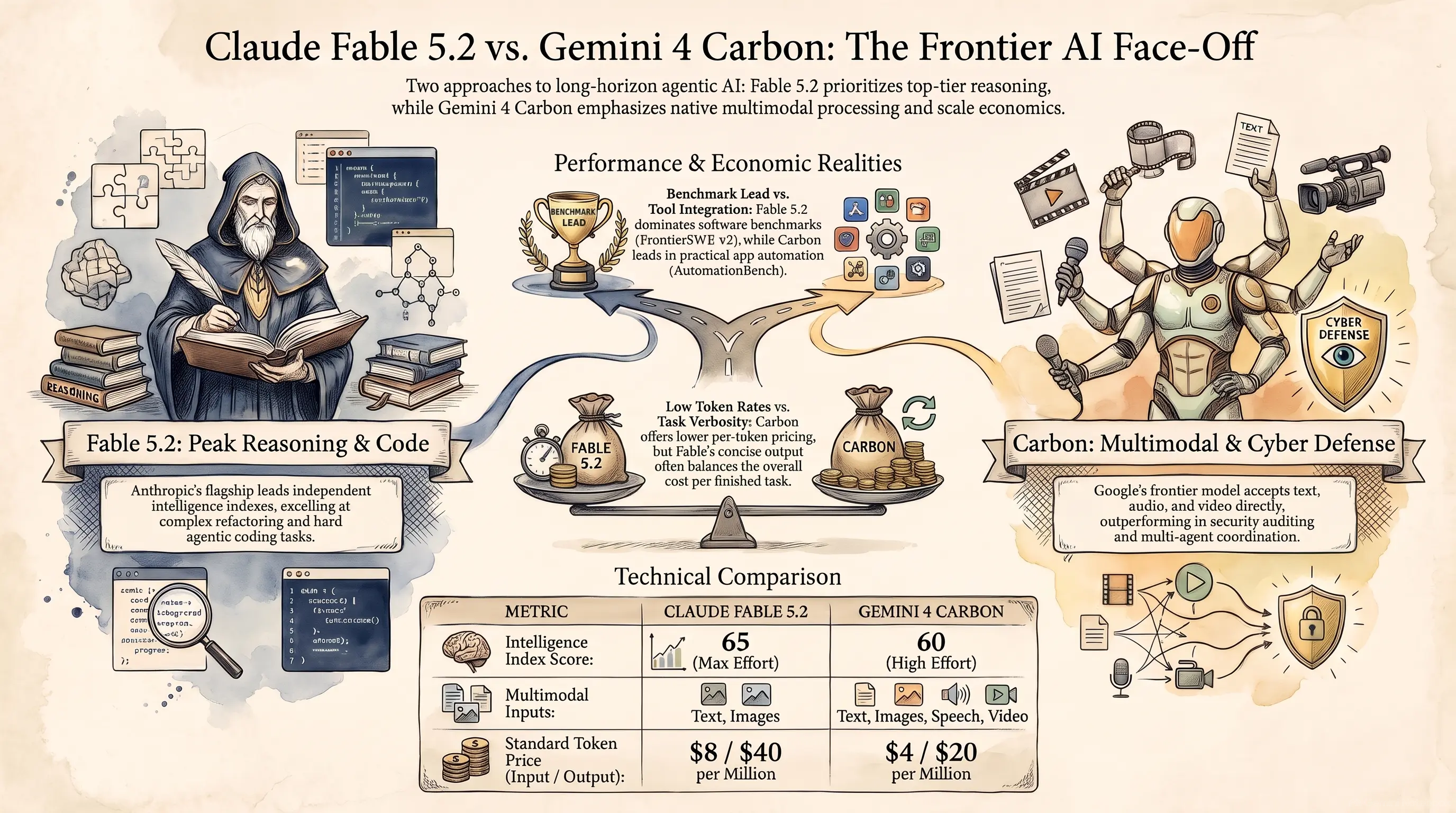
Anthropic reports output that arrives up to 30% faster than Fable 5.1, plus clear gains in coding, reasoning and vision. The price also dropped to $8 per million input tokens and $40 per million output tokens, down from $10 and $50 for the previous Fable versions. A token is a small chunk of text, often a piece of a word.
Additionally, a new fast mode generates tokens up to 2.5 times faster at double the standard rate. In fact, Anthropic also says Fable 5.2 blocks about 55% fewer harmless requests than Fable 5.1 in early testing, which matters if older versions refused your legitimate security or science questions.
Key Claude Fable 5.2 specifications in plain language
The official Claude Fable 5.2 model documentation lists a 1 million token context window and up to 128,000 output tokens in one reply. The context window is the amount of text the model reads and remembers at once, which Anthropic puts at roughly 555,000 words.
Thinking is always on, and you choose an effort level from Low, Medium, High, Xhigh or Max. Higher effort means deeper reasoning, longer waits and bigger bills. Meanwhile, Medium is the default in the Claude apps and Claude Code, while the API defaults to High. The knowledge cutoff is June 2026, and the API model ID is claude-fable-5-2.
Read this article: Claude AI Models: Opus, Fable, Sonnet or Haiku, Which Wins?
Round 2: What Is Gemini 4 Carbon?
Gemini 4 Carbon is the strongest frontier model from Google DeepMind. Google announced it on October 28, 2026, two weeks after Gemini 4 Argon. At first, only a small group of cyber defenders inside Google’s Fairwind Program had access.
Then, on November 10, Google opened Carbon to paying developers, enterprises and Google AI Ultra subscribers, as confirmed in the official Google announcement that Gemini 4 Carbon is now available. Google built Carbon for sustained agentic workflows, cybersecurity defense and long engineering projects, such as tracing and patching bugs across a large codebase over several days.
How Gemini 4 Carbon works for developers and everyday users
Developers reach Carbon through the paid Gemini API tier in Google AI Studio and Android Studio. Enterprises use it through Gemini for business. Everyday users on Google AI Ultra get it inside the Gemini app, AI Mode in Search and Google Antigravity, the agent first coding platform from Google.
Moreover, Antigravity adds a preview command called /swarm that turns one prompt into a coordinated team of agents, where Carbon plans and audits while lighter models do parallel work. However, Google still recommends Gemini 4 Argon for most everyday coding, because Carbon spends more tokens exploring and checking its own work.
Key Gemini 4 Carbon specifications in plain language
Google’s own posts do not state a context window, but Artificial Analysis lists 1 million tokens for Carbon, the same as Fable 5.2. Carbon accepts text, images, speech and video as input, while Fable 5.2 accepts text and images.
The introductory API price is $2 per million input tokens and $10 per million output tokens until November 30, 2026. After that date, the standard price becomes $4 and $20. Additionally, cached input, meaning repeated text the model has already processed, gets a 95% discount. Therefore, Carbon wins on sticker price by a wide margin.
Claude Fable 5.2 vs Gemini 4 Carbon: Side by Side Feature Breakdown
Before the numbers, it helps to see where each model fits inside its own family. Both labs sell a cheaper model one step below the flagship, and both labs tell most users to start there. Anthropic points everyday coding and knowledge work to Claude Opus 5.5. Similarly, Google points the same work to Gemini 4 Argon.
For that reason, the table below compares all four options. Read the Target Audience column first, because it shows who gets the most value from each model, whether you run a business, create content or lead an engineering team.
| Model | What it does | Standout Features | Strength / Weakness | Best For | Target Audience |
|---|---|---|---|---|---|
| Claude Fable 5.2 (Anthropic) | Top tier reasoning and agentic model for the hardest technical work | #1 on the Artificial Analysis Intelligence Index (65), 128K output, fast mode | Strength: leads most coding, science and knowledge tests. Weakness: highest token price, blocks offensive security work | Large refactors, long agent runs, research reports | Software engineers, CTOs, researchers, consultants, enterprise teams |
| Gemini 4 Carbon (Google) | Strongest Google model for long engineering tasks and cyber defense | Speech and video input, /swarm agent teams, 95% cache discount | Strength: low token price, strong security results. Weakness: slower per task, heavy token use, price doubles in December | Business automations, security audits, media analysis, high volume jobs | Security teams, budget startups, YouTubers, creators, Google Workspace businesses |
| Claude Opus 5.5 (Anthropic) | Recommended starting model for most coding and knowledge tasks | 1M context, $4 / $20 pricing | Strength: half the price of Fable. Weakness: trails Fable on the hardest tasks | Daily coding, writing, analysis | Professionals, freelancers, small teams |
| Gemini 4 Argon (Google) | Recommended default for most software and knowledge work | Available on Google AI Pro and above | Strength: affordable and widely available. Weakness: scores well below Carbon | Everyday assistant work, routine code | Students, marketers, businessmen, everyday Gemini users |
Round 3: Claude Fable 5.2 vs Gemini 4 Carbon Benchmarks, Who Leads Where?
The official head to head table
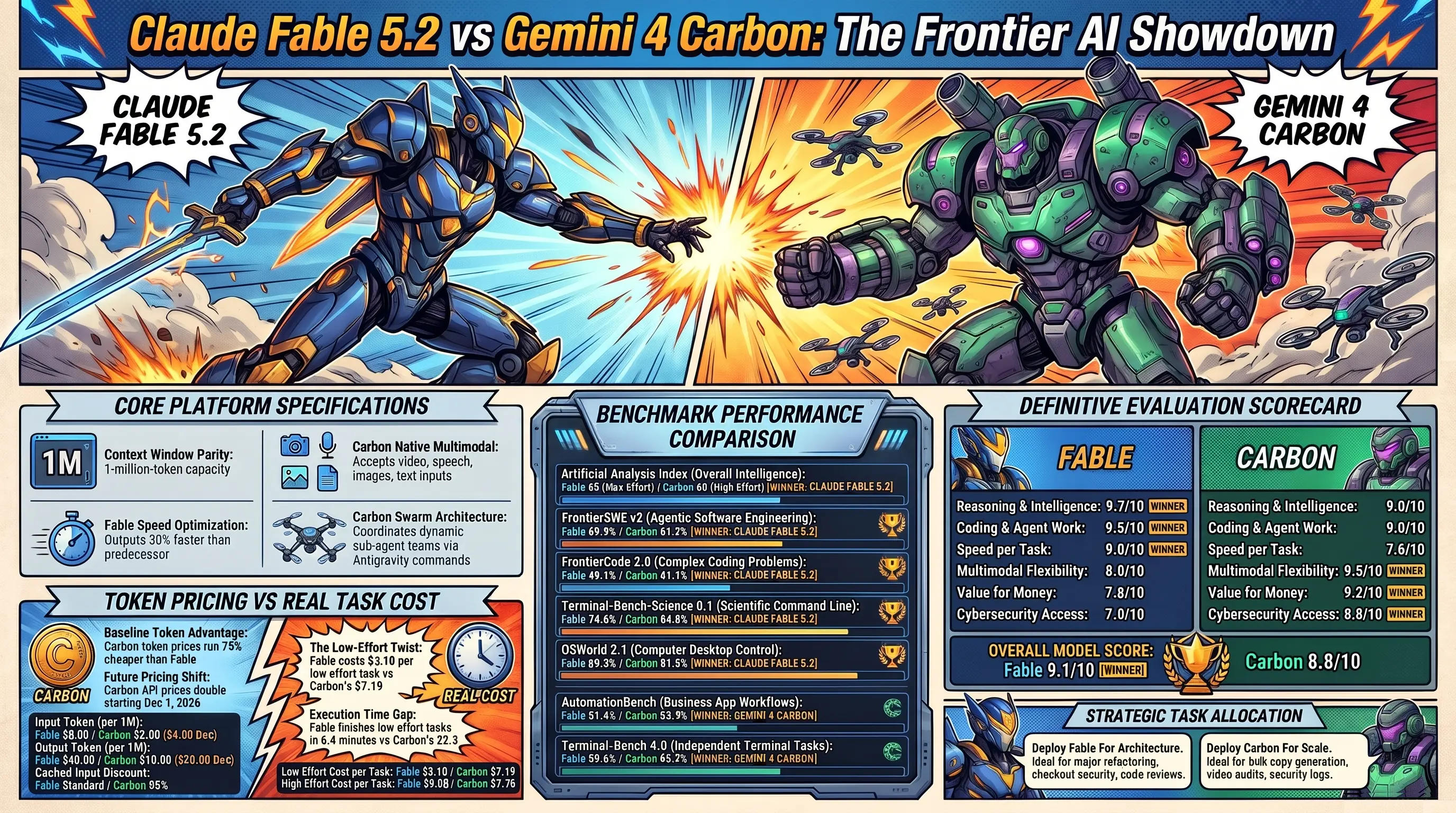
A benchmark is a standardized exam for AI models, and each one tests a single skill. Anthropic’s launch post includes Gemini 4 Carbon in its comparison table, and the gaps are clear. Fable 5.2 leads on agentic coding, scientific terminal work and computer use.
In fact, the only clean Carbon win in this table is AutomationBench, a Zapier test that measures how well a model chains real business apps together, while chart reading ends close to a tie. However, Fable ran FrontierCode at Xhigh effort while Carbon ran it at Medium, so that gap partly reflects effort settings.
| Benchmark | What it tests (plain language) | Fable 5.2 | Gemini 4 Carbon | Leader |
|---|---|---|---|---|
| FrontierSWE v2 | Fixing real software engineering tasks as an agent | 69.9% | 61.2% | Fable |
| FrontierCode 2.0 | Hard agentic coding problems | 49.1% (Xhigh) | 41.1% (Medium) | Fable |
| Terminal-Bench-Science 0.1 | Scientific work inside a command line | 74.6% | 64.8% | Fable |
| OSWorld 2.1 (offline partial) | Operating a computer desktop like a person | 89.3% | 81.5% | Fable |
| AA-Briefcase v1.1 (rubric) | Finished knowledge work deliverables | 66.1% | 61.8% | Fable |
| AutomationBench | Business workflows across real apps | 51.4% | 53.9% | Carbon |
| Chartography (no tools) | Reading and understanding charts | 73.4% | 72.5% | Near tie |
Source: Anthropic launch post, November 9, 2026. Competitor scores were compiled by Anthropic.
Independent results from Artificial Analysis
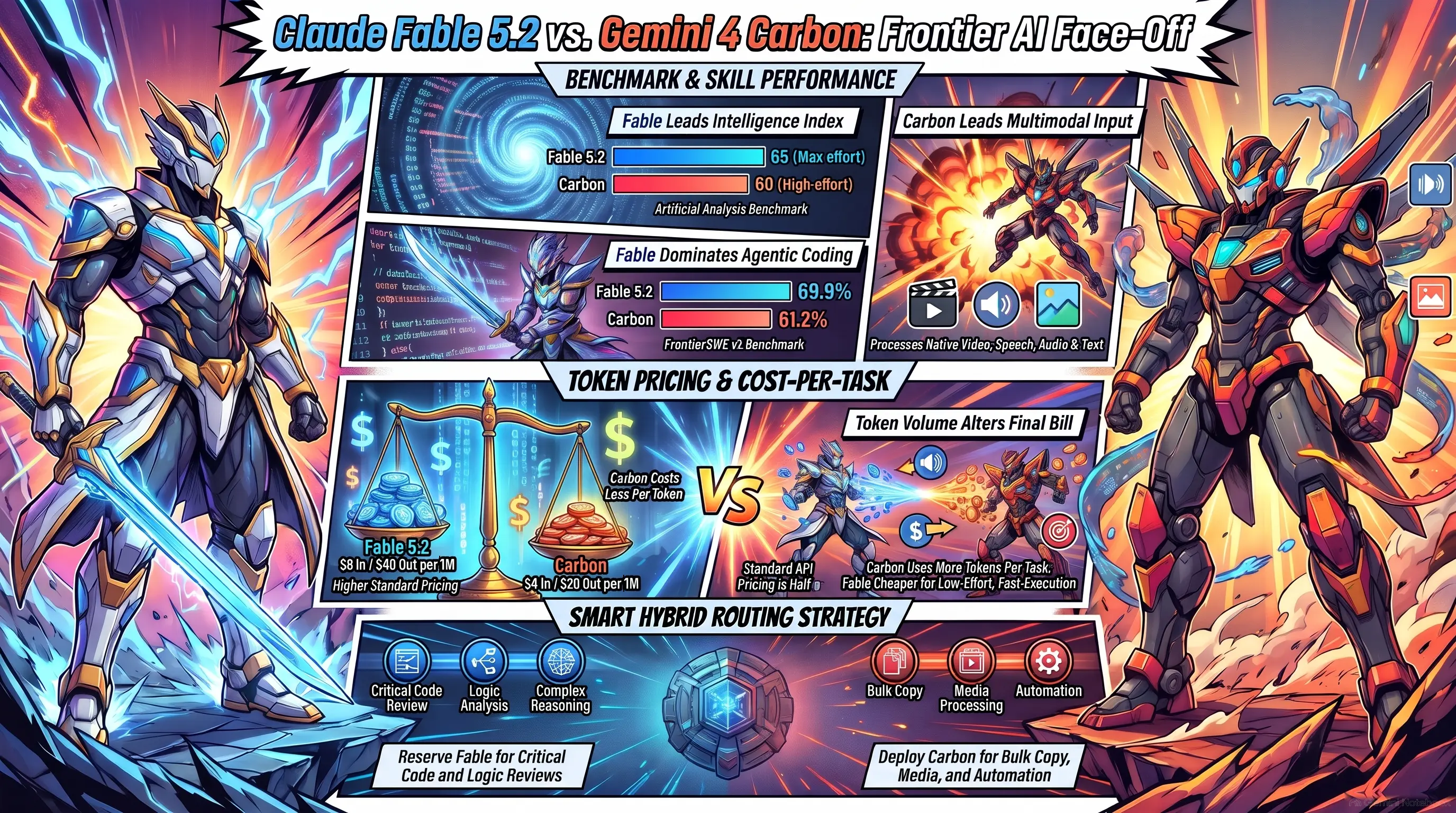
Artificial Analysis is an independent benchmarking company, and its Claude Fable 5.2 vs Gemini 4 Carbon release comparison puts Fable 5.2 at Max effort on 65 points, ahead of Carbon at High effort on 60. Fable leads the science and knowledge tests by wide margins, for example 80.2% against 69.1% on HLE-Diamond, a hard reasoning exam.
However, Carbon wins three practical tests: Terminal-Bench 4.0 (65.2% against 59.6%), AutomationBench (77.8% against 76.4%) and GDP.pdf, a document task (28.4% against 24.2%). Consequently, Carbon is a serious rival in daily agent work.
Claude Fable 5.2 vs Gemini 4 Carbon Pricing: Is Carbon Cheaper in Real Use?
On token price, the answer is a clear yes. Take a research job that reads 1 million tokens of documents and writes a 200,000 token report. On Fable 5.2, that job costs $8 for input plus $8 for output, so $16 in total. On Carbon at the November introductory rate, it costs $2 plus $2, so $4.
However, from December, the same Carbon job costs $8. So Carbon costs a quarter of Fable now and half from December. For high volume work such as product descriptions or support replies, that gap adds up fast.
The cost per task twist most tables miss
Token price is only half of the bill. The other half is how many tokens a model burns to finish the job. Artificial Analysis measures the full cost per task at Carbon’s December rates. At High effort, Carbon averages $7.76 per task against $9.08 for Fable.
However, at Low effort both models score 54 points, yet Fable costs $3.10 per task while Carbon costs $7.19, because Carbon writes far more tokens. Moreover, Fable at Low also finishes in about 6.4 minutes against 22.3 minutes for Carbon. As VentureBeat’s analysis of the Carbon release warns, a lower token price does not always mean a lower final bill.
Note: Carbon’s introductory price ends on November 30, 2026. Plan every budget for December onward with the $4 and $20 rates, not the launch rates.
Is it free to use either model?
Neither model is free. On the Claude side, Fable 5.2 is not part of the free plan. Anthropic’s launch post says Fable usage is included for up to 50% of weekly usage limits on Pro and standard Team seats, and API use is billed per token.
On the Google side, Carbon inside the Gemini app is limited to Google AI Ultra subscribers, a plan that starts at $99.99 per month in the US. Meanwhile, Google AI Pro users keep Gemini 4 Argon, and API access requires the paid Gemini tier. Both companies change plan limits often, so check the official pricing pages before you subscribe.
Read this article: Claude AI Tutorial: Are You Using Every Feature Right?
Claude Fable 5.2 vs Gemini 4 Carbon for Coding: Which Is Better?
For the hardest coding work, Fable 5.2 holds the edge. It leads FrontierSWE v2 by almost nine points and FrontierCode 2.0 on both the official and independent tables.
Moreover, Anthropic shared long agent examples, including one Fable 5.2 instance that coordinated more than 1,000 subagents for eight days to build a prototype operating system that boots on a laptop. Vercel engineer Joe Haddad summed up the feeling in five words: “The model is in my head.” That kind of intent reading matters on messy codebases.
Where Gemini 4 Carbon Pulls Ahead in Coding
On the other hand, Carbon is the stronger pick for terminal heavy agent loops and cost sensitive pipelines. It leads Terminal-Bench 4.0 on the independent table, and Google reports a #1 rank on CursorBench 4.0 at more than twice the cost efficiency of the next best external model.
Additionally, Carbon reached 1,768 Elo on WebDev Arena, a ranking built from blind user votes on web apps, which places it fourth. The /swarm feature also suits developers who want Carbon to plan and audit while cheaper models write the bulk of the code. Therefore, choose Fable for depth and Carbon for scale.
Claude Fable 5.2 vs Gemini 4 Carbon on Safety: Is It Safe to Use Each Model?
Both models are safe for normal business use, but they treat security work in opposite ways. Fable 5.2 uses classifiers that block high risk cyber activity, such as penetration testing and exploit generation, and routes blocked requests to older Claude models. Instead, security teams who need that work apply for Claude Mythos 5.2 through Anthropic’s Cyber Verification Program.
On the other hand, Carbon takes a different path. Google reports 88.2% on SEC-bench Pro for finding vulnerabilities, 54.8% on ExploitGym and 71.0% on CWE-bench for patching. Meanwhile, its least restricted version, Carbon for cyber, stays inside the gated Fairwind Program for approved defenders.
Safety Test Results From Both Labs
On safety testing, Google reports that Carbon blocked 99% of attack attempts from an adaptive red teaming agent and passed 92% of a 375 task honesty test, up from 70% for Argon. Similarly, Anthropic reports that Mythos 5.2 scored 2.67 on an automated behavior audit of about 1,900 scenarios, where lower is better, against 2.79 for Opus 5.5.
If your work touches legal, medical or financial decisions, treat both models as assistants and verify every output with a qualified professional.
Step by Step Guide: How to Use Claude Fable 5.2
Getting started with Fable 5.2 takes about five minutes, whether you prefer a chat window, a terminal or code. The key decision is the effort level, because it controls quality, speed and cost together. Therefore, start low, raise it only when the answer falls short, and keep long tasks inside one conversation so the model keeps full context.
The steps below follow the official Claude apps and API documentation published on November 9, 2026, so the menus and names match what you see on screen today.
- Choose your door. Use claude.ai or the Claude apps on a paid plan, Claude Code in your terminal, or the Claude API.
- Select the model. Pick Claude Fable 5.2 in the model menu, or set the API model to
claude-fable-5-2. - Set the effort level. Start at Medium. Move to High or Xhigh for big refactors, and keep Max for rare, high stakes problems.
- Load full context. Upload every file or document the task needs, since the 1M token window holds a lot.
- Delegate smartly. Let Fable act as the Orchestrator while Sonnet 5.5 or Haiku 5.5 handle simple subtasks.
Step by Step Guide: How to Use Gemini 4 Carbon
Carbon reaches you through Google’s own products and the paid Gemini API. Because Google positions Argon as the default, you pick Carbon on purpose for deeper work. One habit helps a lot. Send Carbon your video or audio files directly instead of transcripts, because native multimodal input is one of its clearest advantages.
Additionally, watch the token meter during your first week, since Carbon explores and verifies before it answers, and that behavior shapes your bill more than the token price alone.
- Get access. Subscribe to Google AI Ultra, or enable billing on the Gemini API paid tier in Google AI Studio.
- Select the model. Choose Gemini 4 Carbon in the Gemini app, AI Studio or Gemini for business, and copy the exact model ID from AI Studio for code.
- Pick a thinking level. High costs only slightly more than Medium on Artificial Analysis, so High is a fair default for hard jobs.
- Use native media. Upload video, audio, images or long PDFs and ask questions across all of them in one prompt.
- Scale with /swarm. In Google Antigravity, type /swarm with your project goal to start a coordinated team of agents.
Practical Playbook: Black Friday 2026 Workflows for Both Models
Case Study 1: The Black Friday Store Sprint
Black Friday falls on November 27, 2026, which makes it a fair real world test for the Claude Fable 5.2 vs Gemini 4 Carbon split. Picture a small fashion brand with 400 products, a Shopify storefront and one developer.
First, Carbon writes fresh, search friendly descriptions for every product in batches, and reviews the founder’s ten minute video walkthrough of the new collection to pull out selling points. Next, Fable 5.2 audits the discount code logic and the checkout scripts, then writes tests for every edge case, such as stacked coupons and free shipping thresholds. As a result, the cheaper model handles the volume while the strongest model guards the revenue path.
Prompt Templates for Both Models
Prompt Template (Gemini 4 Carbon): You are an ecommerce copywriter. Watch the attached video of our {Collection Name} launch and list the five strongest selling points. Then write a 120 word product description for each product in the attached CSV, using the tone {Brand Tone}, the primary keyword {Keyword} and one Black Friday offer line: {Offer Details}.
Prompt Template (Claude Fable 5.2): Review the attached checkout and discount code files from our {Store Platform} theme. Find every scenario where {Discount Rule} breaks, such as stacked coupons or minimum cart values. Explain each bug in plain language, propose a fix, and write automated tests that cover all edge cases before {Launch Date}.
Why this works: Each model does the job its benchmarks favor. Carbon’s video input and low price fit bulk content, while Fable’s lead on agentic coding fits the code that handles real money.
The Secret: Run Fable at Medium effort for drafting and switch to High only for the final review. Artificial Analysis data shows Fable at Medium costs $3.80 per task against $9.08 at High.
Read this article: Claude AI Video Editing: Is This the Smartest Reel Workflow?
Department of Verdicts: Why Each Model Wins Where the Other Falls Short
Fable 5.2 wins where failure is expensive. It leads the broad independent index, most coding rows and every science test. For example, Oracle’s machine learning team reports that Fable’s SQL returned correct totals where two other models came out five to eight times too high.
In contrast, Carbon wins where volume, media and cyber defense matter. Wiz used Carbon to find unknown vulnerabilities in two major software providers in under two hours. However, Carbon burns more tokens per task and loses its launch pricing on November 30. Instead of picking one winner, smart teams route each task to the model that fits it.
My Honest Score Card: Claude Fable 5.2 vs Gemini 4 Carbon
The scores below rate each model out of 10 on the criteria that matter most to SoulAI Writes readers. They come from the published benchmark data, the verified pricing and the access rules covered in this article, as of November 11, 2026. Every score reflects a real weakness as well as a strength.
For example, Fable loses points on value because its token price is four times Carbon’s this month. Likewise, Carbon loses points on speed because it takes longer per task on independent tests. Use the overall score as a guide, then weigh the rows that match your own work.
| Criterion | Claude Fable 5.2 | Gemini 4 Carbon |
|---|---|---|
| Reasoning and Intelligence | 9.7 | 9.0 |
| Coding and Agentic Work | 9.5 | 9.0 |
| Speed per Task | 9.0 | 7.6 |
| Multimodal Input | 8.0 | 9.5 |
| Value for Money | 7.8 | 9.2 |
| Cybersecurity Access | 7.0 | 8.8 |
| Availability and Ease of Use | 9.4 | 8.5 |
| Overall Score | 9.1 | 8.8 |
Frequently Asked Questions About Claude Fable 5.2 vs Gemini 4 Carbon
Here are the most common questions about Claude Fable 5.2 vs Gemini 4 Carbon, answered from the official launch posts and independent test data.
Is Claude Fable 5.2 better than Gemini 4 Carbon?
Claude Fable 5.2 is the stronger model on most published tests, but Gemini 4 Carbon wins on price and a few practical tasks. On the independent Artificial Analysis Intelligence Index, Fable 5.2 at Max effort scores 65 against 60 for Carbon at High effort, and Fable leads the hardest science, knowledge and coding evaluations. However, Carbon leads Terminal-Bench 4.0, AutomationBench and the GDP.pdf document task, and it accepts speech and video input. Choose Fable when accuracy on complex work matters most, and choose Carbon for high volume jobs, media files or cyber defense.
How much do Claude Fable 5.2 and Gemini 4 Carbon cost?
Claude Fable 5.2 costs $8 per million input tokens and $40 per million output tokens on the API, and its fast mode costs double. Gemini 4 Carbon costs $2 per million input tokens and $10 per million output tokens until November 30, 2026, then $4 and $20, as stated in Google's Carbon availability post. Cached input on Carbon gets a 95% discount. In the apps, Fable is included within weekly limits on paid Claude plans, while Carbon needs Google AI Ultra. Measure one real job first, because cost per task depends on token use.
Which is better for coding, Claude Fable 5.2 or Gemini 4 Carbon?
For complex software engineering, Claude Fable 5.2 leads. It scores 69.9% on FrontierSWE v2 against 61.2% for Carbon, and it leads FrontierCode 2.0 on both Anthropic's table and the independent Artificial Analysis results. On the other hand, Gemini 4 Carbon is the better value for terminal heavy loops and large automated pipelines, and it leads Terminal-Bench 4.0 on the independent table. Many teams combine them, with Fable handling architecture and code review while a cheaper model writes routine code. Always test on your own repository before switching.
What is the difference between Claude Fable 5.2 and Claude Mythos 5.2?
Claude Fable 5.2 and Claude Mythos 5.2 are the same underlying model with different safety settings and access rules. Fable 5.2 includes extra classifiers that block high risk cybersecurity tasks, such as exploit generation, and most research biology tasks, and it is open to every paying Claude user and API customer. In contrast, Mythos 5.2 runs with lighter safeguards in those two areas and goes only to vetted organizations through Anthropic's verification programs or Claude Security for Enterprise customers. The official Fable 5.2 documentation explains both access paths for developers.
Is Gemini 4 Carbon available to everyone now?
Gemini 4 Carbon became widely available on November 10, 2026, but not on every plan. Paying developers reach it through the Gemini API paid tier in Google AI Studio and Android Studio, and enterprises reach it through Gemini for business. Google AI Ultra subscribers get it in the Gemini app, AI Mode in Search and Google Antigravity. Meanwhile, free users and Google AI Pro subscribers keep Gemini 4 Argon. Google has not yet published a country by country rollout schedule, so enterprise buyers should confirm regional access first.
The Smart Money Move: Pick by Task, Not by Hype
The Claude Fable 5.2 vs Gemini 4 Carbon race has no single champion, and that is good news for you. Fable 5.2 is the sharper thinker for code, science and finished documents. Carbon is the thriftier worker for automation, media and security defense, especially before its price rises on December 1.
Therefore, test both on one real task from your own week and compare the final bill, not the token price. Keep the official Anthropic release notes bookmarked, since both labs ship fast. Route each job to the right model, and you save hours of rework and real money every single month.
Priyanshu Khatri Founder & Chief AI Analyst, SoulAI Writes
Read more articles
Claude Fable 5.2 vs Gemini 4 Carbon: Which AI Wins?
Claude Fable 5.2 vs Gemini 4 Carbon: Which Frontier AI Model Wins Your Work and…
Gemini 4 Carbon: Is Google’s Strongest AI Worth It?

Is Claude Fable 5.2 Worth It? Benchmarks, Pricing and API
Claude AI Models: Opus, Fable, Sonnet or Haiku, Which Wins?
Which Claude AI Models Should You Pick: Opus 5.5, Fable 5.1, Sonnet 5.5 or Haiku…

Claude AI Tutorial: Are You Using Every Feature Right?
Are You Only Chatting With Claude AI When It Is Ready to Run Your Entire…







Leave a Reply