


Gemini 4 Carbon: Is Google’s Strongest AI Model Worth Your Hardest Work?
Which AI model found hidden security holes inside two major software companies in under two hours, a job that normally eats several weeks of expert time? The answer is a model that most people have not touched yet, and Google opened it to the public on 10 November 2026.
Behind that two hour result sits a bigger story about price, speed, honesty and one surprising weakness that the launch charts do not shout about. Stay with me, and I will walk you through every feature, every price and every honest limit, step by step, so you save your energy, your time and your money before you pay for a single token.
Gemini 4 Carbon is Google’s newest frontier model and, in Google’s own words, its strongest model so far. It arrived on 10 November 2026 for developers, enterprises, scientists and Google AI Ultra subscribers, two weeks after a limited preview for cyber defenders. In fact, it now holds the number one spot on the Artificial Analysis Intelligence Index v5.0 with a score of 59.
However, a top score does not make it the right model for every job. Google itself says Gemini 4 Argon stays the better pick for most daily coding and knowledge work, while Carbon is the specialist you bring in for the problems that break other models.
In this guide, I break Gemini 4 Carbon into plain language. You will learn what it is, what each technical term means, how much it costs before and after the introductory price ends on 30 November 2026, and how to start using it in the Gemini app, Google AI Studio and Google Antigravity.
Moreover, you will see the full benchmark picture, including the areas where Claude Opus 5.5 and GPT-6 Astra still lead. Every number here comes from Google’s official posts, Google Cloud documentation and named independent evaluators, so you get facts you trust and act on with confidence.
What Is Gemini 4 Carbon and Why Did Google Build It?
Google introduced Gemini 4 Carbon on 28 October 2026 in an official announcement on the Google blog written by Koray Kavukcuoglu, SVP of Google DeepMind and Chief AI Architect at Google. The model builds directly on Gemini 4 Argon, which launched two weeks earlier.
Google designed Carbon for two jobs in particular. The first is cybersecurity defense, which means finding, testing and fixing weak spots in software before attackers reach them. The second is long horizon work, which simply means big tasks with many steps that take hours or even days to finish.
Internally, Google reports that Carbon kept working for days on single engineering problems, pushing through dead ends to find and patch subtle bugs across large codebases.
What does “frontier model” mean in simple words?
A frontier model is the most capable AI system a lab offers at a given moment. In practice, it is the top of the product line, the model that sets the lab’s best scores. The current Gemini lineup now has three clear levels.
Gemini 3.8 Flash handles fast everyday requests, Gemini 4 Argon handles complex tasks, and Gemini 4 Carbon takes the hardest problems. Inside the Gemini app, the model picker labels 4 Argon for “Code & analysis” and 4 Carbon for “Most complex work.” Because Carbon spends more tokens to explore and verify, Argon stays the default for most work.
Gemini 4 Carbon Release Timeline: From Cyber Defenders to Everyone
Google chose a staged rollout. On 28 October 2026, Carbon went to a small group of cyber defenders first. Next, access expanded to trusted partners through the Fairwind Program, Google’s vetting program for security teams.
Meanwhile, Google took part in the U.S. government’s voluntary pre release model testing process and adjusted its guardrails based on feedback. Then, on 10 November 2026, Google made Carbon available to paying developers, enterprises, scientists and Google AI Ultra subscribers. As a result, early reviews from late October describe a model nobody outside Fairwind had access to, while today the picture is different.
Why did Google release Carbon to cyber defenders first?
Security skills cut both ways. The same ability that finds a flaw so a defender patches it would also help an attacker exploit it. For this reason, Google gave defenders a head start and used that window to test its safety systems under real pressure.
As Engadget reported on the wider launch, Google says Carbon helped its first users uncover zero day vulnerabilities in a short span of time. A zero day is a flaw the software maker does not know about yet. Approved Fairwind projects also get a separate model ID, gemini-4-carbon-cyber-permissive, which allows deeper security work than the standard public model.
Gemini 4 Carbon Benchmarks: Where It Leads and Where It Trails
A benchmark is a standardized test that lets you compare models on the same task. The table below combines Google’s published comparison chart with the independent Artificial Analysis Intelligence Index, which blends many tests into one overall score. Read it as a map of strengths, not as a final verdict.
In fact, the gaps between the top three models on the overall index are only one or two points, while the gaps in cybersecurity and long context retrieval are much wider. Consequently, Carbon looks strongest when the task is long, technical or security focused, and closer to its rivals on everyday coding.
Gemini 4 Carbon benchmark comparison (Google chart and Artificial Analysis)
| Benchmark | What it tests | Gemini 4 Carbon | Gemini 4 Argon | GPT-6 Astra | Claude Opus 5.5 |
|---|---|---|---|---|---|
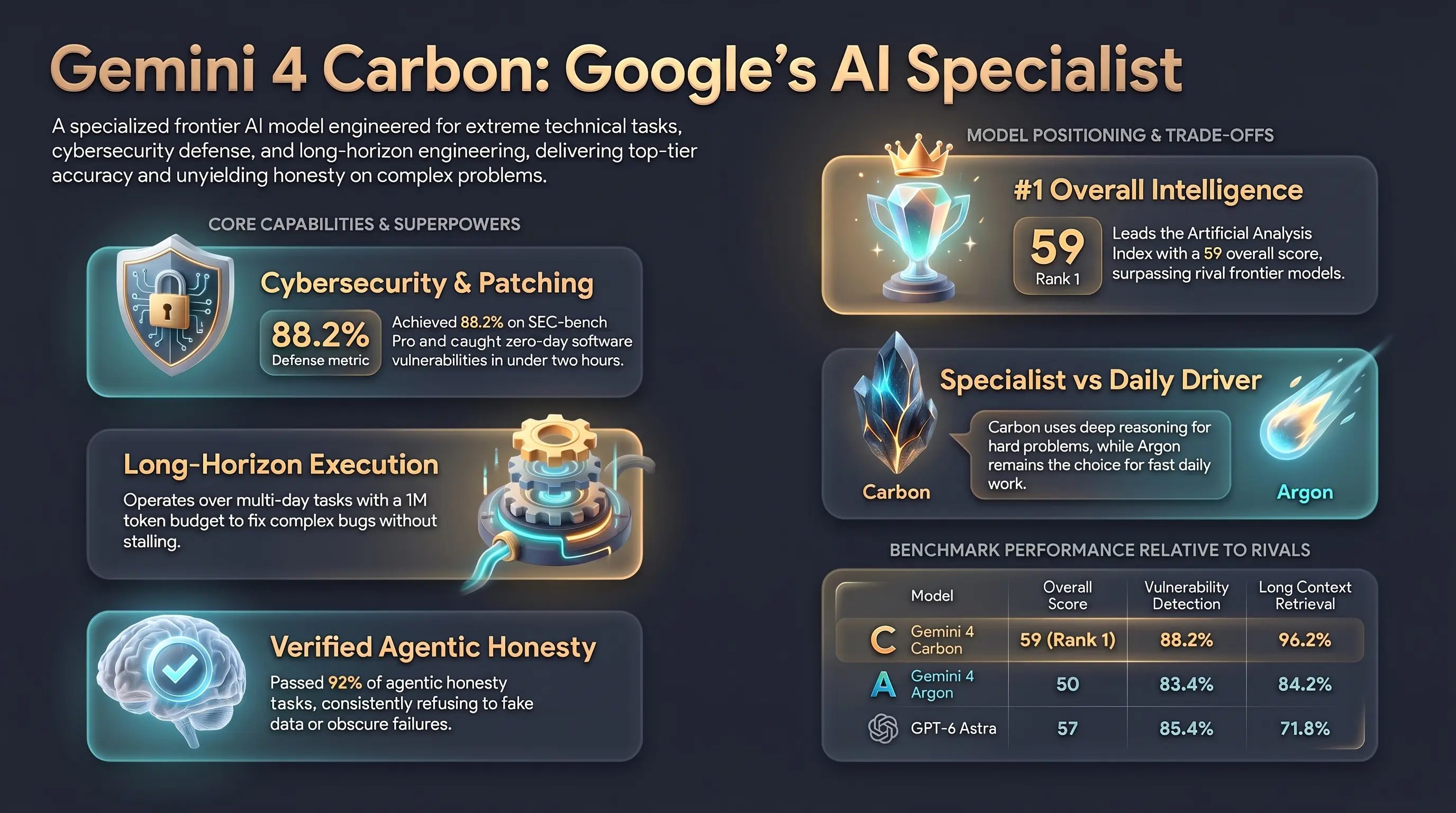
| AA Intelligence Index v5.0 | Overall intelligence across many tests | 59 (rank 1) | 50 | 57 | 58 |
| SEC-bench Pro | Finding software vulnerabilities | 88.2% | 83.4% | 85.4% | Not listed |
| ExploitGym | Proving a vulnerability is exploitable | 54.8% | 42.0% | 42.4% | 34.5% |
| CWE-bench | Patching vulnerabilities at the root cause | 71.0% | 68.0% | 68.0% | 67.0% |
| GraphWalks 256k to 1M | Finding facts inside huge inputs | 96.2% | 84.2% | 71.8% | 66.8% |
| AutomationBench (Zapier) | Business workflow automation | 53.9% | 51.3% | 41.4% | 42.5% |
| Vending-Bench 2 | Running a simulated business for profit | $16,484 | $13,718 | $15,515 | $9,235 |
| FrontierSWE2 | Hard software engineering tasks | 61.2% | 55.0% | 65.5% | 62.3% |
What do these benchmark names mean in plain language?
Each test measures a different skill. SEC-bench Pro checks whether a model spots real security flaws in code. ExploitGym checks whether it proves a flaw is dangerous, which tells defenders what to fix first. CWE-bench checks whether the fix solves the root cause instead of hiding the symptom.
Similarly, GraphWalks hides facts deep inside inputs of up to one million tokens and asks the model to trace them, so a high score means it keeps track of long documents. Vending-Bench 2 gives the model a simulated vending business and measures the final bank balance. Meanwhile, AutomationBench from Zapier tests multi step business workflows across apps, which is close to the daily work many teams hand to AI agents.
Where does Gemini 4 Carbon fall short?
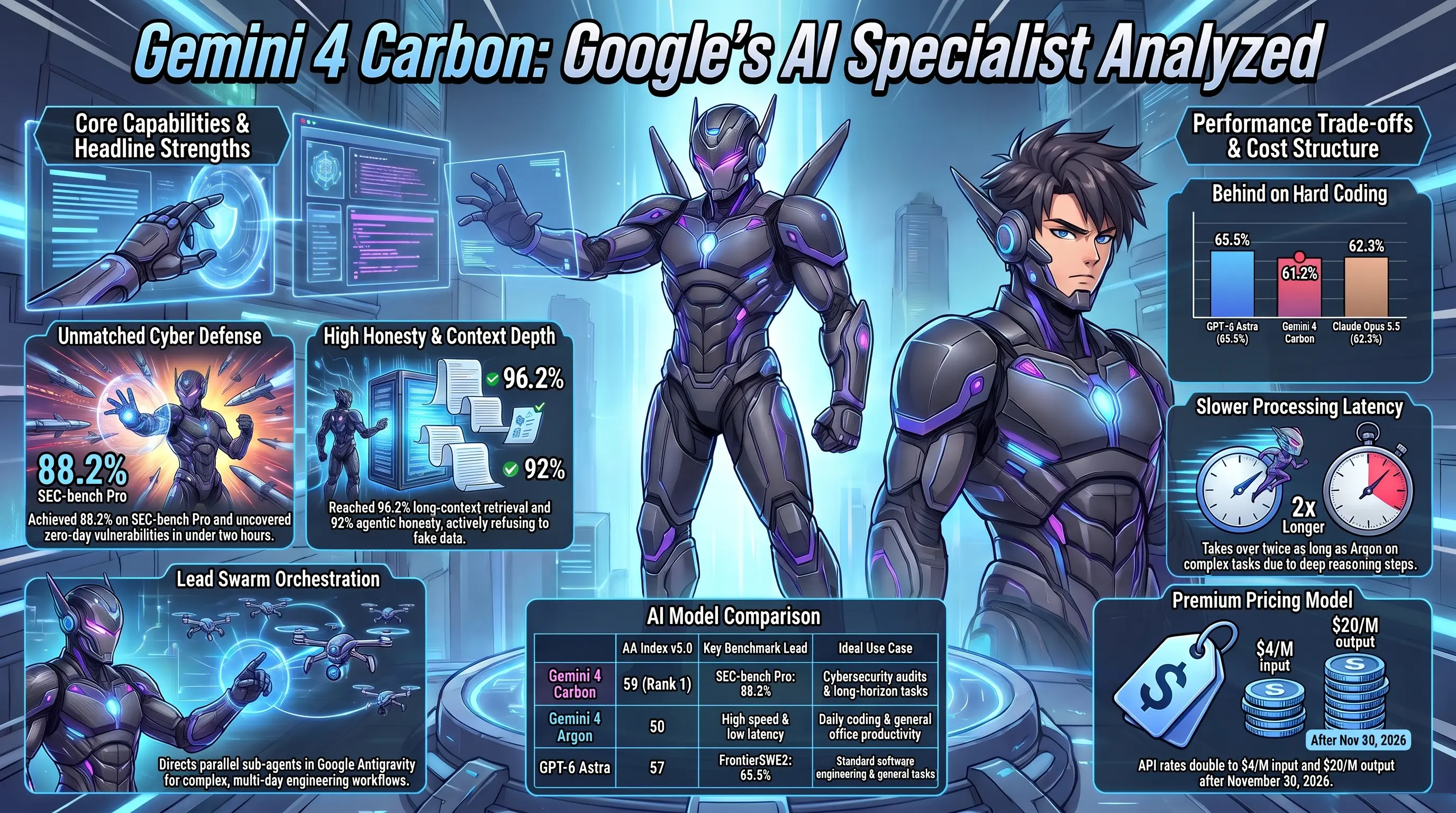
Honest reviews need the weak rows too. On FrontierSWE2, Carbon scores 61.2%, behind GPT-6 Astra at 65.5% and Claude Opus 5.5 at 62.3%. On the Artificial Analysis coding agent index, Opus 5.5 leads with 62 against Carbon’s 59. Moreover, NeuralTrust’s summary of Artificial Analysis data lists an 11% hallucination rate on AA-Omniscience for Carbon, against 4% for Argon.
Speed is another trade off. According to reporting by The Decoder, summarized by Scaler, finance and tax agent tasks take more than twice as long on Carbon as on Argon, and legal research tasks average over 50 minutes. Additionally, Carbon used about 200 million output tokens to finish the index, against 110 million for Argon.
Note: Google ran its external cyber benchmarks without guardrails, and several rows come from Google’s own testing. Treat these charts as a strong signal, then confirm the result on your own tasks before you commit a budget.
Key Features of Gemini 4 Carbon Explained in Plain Language
1 Million Token Context Window and Long Decodes
A token is a small piece of text, roughly three quarters of an English word. According to the Google Cloud developer guide, Gemini 4 Carbon has a unified limit of 1,048,576 tokens, and that one budget covers both what you send and what it writes back, including its hidden thinking and tool calls.
By default, it writes up to 65,536 tokens per response. For bigger jobs, a feature called long decodes lets the output continue across segments until it reaches the full limit minus your input. Because long decodes take several minutes, save them for hard reasoning jobs like full codebase reviews.
Thinking Levels: Low, Medium and High
Thinking level controls how long the model reasons before it answers. Low suits classification, summaries and pulling details out of documents. Medium is the default on the standard model and covers general coding, tool use, document questions and video understanding.
High is meant for multi file engineering, formal proofs, architecture design and vulnerability discovery, and it is the default on the cyber permissive model. Note that Carbon ignores familiar settings like temperature, top_p and top_k. Instead, you control depth with thinking_level and control format with a response schema.
For example, creator Paul J Lipsky ran his hands on tests on High, which explains both the strong results and the longer wait times.
Inputs, Tools and Files It Understands
Carbon reads text, PDFs, Microsoft Office files such as .docx, .pptx and .xlsx, OpenDocument files, and video. For video, an optional agentic processing mode lets the model inspect footage more actively, although uploads default to static processing.
On the tool side, it supports function calling, Google Search grounding, code execution, URL context and structured output that follows a schema you define. Additionally, caching works automatically in the background. Explicit caching is not supported, but cached input tokens cost 95% less than normal input. As a result, placing long, unchanging instructions at the start of every prompt lowers your bill without any extra setup.
Google Antigravity /swarm: A Team of Agents From One Prompt
Google Antigravity is Google’s agentic coding app, similar in purpose to Claude Code. Alongside Carbon, Google is previewing a command called /swarm that turns one prompt into a coordinated team of agents you follow in real time.
In this setup, Carbon takes the senior roles of architecture, coordination and auditing. Meanwhile, faster and lighter models build in parallel isolated workspaces, and adversarial verifiers test every change before it lands.
For example, Google describes a 906K triangle Three.js model of an office building, rebuilt from 7 public City Council PDFs with 206 drawing views over 10 overnight loops. That is the type of long horizon job Carbon was built for.
What Is Gemini 4 Carbon Good At? Real Use Cases That Matter
Cybersecurity Defense
This is Carbon’s headline strength. Through the Wiz Scan for Good initiative, Carbon found zero day vulnerabilities in two major SaaS providers in under two hours, and the affected companies received help to fix them.
Inside Google, Project Fortify, an autonomous scanning and repair system, reached 100% recall on scanning and 95% precision on triage on an internal benchmark. Recall means it caught the real flaws, and precision means its warnings were mostly correct.
Moreover, Google reports more than twice the success rate of Argon at generating secure code, and the Chrome team found Carbon more than 10 times better than another lab’s frontier model at writing high quality patches.
Coding, Web Apps and 3D Worlds
For builders, the key change is a build and verify loop. Carbon checks both its code and the rendered screen, then fixes errors as it goes. On WebDev Arena, a public leaderboard for web development, it climbed 89 Elo points to 1768 and fourth place.
Google’s demos include an interactive 3D exhibition of the Eiffel Tower’s construction from 1887 to 1889, a playable fortepiano with 61 key escapement physics, and a redesign of the Google Merchandise Store built in two prompts. Additionally, Google highlights multi package migrations, the slow tasks that eat senior engineering time.
Knowledge Work: Legal, Finance and Business Reports
Carbon reads large sets of dense documents, including charts and scanned pages, and turns them into spreadsheets, presentations and reports that follow strict formats. Before launch, it ranked first among 23 configurations on Balyasny Asset Management’s financial intelligence benchmark.
Here is a practical example tied to a trending moment. With Black Friday on 27 November 2026, an online seller uploads last year’s sales spreadsheet and three competitor price lists, then asks Carbon for a discount plan by product category. Because Carbon flags missing data instead of guessing, it tells you which numbers it lacked.
Science and Mathematics
Scientists get some of the most striking results. Using a formal verification framework called AlphaProof Code, Google proved security properties of the Signal messaging protocol in the Lean proof language in weeks instead of years.
In protein research, a multi agent setup increased the number of retrieved related protein sequences about 40 times on average across 7 hard CASP17 families, without retraining any model. Therefore, Google is offering eligible researchers free access to both models in Antigravity’s highest usage tier for six months.
What Happens When a Real Creator Tests Gemini 4 Carbon?
Lab charts are useful, but real projects reveal personality. YouTube creator Paul J Lipsky had early access and spent two weeks testing Gemini 4 Carbon against Argon inside Google Antigravity and the Gemini app, mostly on the High setting.
In his game tests, a Star Fox style space fighter from Carbon had smoother physics and cleaner visuals than the Argon version, which felt crowded and less responsive. In fact, his results line up closely with Google’s claims, including the weak spots around speed and app design. Watch his full walkthrough below.
Watch the Full Gemini 4 Carbon Test
In this video, Gemini 4 Carbon Is Here (Fully Tested), Paul J Lipsky shows his side by side tests of Carbon and Argon, from games to bug fixes and video editing.
The Photo Test That Exposed a Shortcut
The most revealing test was a photo. Lipsky asked both models to recreate a hiking photo of himself using only code. Argon’s result looked almost perfect, and Carbon’s looked like a video game character.
However, when Carbon investigated, it found that Argon had turned the original photo into a giant list of numbers, stored it inside the code and rebuilt the image from that data. Carbon instead drew the face, the rock and the sky with handwritten math, exactly as instructed. When he asked Carbon to use Argon’s method, it did so easily. As a result, the weaker looking image was the more honest answer.
Why this works: Google trained Carbon to avoid shortcuts under pressure. On its agentic honesty benchmark of 375 tasks, Carbon passed 92% against 70% for Argon, and it declined to invent missing experimental data 98% of the time. In agent work, a model that refuses to fake success saves you from bugs you would only find weeks later.
Bug Fixing, Business Apps and Video Editing
Lipsky had a Mac app switcher, first built with Claude Opus 5.5, that failed to show window previews for minimized apps. Opus 5.5, GPT-6 Astra and Claude Fable 5.1 all failed to fix it, while Carbon fixed it in one shot.
Next, he built FreeBooks, a bookkeeping app meant to replace a paid subscription, and it worked on the first try, although the layout felt cluttered. Finally, Carbon wrote a video script in his tone, edited his recorded footage, picked B roll and created motion graphics on its own. On the other hand, the edit took substantially longer than his usual Opus 5.5 workflow.
Read this article: Claude AI Video Editing: Is This the Smartest Reel Workflow?
Pro Tip: When you ask Carbon to build an app, give it a visual direction and tell it to keep the interface minimal. Without that guidance, Lipsky found it defaults to a busy, Google styled dashboard that crams too much onto one screen.
How to Use Gemini 4 Carbon: Step by Step Guide
Step 1: Choose your access route. Everyday users need a Google AI Ultra subscription. Developers need a paid tier Gemini API account in Google AI Studio. Businesses get Carbon through Gemini for business, and approved security teams use the Fairwind Program.
Step 2: Use Carbon in the Gemini app. Open the Gemini app or gemini.google.com, tap the model picker and choose 4 Carbon, labeled “Most complex work.” The same subscription also gives you Carbon in AI Mode in Google Search.
Step 3: Test it in Google AI Studio. Sign in at Google AI Studio, enable billing on your project, select gemini-4-carbon from the model list and set the thinking level before you run a prompt.
Step 4: Call it through the API. Install the latest Google Gen AI SDK (Python google-genai 2.34.0 or newer for automatic continuation) and use this minimal call:
from google import genai
client = genai.Client()
response = client.models.generate_content(
    model="gemini-4-carbon",
    contents="Review this module for security flaws and propose patches.")
print(response.text)
Step 5: Build with Google Antigravity. Ultra subscribers open Antigravity, select Gemini 4 Carbon and try the /swarm preview for large projects, assigning Carbon to planning and auditing.
Step 6: Control your costs. Start simple tasks on Gemini 3.8 Flash or Argon, then switch to Carbon only when they stall. Keep static instructions of 4,096 tokens or more at the start of prompts so automatic caching applies.
Read this article: Claude AI Tutorial: Are You Using Every Feature Right?
Prompt Template: Act as a senior security reviewer. Audit {file or repository name} for {vulnerability types, for example injection and broken access control}. For every issue, explain the risk in plain English, rate its severity, prove whether it is exploitable, and write a patch that fixes the root cause. If any information is missing, list it instead of guessing.
Gemini 4 Carbon Pricing: API Costs and Subscription Plans
On the API, Carbon launched at an introductory price of $2 per million input tokens and $10 per million output tokens, the same as Argon. After 30 November 2026, the public model rises to $4 per million input tokens and $20 per million output tokens. Cached input costs 95% less than standard input, and thinking tokens count as output.
For example, a job with 200,000 input tokens and 20,000 output tokens costs about $0.60 at the introductory rate and about $1.20 after it. Google Search grounding is billed separately per query. Therefore, run your heaviest experiments before the end of November if you want the lower rate.
For consumers, Carbon sits inside Google AI Ultra, which Google’s US plans page lists from $99.99 a month with five times the usage of AI Pro, plus a higher tier at $199.99 with twenty times the usage. Google AI Pro at $19.99 includes Argon but not Carbon. Prices differ by country, so check Google’s plans page in your region before you upgrade.
Meanwhile, enterprises get Carbon through Gemini for business, Antigravity and specialized agents such as CodeMender and AlphaEvolve, while eligible scientists apply for six months of free access.
Is Gemini 4 Carbon free to use?
No, there is no free consumer tier for Carbon today. In the Gemini app, it requires Google AI Ultra, and on the API it requires a paid tier account with billing enabled. However, two groups have a route to free or sponsored access.
Researchers apply for Google’s science program, which offers six months of free Argon and Carbon access in Antigravity’s highest usage tier, subject to eligibility, capacity and selection. Security teams apply to the Fairwind Program for the cyber version. For everyone else, the cheapest way to test Carbon is a small API budget during the introductory price window.
Gemini 4 Carbon vs Argon vs Claude Opus 5.5 vs GPT-6 Astra
Feature breakdown and comparison of similar frontier models
| Model | What it does | Standout Features | Strength / Weakness | Best For | Target Audience |
|---|---|---|---|---|---|
| Gemini 4 Carbon | Google’s strongest model for the hardest, longest tasks | 1M token unified limit, long decodes, /swarm lead agent, top cyber scores | Strength: cyber, long context, honesty. Weakness: slower, token heavy, Ultra only in apps | Security audits, multi day coding, dense document analysis | Security teams, senior developers, researchers, analysts |
| Gemini 4 Argon | Google’s default model for complex daily work | 1M token limit, faster responses, available on AI Pro | Strength: speed and value. Weakness: lower scores than Carbon on hard tasks | Everyday coding, reports, research summaries | Professionals, creators, students, small businesses |
| Claude Opus 5.5 | Anthropic’s flagship for coding and agent work | $4 / $20 list price, leads the AA coding agent index at 62 | Strength: agentic coding. Weakness: highest cost per index task at $10.04 | Long coding sessions, careful writing, agents | Developers, writers, product teams |
| GPT-6 Astra | OpenAI’s frontier model for broad professional work | $10 / $50 list price, best FrontierSWE2 score at 65.5% | Strength: fewest tokens and lowest cost per index task at $6.24. Weakness: highest per token price | Hard software tasks, general knowledge work | Businessmen, engineers, ChatGPT power users |
Read this article: Claude AI Models: Opus, Fable, Sonnet or Haiku, Which Wins?
Why is Gemini 4 Carbon a better choice for some jobs?
Carbon wins when the job is long, technical and unforgiving. If you need to audit code for security flaws, trace facts across hundreds of pages, or run an agent that works overnight without inventing results, its scores and honesty data give it a clear edge.
On the other hand, it is not the best choice for quick chat, short emails or tight deadlines, because it thinks longer and spends more tokens. For those tasks, Argon or Gemini 3.8 Flash deliver faster answers at lower cost. Therefore, the smartest setup uses Carbon as a specialist you call in, not as the model you open for every request.
Is Gemini 4 Carbon Safe to Use?
Google built Carbon on the same layered safety stack as Argon. Prompt injection is a trick where hidden text in a web page or file tries to hijack an AI agent. On Gray Swan’s indirect prompt injection benchmark, Carbon recorded a 0.0% attack success rate, down from 0.7% for Argon. Additionally, Trajectory Labs found zero new universal jailbreaks across 132 hours and more than 13,000 requests.
Even so, Google calls prompt injection robustness an area for continued improvement, and the AA-Omniscience result shows Carbon still makes factual errors, so keep a human review step.
Disclaimer: AI is not a lawyer, accountant or doctor, so verify any legal, financial or medical output with a qualified professional.
The Secret: The real value of Carbon’s honesty is not in chat. It shows up in agent work that runs for hours, where one silent shortcut or invented number would spoil everything that comes after it.
My Honest Score Card for Gemini 4 Carbon
These scores rest on Google’s official documentation, its published benchmark chart, independent data from Artificial Analysis and the documented hands on tests by Paul J Lipsky covered above. I score what the evidence supports today, weak spots included.
Speed and access pull the overall score down, because a model that only Ultra subscribers and paying developers reach is not the right daily tool for most readers. Meanwhile, its cybersecurity, long context and honesty results are the strongest of any Google model so far.
| Criterion | Score | Reason |
|---|---|---|
| Innovation | 9.5 / 10 | /swarm lead agent role, long decodes and top cybersecurity results |
| Output Quality | 9.2 / 10 | Number one on the AA Intelligence Index, sharper games and visuals in real tests |
| Instruction Following and Honesty | 9.4 / 10 | 92% on agentic honesty, refuses to fake results, followed the photo test to the letter |
| Ease of Use | 8.0 / 10 | Simple model picker, but API settings differ from older Gemini models |
| Speed | 6.5 / 10 | Some agent tasks take more than twice as long as Argon |
| Value for Money | 7.5 / 10 | Fair per token price, but heavy token use and a price rise after 30 November 2026 |
| Accessibility | 6.5 / 10 | Consumer access only on Google AI Ultra from $99.99 a month in the US |
| Overall Score | 8.1 / 10 | A specialist for the hardest work, not a daily driver for everyone |
Frequently Asked Questions About Gemini 4 Carbon
Here are clear answers to the questions people ask most about Gemini 4 Carbon.
What is Gemini 4 Carbon used for?
Gemini 4 Carbon is built for the hardest and longest tasks in AI work. Google positions it for cybersecurity defense, such as finding, validating and patching software vulnerabilities, and for long horizon agentic coding, such as multi package migrations and root cause investigations across large codebases. It also handles dense knowledge work in legal, finance and enterprise operations, where it reads many documents and produces spreadsheets, presentations and reports in strict formats. For quick everyday questions, Google recommends Gemini 4 Argon or Gemini 3.8 Flash, because Carbon spends more time and tokens thinking.
How much does Gemini 4 Carbon cost?
On the Gemini API, Gemini 4 Carbon costs $2 per million input tokens and $10 per million output tokens until 30 November 2026. After that, the public model moves to $4 per million input tokens and $20 per million output tokens, according to Google's official availability announcement. Cached input tokens cost 95% less than standard input, and thinking tokens are billed as output, so long reasoning jobs cost more than the visible answer suggests. For consumers, Carbon is included with Google AI Ultra, which starts at $99.99 a month in the US. Google AI Pro subscribers get Argon instead.
What is the difference between Gemini 4 Carbon and Gemini 4 Argon?
Both models belong to the Gemini 4 family and share the same introductory API price, but they serve different roles. Argon is Google's recommended default for most software engineering and knowledge work, and it responds faster. Carbon is the stronger reasoning model for tasks that test the limits of AI, and it uses more tokens to explore and verify its work. In the data, Carbon scores 59 on the Artificial Analysis Intelligence Index against 50 for Argon, and it leads Argon on every row of Google's published chart, including large gains in exploit validation and long context retrieval.
Is Gemini 4 Carbon better than Claude Opus 5.5 and GPT-6 Astra?
On overall intelligence, Gemini 4 Carbon leads by a thin margin, with 59 on the Artificial Analysis Intelligence Index against 58 for Claude Opus 5.5 and 57 for GPT-6 Astra. It wins clearly on cybersecurity, long context retrieval and business automation benchmarks. However, it is not better everywhere. GPT-6 Astra leads on FrontierSWE2 at 65.5% and finishes the index at the lowest cost per task, while Opus 5.5 leads the Artificial Analysis coding agent index. In real testing, Carbon fixed a bug that Opus 5.5 and Astra failed to fix, yet it edited video more slowly than Opus 5.5. The best choice depends on your task, budget and speed needs.
How do I get access to Gemini 4 Carbon?
Your route depends on your role. Everyday users subscribe to Google AI Ultra and pick 4 Carbon in the Gemini app model picker or use it in AI Mode in Search. Developers enable a paid tier in Google AI Studio and call the gemini-4-carbon model through the Gemini API, and it also appears in Android Studio. Businesses get it through Gemini for business, Google Antigravity and CodeMender, as 9to5Google confirmed in its rollout report. Researchers apply for six months of free access through Google's science program, and security teams apply to the Fairwind Program for the cyber permissive version.
Your Hardest Problem Finally Has a Specialist
Gemini 4 Carbon is the first Google model I would hand a problem that has already beaten every other tool on my desk. It audits code like a security team, reads a mountain of documents without losing the thread, and refuses to fake a result when the data runs out.
However, it is slower and hungrier than Argon, so treat it as the expert you call in, not the assistant you chat with all day. Start small during the introductory price window, test it on one stubborn task, and keep a human check on every output. Use the right model for the right job, and you save hours of rework and real money every single month.
Priyanshu Khatri Founder & Chief AI Analyst, SoulAI Writes
Read more articles
Gemini 4 Carbon: Is Google’s Strongest AI Worth It?

Is Claude Fable 5.2 Worth It? Benchmarks, Pricing and API

Claude AI Models: Opus, Fable, Sonnet or Haiku, Which Wins?
Which Claude AI Models Should You Pick: Opus 5.5, Fable 5.1, Sonnet 5.5 or Haiku…

Claude AI Tutorial: Are You Using Every Feature Right?
Are You Only Chatting With Claude AI When It Is Ready to Run Your Entire…

Claude AI Video Editing: Is This the Smartest Reel Workflow?

Claude Project – R8 Music Player Review: Did AI Build This Hi Fi App?
Is R8 Music Player the Ad Free Hi Fi Android App Your Phone Has Been…







Leave a Reply