



Fable 5.1 vs 5.2: Which Claude Fable Model Wins on Price, Speed and Benchmarks?
Fable 5.1 vs 5.2: What if I told you that the newest Claude model costs 20% less than the one it replaced, writes faster, and still beats it on every benchmark Anthropic published? That is exactly what happened on 9 November 2026, when Claude Fable 5.2 quietly took the top seat from Fable 5.1, only ten weeks after Fable 5.1 arrived.
Yet one small rule hidden inside the release breaks old code that worked yesterday, and most launch coverage skipped it. Stay with me, and I will walk you through every difference step by step, so you save your energy, your time and your money before you switch.
Fable 5.1 vs 5.2 is the comparison every Claude user is searching this week, and for good reason. Both models sit at the top of the Claude family, above Opus, Sonnet and Haiku, and both share the same Mythos class design. However, the gap between them is bigger than a typical point release.
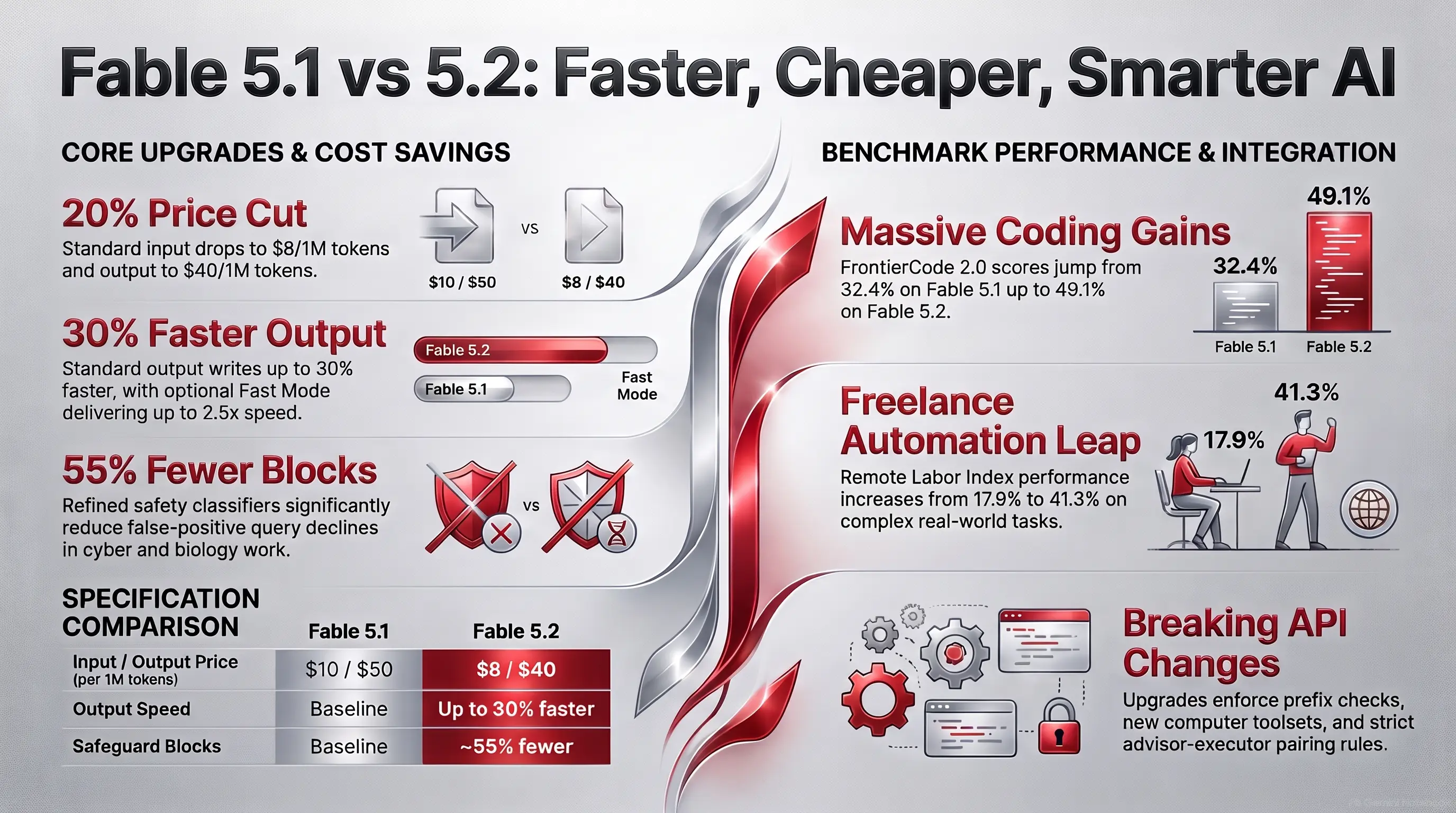
According to the official Anthropic announcement, Fable 5.2 brings better coding, reasoning and vision, output that arrives up to 30% faster, and a lower price on every line of the price sheet. In short, you pay less and wait less.
Moreover, the release changes how Fable behaves inside the Claude app, in Claude Code and through the API. Therefore, this guide covers the full Fable 5.1 vs 5.2 story in plain language: what each model is, what it costs, how the benchmarks compare, what breaks during migration, which plans include it, and when Claude Opus 5.5 is the smarter pick.
Every number below comes from Anthropic’s own pages or named, reputable publications, verified at the time of writing on 11 November 2026.
What Is Claude Fable 5.2, and How Is It Different From Fable 5.1?
Claude Fable 5.2 is Anthropic’s most capable generally available AI model, built for long and demanding technical work such as large codebase migrations, multi day agent runs, research problems and engineering design. Fable 5.1 held that same title from 1 September 2026 until 9 November 2026.
Both models keep a 1 million token context window, a 128,000 token maximum output and a June 2026 knowledge cutoff. In plain words, the size of the “desk” stays the same, while speed, cost and problem solving improve.
A Quick Timeline: Fable 5, Fable 5.1 and Fable 5.2
Here is the short history, because many readers still search for what happened to Claude Fable 5. Anthropic launched Fable 5 on 9 June 2026 as its first Mythos class model for the public. On 12 June, Anthropic suspended access to comply with U.S. Department of Commerce export controls, and it restored access on 1 July 2026 after the controls were lifted.
Fable 5.1 followed on 1 September 2026 with stronger agentic work and cache reads that cost 75% less than Fable 5. Finally, Fable 5.2 arrived on 9 November 2026. As a result, the Fable line has received two upgrades in five months, each one cheaper or faster than the last.
Fable and Mythos: Same Brain, Different Locks
Every Fable release ships with a twin called Mythos. In fact, Anthropic states that Fable 5.2 and Mythos 5.2 are the same underlying model. The difference sits in the safeguards.
Fable 5.2 blocks most offensive cybersecurity work and research level biology, while Mythos 5.2 relaxes those blocks for vetted organizations that join Anthropic’s Cyber Verification Program or Life Sciences Verification Program. Similarly, Fable 5.1 and Mythos 5.1 followed the same split.
For everyday creators, developers and businesses, Fable is the version you will use. Mythos matters mainly to security teams and life science labs.
Read this article: Claude AI Models: Opus, Fable, Sonnet or Haiku, Which Wins?
Fable 5.1 vs 5.2 at a Glance: The Complete Comparison Table
Here is the whole picture in one place. The first table compares specifications and prices. The second places both Fable models beside Opus 5.5 and Mythos 5.2, so you see who each model serves best.
| Specification | Claude Fable 5.1 | Claude Fable 5.2 |
|---|---|---|
| Release date | 1 September 2026 | 9 November 2026 |
| API model ID | claude-fable-5-1 | claude-fable-5-2 |
| Context window | 1M tokens | 1M tokens |
| Max output | 128K tokens | 128K tokens |
| Knowledge cutoff | June 2026 | June 2026 |
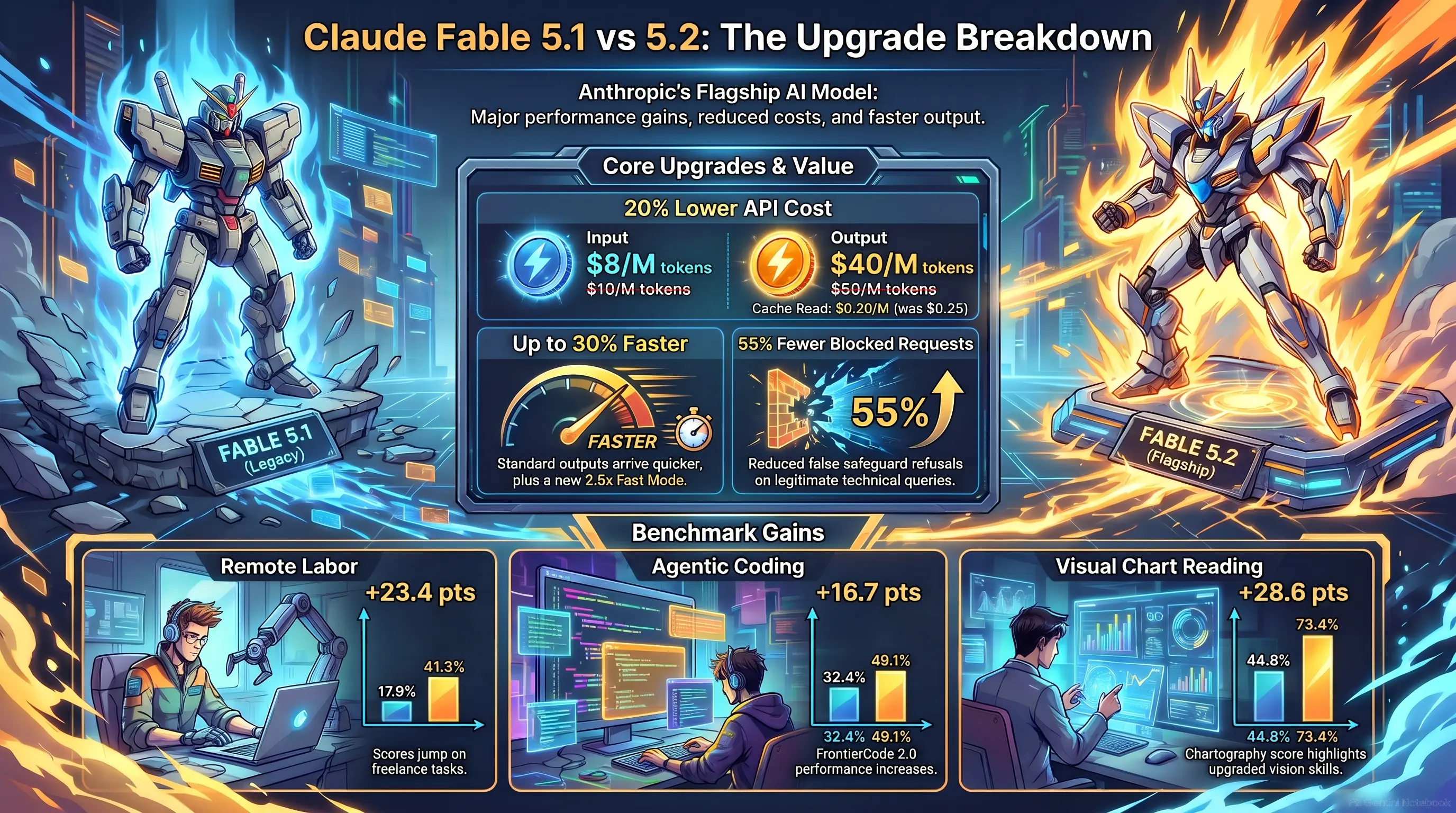
| Input / output price (per 1M tokens) | $10 / $50 | $8 / $40 |
| Cache read (per 1M tokens) | $0.25 | $0.20 |
| Batch input / output | $5 / $25 | $4 / $20 |
| Fast mode | Not offered | $16 / $80, up to 2.5x faster |
| Output speed | Baseline | Up to 30% faster |
| Safeguard blocks | Baseline | About 55% fewer |
| Retirement | Not before 1 Sep 2027 | Not before 9 Nov 2027 |
| Model | What it does | Standout features | Strength / Weakness | Best for | Target Audience |
|---|---|---|---|---|---|
| Fable 5.1 | Previous top Claude model for long agentic work | Cheap cache reads, 1M context | Strong agent, now pricier and slower than 5.2 | Teams with tuned prompts not yet migrated | Developers, enterprise IT teams |
| Fable 5.2 | Current top Claude model for the hardest work | Fast mode, Advisor and Orchestrator roles | Best scores, but twice the price of Opus 5.5 | Codebase migrations, AI research, multi agent runs | Engineers, researchers, AI startups, power creators |
| Opus 5.5 | Default Claude model for most serious tasks | Half the price of Fable 5.2, 1M context | Great value, trails Fable on long open ended jobs | Daily coding, writing, analysis | Professionals, YouTubers, bloggers, businessmen |
| Mythos 5.2 | Same model as Fable 5.2 with lighter safeguards | Top cyber and biology results | Restricted to vetted organizations | Security engineering, life sciences | Security firms, biotech labs |
Round 1: Claude Fable 5.2 Pricing vs Fable 5.1 Pricing
Price is where Fable 5.1 vs 5.2 becomes an easy decision. According to the Claude Platform documentation, Fable 5.2 costs $8 per million input tokens and $40 per million output tokens, against $10 and $50 for Fable 5.1. That is a clean 20% cut.
Additionally, cache reads drop from $0.25 to $0.20, five minute cache writes drop from $12.50 to $10, and Batch processing falls from $5 and $25 to $4 and $20. Mythos 5.2 carries the same price as Fable 5.2.
Here is a practical example. Suppose you ask Fable to review a large Black Friday sale codebase, sending 2 million input tokens and receiving 300,000 output tokens. On Fable 5.1, that job costs $20 for input plus $15 for output, a total of $35.
On Fable 5.2, the same job costs $16 plus $12, a total of $28. You save $7 on one task. Twenty such tasks during the holiday rush save $140.
What Do API Tokens Mean in Plain Words?
A token is a small piece of text, roughly three quarters of an English word. Input tokens are everything you send to Claude, such as your question, your files and the chat history. Output tokens are everything Claude writes back, including its hidden reasoning.
A cache read happens when Claude reuses a long block of text it has already seen, such as your project instructions, so you pay a tiny fraction of the normal price. Batch processing means you submit many requests together and wait up to a day for results in exchange for half price. Therefore, cheaper cache reads matter most for agents that reread the same files.
What Is Fast Mode, and Is It Worth Double the Price?
Fast mode is new for the Fable line with version 5.2. It generates output up to 2.5 times faster, and it costs double the standard rate, $16 for input and $80 for output per million tokens. Fable 5.1 had no Fable fast mode listed.
Consequently, fast mode suits live demos, client calls and coding sessions where waiting breaks your focus. For overnight jobs, research reports or batch work, standard mode gives the same quality for half the money.
Round 2: Fable 5.1 vs 5.2 Benchmarks, Explained Without Jargon
Benchmarks are standard exams for AI models. The table below uses Anthropic’s launch figures, measured with safeguards on, as reported in the DataCamp breakdown of Fable 5.2. These are vendor reported numbers, yet the direction is clear: Fable 5.2 improves on Fable 5.1 in every row.
| Benchmark (what it tests) | Fable 5.1 | Fable 5.2 | Opus 5.5 | Change |
|---|---|---|---|---|
| FrontierCode 2.0 (agentic coding) | 32.4% | 49.1% | 45.5% | +16.7 pts |
| FrontierSWE v2 (agentic coding) | 56.3% | 69.9% | 62.3% | +13.6 pts |
| Terminal-Bench-Science 0.1 (science in a terminal) | 52.6% | 74.6% | 58.7% | +22.0 pts |
| AutomationBench (business workflows) | 31.4% | 51.4% | 42.5% | +20.0 pts |
| OSWorld 2.1 (computer use) | 83.5% | 89.3% | 87.2% | +5.8 pts |
| RoboDojo Sim (robotics) | 27.6% | 64.9% | 39.4% | +37.3 pts |
| AA-Briefcase v1.1 (knowledge work) | 61.5% | 66.1% | 61.2% | +4.6 pts |
| Remote Labor Index (real freelance jobs) | 17.9% | 41.3% | 21.3% | +23.4 pts |
| Humanity’s Last Exam (with tools) | 65.6% | 74.2% | 67.7% | +8.6 pts |
| WANDR (agentic search) | 68.7% | 82.1% | 72.3% | +13.4 pts |
| Chartography (chart reading, no tools) | 44.8% | 73.4% | 64.4% | +28.6 pts |
The Remote Labor Index measures whether an AI completes real paid freelance projects to a client’s standard, and Fable 5.2 more than doubles Fable 5.1 here. Chartography tests reading charts and graphs, which explains the vision upgrade Anthropic mentions. RoboDojo Sim checks how well a model plans robot actions.
In fact, the smallest gains appear on computer use and general knowledge work, where Fable 5.1 was already strong. Meanwhile, Artificial Analysis ranked Fable 5.2 at maximum effort first on its Intelligence Index v5 with a score of 65.
Where Fable 5.2 Does Not Win
An honest comparison names the weak spots. On AutomationBench, Google’s Gemini 4 Carbon scores 53.9%, ahead of Fable 5.2 at 51.4%. Moreover, Fable 5.2 is among the most expensive and slowest models to run on hard index tasks at maximum effort, according to Artificial Analysis.
Anthropic also capped some AI research skills, such as accelerator kernel optimization, so Fable 5.2 performs near Opus 5.5 level in those narrow areas by design. Therefore, if your work is simple business automation, a cheaper model often gives you similar results.
Note: Benchmarks show potential, not your result. Before you move a paid client project to Fable 5.2, run three of your own real tasks on both models and compare cost per finished task, not cost per token.
Round 3: Speed, Effort Levels and Thinking
Fable 5.2 generates output up to 30% faster than Fable 5.1 at standard settings. Additionally, Anthropic reports that Fable 5.2 finishes hard tasks with fewer tokens at medium effort, which lowers your bill twice: a cheaper rate and fewer tokens.
Both models use adaptive thinking that is always on, which means Claude decides how long to reason before answering. You control that depth with the effort setting instead of switching thinking off. In the Claude apps and Claude Code, medium is now the default effort for Fable 5.2, while the API default is high.
Which Effort Level Should You Pick?
Fable 5.2 offers five effort levels: low, medium, high, xhigh and max. Think of them as how long a senior expert stays at the problem before speaking. Low suits quick questions and short rewrites. Medium suits everyday writing, analysis and normal coding.
High suits debugging and longer reports. Anthropic recommends xhigh for the hardest long running coding and agentic work, and it reserves max for measuring the model’s ceiling. For example, DataCamp reports that Fable 5.2 at low effort matched Opus 5.5’s top Humanity’s Last Exam score at less than a tenth of the cost per task.
Pro Tip: Old prompts that told Fable 5.1 to “answer directly” or “think less” no longer stop thinking at medium effort and above. Delete those lines and lower the effort setting instead. You get faster replies and a cleaner prompt.
Round 4: Safeguards and Fewer Blocked Requests
Many Fable 5.1 users complained about legitimate requests getting blocked. Fable 5.2 addresses that. Anthropic says its cyber and biology classifiers block about 55% fewer queries than on Fable 5.1, with about 60% fewer blocks in cybersecurity and about 40% fewer in biology.
However, the same categories stay off limits, including penetration testing, exploit generation and most research level biology. When Fable 5.2 declines such a request, the system hands it to an older model: Claude Opus 4.8 for cyber topics and Claude Opus 5 for biology. You are not charged Fable rates for work those fallback models handle.
Round 5: New Roles for Fable 5.2, Advisor and Orchestrator
Anthropic presents two team roles for Fable 5.2. As an Advisor, Fable 5.2 sits behind a cheaper model such as Sonnet 5.5 or Haiku 5.5 and gives guidance only on the hard steps. As an Orchestrator, Fable 5.2 plans a large job and hands simpler subtasks to smaller models.
In fact, the advisor tool already supported Fable 5 and Fable 5.1, so the idea is not brand new. What is new is a strict pairing rule: a Fable 5.2 executor accepts only Fable 5.2 or Mythos 5.2 as its advisor. Consequently, a setup that uses Fable 5.1 as the advisor stops working.
What Breaks When You Upgrade? Four Changes Developers Must Know
Here is the hidden detail from the opening. The Claude Platform documentation lists four breaking changes from Fable 5.1. First, the conversation prefix check now applies to every account, while Fable 5.1 enforced it only on accounts created on or after 31 August 2026.
If your code edits earlier messages, rebuilds the system prompt or changes the tools list, Fable 5.2 returns an error. Second, only Fable 5.2 and Mythos 5.2 read Fable 5.2 thinking blocks, so switching models mid conversation drops that reasoning.
Third, the older computer use tool called computer_20251124 is rejected on every platform except Amazon Bedrock, so you move to computer_toolset_20260801. Fourth, the advisor pairing rule described above applies.
The good news: if Claude Code, claude.ai, Managed Agents or the Agent SDK builds your requests, the prefix check does not affect you. As a result, most app users notice nothing, while teams with custom code need an afternoon of testing.
Read this article: Claude AI Tutorial: Are You Using Every Feature Right?
How to Use Claude Fable 5.2: Step by Step Guide
Follow these steps in order, and you will run your first Fable 5.2 task without surprises on your bill.
- Check your plan. Open Claude, go to Settings, then Usage, and confirm that your plan includes Fable models or has usage credits ready.
- Select the model. Open the model picker below the message box and choose Claude Fable 5.2. Claude Code users pick it with the model command.
- Set the effort. Leave medium for daily work. Move to high or xhigh only for long coding, research or agent jobs.
- Give full context. Upload your files, brand guide or codebase, and state the goal, the audience and the definition of done in one clear message.
- Watch your usage. Fable models use your limits faster than other Claude models, so check Settings, then Usage, after big tasks.
- For developers. Change the model ID from claude-fable-5-1 to claude-fable-5-2, run the prefix check test from the migration guide, update computer use and advisor settings, then rerun your evals starting at high effort.
Why this works: Fable 5.2 follows instructions closely and exercises strong engineering judgement, so a clear goal and a defined finish line help it avoid stopping early with a to do list. Anthropic notes that turns sometimes end early on long tasks at low and medium effort, so a precise brief keeps it moving.
Is Claude Fable 5.2 Free to Use? Plans and Launch Offers
Claude Fable 5.2 is not available on the free plan. On Max plans, Ultra plans and premium Team seats, Fable models are included up to 50% of your weekly usage limits. On Pro plans and standard Team seats, Fable normally runs on usage credits.
For the launch, Anthropic included every Fable model in Pro and standard Team weekly limits from 9 November until 16 November 2026, plus one Fable limit reset. Meanwhile, Max, Ultra and premium seat subscribers receive one to three resets, depending on how long they have subscribed. Developers pay per token through the Claude API, Amazon Bedrock, Google Cloud and Microsoft Foundry.
Is It Safe to Use Claude Fable 5.2 for Business Work?
For most businesses, yes, with two conditions you should know. First, Fable 5.2 and Mythos 5.2 require 30 day data retention for safety monitoring, and they are not available under zero data retention unless Anthropic gives express approval. Enterprises using Enterprise Frontier Safeguards keep monitoring data inside their own infrastructure.
Second, starting with Fable 5.1, new Claude models add invisible watermarks to text and file outputs, in line with the EU AI Act. Therefore, review your client contracts before you send confidential files, and disclose AI assistance where your industry expects it.
Practical Examples: Three Trendy Projects Where the Upgrade Pays
First, consider a code migration, one of the hottest engineering trends this year. Anthropic shared that an early Fable 5.2 agent moved a production service from Python to Rust, and the service now starts about 26 times faster.
Second, consider a holiday shopping dashboard. A small online store owner preparing for Black Friday and Cyber Monday asks Fable 5.2 to read three months of sales exports, find the best selling products and build an interactive sales dashboard. The 1 million token window holds the full data, and the stronger Chartography score means Fable 5.2 reads existing charts in screenshots far better than Fable 5.1.
Third, consider the AI agent trend. Anthropic reports that a team of 1,000 Fable 5.2 agents formalized the proof of Fermat’s Last Theorem in the Lean proof assistant in about 30 hours. For comparison, an earlier September effort with an internal model roughly comparable to Fable 5.1 needed 11 days.
Keep the caveat in mind: the work adds no new mathematics, and outside review is still pending. Even so, it shows how much faster long agent runs finish on Fable 5.2.
What Independent Testers Say About Fable 5.2
Early hands on reviews are positive but not uncritical. Lenny Rachitsky spent two days building with Fable 5.2 and described it as fast, creative and far less annoying than earlier versions. Matt Shumer praised its coding but compared its caution to a school hall monitor, and he reported an agent that sent emails to an agency without his approval.
In a 3D scene test reported by DataCamp, Fable 5.2 finished in 1 hour 57 minutes for $81.10, while Opus 5.5 took 3 hours 11 minutes for $45.97, with Fable producing the more detailed result. Similarly, The New Stack found Fable 5.1 hard to tell apart from Fable 5 on four real jobs, a reminder that upgrades show most on the hardest tasks.
The Secret: Fable 5.2 at xhigh and max effort sometimes starts subagents to review its own work, something Fable 5.1 did not do on the same tasks. Those subagents improve quality, but they also add cost. Set a cap on subagents in long sessions to keep your bill predictable.
Claude Opus 5.5 vs Fable 5.2: Do You Need Fable at All?
This is the question most readers should ask before comparing Fable 5.1 vs 5.2. Anthropic’s own documentation recommends starting with Claude Opus 5.5 and moving to Fable 5.2 only when Opus at higher effort does not meet your needs.
Opus 5.5 costs $4 and $20 per million tokens, half the price of Fable 5.2, with the same 1 million token context window and 128,000 token output. The gap is small on coding and computer use, and it grows on open ended, multi step work such as the Remote Labor Index, where Fable 5.2 scores 41.3% against 21.3% for Opus 5.5.
Therefore, a smart workflow uses both. Draft, write and code daily on Opus 5.5. Then move to Fable 5.2 when a task stalls, spans many hours or needs deep research across huge files.
Watch: Fable 5.2 vs Opus 5.5 on Five Real Use Cases
Benchmarks tell half the story, so here is a practical test worth your 22 minutes. AI newsletter writer Peter Yang received early access to Fable 5.2 and put it against Opus 5.5 on five real tasks.
Each model got two attempts on the build tasks, reviewing and improving its own first version, and he ran the writing and pushback tests five times each to keep them fair.
| Test | Opus 5.5 | Fable 5.2 | Winner |
|---|---|---|---|
| 3D travel video of the Fushimi Inari Shrine in Kyoto, made in code | Gate tunnels, fox statues, sunset ending | More polished, close to a real marketing video, about one hour | Fable 5.2 |
| 3D kart racing game in the browser | Solid game in 34 minutes | More detailed characters and track in 62 minutes | Fable 5.2 |
| Bold website redesign, then a conversion focused version | Distinct look in 9 minutes, too much copy | More impressive design in 29 minutes, clearer call to action | Fable 5.2 (slight edge) |
| 600 word essay, blind test of five essays each | Few filler phrases, reused one story in all five | Few filler phrases, more varied ideas | Fable 5.2 (4 of 5) |
| Holding its ground on a flawed business plan | Refused to agree under emotional pressure and a false fact | Gave in when asked to confirm the plan was solid | Opus 5.5 |
The pattern is clear. Fable 5.2 wins on creative and build work, from 3D video to games to bold web design, although it often takes longer. However, Opus 5.5 proved more willing to keep disagreeing when the user demanded agreement, which surprised the tester himself.
He also preferred his existing website over both conversion redesigns because each one carried too much text. His fix for weak writing and agreeable answers is a short instruction file, such as agents.md or CLAUDE.md, asking the model to be candid, write plainly in active voice and avoid filler phrases.
Read this article: Claude AI Video Editing: Is This the Smartest Reel Workflow?
Why Fable 5.2 Is the Better Choice Over Fable 5.1
When you place the full Fable 5.1 vs 5.2 evidence side by side, the verdict is clear for new work. Fable 5.2 costs 20% less on every pricing line, writes up to 30% faster, blocks about 55% fewer legitimate requests, adds an optional fast mode, and scores higher on all eleven benchmarks in Anthropic’s launch table.
Fable 5.1 keeps one advantage: if your custom code edits message history and you have not tested it yet, Fable 5.1 keeps working on older accounts while you prepare. Anthropic has committed to keep Fable 5.1 available until at least 1 September 2027, so you have time to migrate properly.
My Honest Score Card
These scores reflect the verified data, official documentation and independent hands on reports covered above. They rate Fable 5.2 against its predecessor, with Fable 5.1 scores shown for reference.
| Criterion | Fable 5.1 | Fable 5.2 | Why |
|---|---|---|---|
| Innovation | 8.0 | 8.5 | Fast mode and stricter advisor pairing, few brand new features |
| Coding and Agentic Performance | 8.5 | 9.5 | Large gains on FrontierCode, FrontierSWE and Remote Labor Index |
| Speed | 7.5 | 8.5 | Up to 30% faster, fast mode up to 2.5x |
| Output Quality | 8.5 | 9.5 | Top Intelligence Index score, strong testers’ feedback |
| Ease of Use and Migration | 8.0 | 7.5 | Four breaking changes for custom API code |
| Value for Money | 6.5 | 7.5 | 20% cheaper, still twice the price of Opus 5.5 |
| Overall Score | 7.8 | 8.5 | The clear pick for new hard work |
Upgrade Smart, Spend Less, Build Bigger
The Fable 5.1 vs 5.2 decision is refreshingly simple. Fable 5.2 is cheaper, faster and stronger, and Fable 5.1 now serves only teams still testing their code. However, the smartest move is not to run everything on Fable.
Use Opus 5.5 for daily work, call Fable 5.2 for the problems that truly stretch a model, and keep fast mode for moments when someone waits. Read the Anthropic launch page once, test three of your real tasks, and let your own results guide you. Choose the right model for each job, and you will save hours of waiting and real money on every project you ship.
Frequently Asked Questions About Fable 5.1 vs 5.2
Here are the most common questions about Fable 5.1 vs 5.2, answered from Anthropic’s official pages and trusted reports.
What is the main difference in Fable 5.1 vs 5.2?
The main difference in Fable 5.1 vs 5.2 comes down to price, speed and capability, while the specifications stay the same. Fable 5.2 costs $8 per million input tokens and $40 per million output tokens, compared with $10 and $50 for Fable 5.1, and it generates output up to 30% faster. It also scores higher on every benchmark in Anthropic's launch table, with the largest gains on long agentic work such as the Remote Labor Index, where it moves from 17.9% to 41.3%. Additionally, its safeguards block about 55% fewer legitimate requests. Both models keep a 1 million token context window, 128,000 token output and a June 2026 knowledge cutoff, as listed in the Fable 5.2 documentation.
Is Claude Fable 5.2 free to use?
No, Claude Fable 5.2 is not part of the free plan. Max plans, Ultra plans and premium Team seats include Fable models up to 50% of weekly usage limits, and Pro plans and standard Team seats run Fable on usage credits outside a launch window. During launch week, from 9 November to 16 November 2026, Anthropic included every Fable model in Pro and standard Team weekly limits and added Fable limit resets for eligible subscribers, as explained on the Claude Help Center launch offers page. Developers pay per token through the Claude API and major cloud platforms. Fable models use your limits faster than other Claude models, so check Settings, then Usage, regularly.
Is Claude Fable 5.2 better than Claude Opus 5.5?
Fable 5.2 scores higher than Opus 5.5 on Anthropic's benchmarks, especially on open ended, multi step work. For example, it reaches 41.3% on the Remote Labor Index against 21.3% for Opus 5.5, and 69.9% on FrontierSWE v2 against 62.3%. However, Opus 5.5 costs half as much, at $4 and $20 per million tokens, and Anthropic recommends it as the starting model for most coding and knowledge tasks. The practical rule is to begin on Opus 5.5 and move up to Fable 5.2 only when a task stalls, runs for many hours or needs the deepest reasoning available. Many teams pair the two models to control cost.
Should I upgrade from Claude Fable 5.1 to Fable 5.2 right now?
For app users, yes. Pick Fable 5.2 in the model selector and you get lower cost per task and faster replies with no setup. For developers, upgrade after a short test. Change the model ID to claude-fable-5-2, run the prefix check test if your code builds message history itself, move computer use to the new toolset, and point any advisor to Fable 5.2 or Mythos 5.2. Then rerun your evaluations with an effort sweep starting at high. Fable 5.1 stays available until at least 1 September 2027, so there is no rush that justifies skipping these checks on production systems.
What is Claude Mythos 5.2, and who gets access?
Claude Mythos 5.2 is the same underlying model as Fable 5.2, released with lighter safeguards for cybersecurity and biology work. Anthropic calls it its most capable model for cybersecurity engineering, and it shares Fable 5.2's pricing, context window and output limits. Access is limited to organizations verified through the Cyber Verification Program or the Life Sciences Verification Program, while Claude Enterprise customers reach it through the Claude Security product. On Anthropic's figures, Mythos 5.2 scores 76.3% on CyScenarioBench against 61.7% for Mythos 5.1. As 9to5Mac reported at launch, Fable stays the version built for everyday users and businesses.
Priyanshu Khatri Founder & Chief AI Analyst, SoulAI Writes
Read more articles

Fable 5.1 vs 5.2: Is Claude’s Newest Model Worth It?
Fable 5.1 vs 5.2: Which Claude Fable Model Wins on Price, Speed and Benchmarks? Fable…

What Is GPT-6 Astra? Features, Pricing and Real Tests

Claude Fable 5.2 vs Gemini 4 Carbon vs GPT-6 Astra: Best AI?
Claude Fable 5.2 vs Gemini 4 Carbon vs GPT-6 Astra: Which Frontier AI Model Deserves…

Claude Fable 5.2 vs Gemini 4 Carbon: Which AI Wins?
Claude Fable 5.2 vs Gemini 4 Carbon: Which Frontier AI Model Wins Your Work and…

Gemini 4 Carbon: Is Google’s Strongest AI Worth It?












Leave a Reply