


Claude Fable 5.2 vs Gemini 4 Carbon vs GPT-6 Astra: Which Frontier AI Model Deserves Your Money?
Claude Fable 5.2 vs Gemini 4 Carbon vs GPT-6 Astra: who wins when Anthropic, Google and OpenAI each crown their own model the smartest on the planet inside ten weeks? The newest arrival takes the independent crown, yet one of the three champions spent its first two weeks locked away from almost everyone.
Stay with me through this round by round breakdown, because the answer decides where you spend your energy, your time and your money for the rest of the year.
Claude Fable 5.2 vs Gemini 4 Carbon vs GPT-6 Astra is the comparison every developer, founder and creator is typing into Google this week, and for good reason. Between 3 September and 9 November 2026, OpenAI released GPT-6 Astra, Google announced Gemini 4 Carbon, and Anthropic shipped Claude Fable 5.2.
Each launch post claims the frontier. Each benchmark table tells a slightly different story. The marketing is loud, the numbers are close, and the access rules differ far more than most readers expect.
In this guide, I compare the three models the way I compare every tool at SoulAI Writes: official documentation first, independent benchmarks second, and hype never. You will learn what each model does, what it costs per million tokens, which plans include it, where each one leads and where each one trails.
Moreover, you will see which model fits your work, whether you write code, run a business, build agents or create content. Every price and score below was checked against official sources on 11 November 2026. Let us settle the Claude Fable 5.2 vs Gemini 4 Carbon vs GPT-6 Astra debate with facts, not fan noise.
Round 1: Meet the Three Heavyweights in the Ring
Before the scores, you need a clear picture of each contender. All three are closed, proprietary reasoning models from the biggest labs in AI. Moreover, all three accept text and images, think before they answer, and target long, complex work rather than quick chat.
In simple terms, a reasoning model spends extra time planning its answer before it writes, which makes it slower than a chatbot but far stronger on hard problems. However, their product strategies differ sharply, and that difference shapes everything from price to who is allowed through the door.
What Is Claude Fable 5.2?
Claude Fable 5.2 is Anthropic’s most capable generally available model, released on 9 November 2026. Within the Claude lineup, Fable sits above Opus, Sonnet and Haiku. In fact, it shares the same underlying model as Claude Mythos 5.2, but Fable carries extra safeguards for cybersecurity and biology, while Mythos goes only to vetted organizations.
Additionally, Anthropic says Fable 5.2 improves coding, reasoning and vision, writes output up to 30% faster than Fable 5.1, and blocks about 55% fewer harmless requests. It offers a 1M token context window, which is the amount of text it reads at once, plus 128K output tokens and five effort levels from Low to Max.
What Is GPT-6 Astra?
GPT-6 Astra is the OpenAI flagship launched on 3 September 2026, which OpenAI calls its most intelligent and aligned model. Its signature skill is computer use. For example, Astra operates software through the screen the way a person does, filling forms, updating CRM records, organizing calendars and testing apps without a custom integration for each tool.
Moreover, it is the first OpenAI model rated Critical for cybersecurity under its Preparedness Framework. Developers call it as gpt-6-astra, with a 1,050,000 token context window and 128K output tokens. Inside ChatGPT, Astra powers the GPT-6 Pro option for eligible plans.
Note: OpenAI cancelled the planned October release of GPT-6.1 Astra after internal safety testing, so GPT-6 Astra is still the current OpenAI flagship.
What Is Gemini 4 Carbon?
Gemini 4 Carbon is the strongest Google DeepMind model, announced on 28 October 2026, two weeks after Gemini 4 Argon. Google describes it as state of the art for cybersecurity and long horizon work, meaning tasks that run for hours or even days without a human restarting them.
In fact, Google says internal teams have watched Carbon persist for days on hard engineering problems, such as tracing and patching subtle bugs in large codebases. Here is the catch. Google released it first to a subset of cyber defenders through its Fairwind Program. Then, on 10 November 2026, Google opened Gemini 4 Carbon to the public: paying developers and businesses through the Gemini API in Google AI Studio and Gemini for business, and Google AI Ultra subscribers in the Gemini app, AI Mode in Search and Google Antigravity.
Read this article: Claude AI Models: Opus, Fable, Sonnet or Haiku, Which Wins?
Round 2: Claude Fable 5.2 vs Gemini 4 Carbon vs GPT-6 Astra Side by Side
The fastest way to see the differences is a single table. Each row draws on official documentation from Anthropic, Google and OpenAI, and adds the target audience that gets the most value from each model.
Read the Best For and Target Audience columns first, because the strongest model on paper delivers nothing if your account is not allowed to use it. As a result, the table works as your shortcut, while the rounds that follow explain every cell with the numbers behind it.
| Model | What It Does | Standout Features | Strength / Weakness | Best For | Target Audience |
|---|---|---|---|---|---|
| Claude Fable 5.2 | Long, open ended coding, research and agent work | 1M context, 128K output, five effort levels, Fast mode, orchestrates smaller Claude models | Strength: tops the independent Intelligence Index and most coding and science tests. Weakness: trails Carbon on business automation, and safeguards reroute some cyber and biology prompts | Hard coding, scientific research, multi hour agents | Developers, researchers, startup founders, enterprise engineering teams |
| GPT-6 Astra | Deep reasoning plus full computer use | Operates apps through the screen, 1.05M context, GPT-6 Pro in ChatGPT, low hallucination rate | Strength: computer use, frontier math, token efficiency. Weakness: highest token price of the three and trails Fable on most shared tests | Office automation, math, agentic browsing, ChatGPT workflows | Business owners, professionals, analysts, ChatGPT power users |
| Gemini 4 Carbon | Long horizon engineering and cyber defense | Runs for days on one task, record SEC-bench Pro and ExploitGym scores, $2 / $10 introductory price | Strength: lowest price and best security results. Weakness: paid plans only, consumer access limited to Google AI Ultra, and the introductory price doubles after 30 November | Security operations, vulnerability patching, long running agents | Paying developers, businesses, Google AI Ultra subscribers and cyber defenders |
Round 3: The Benchmark Battle, Explained in Plain Language
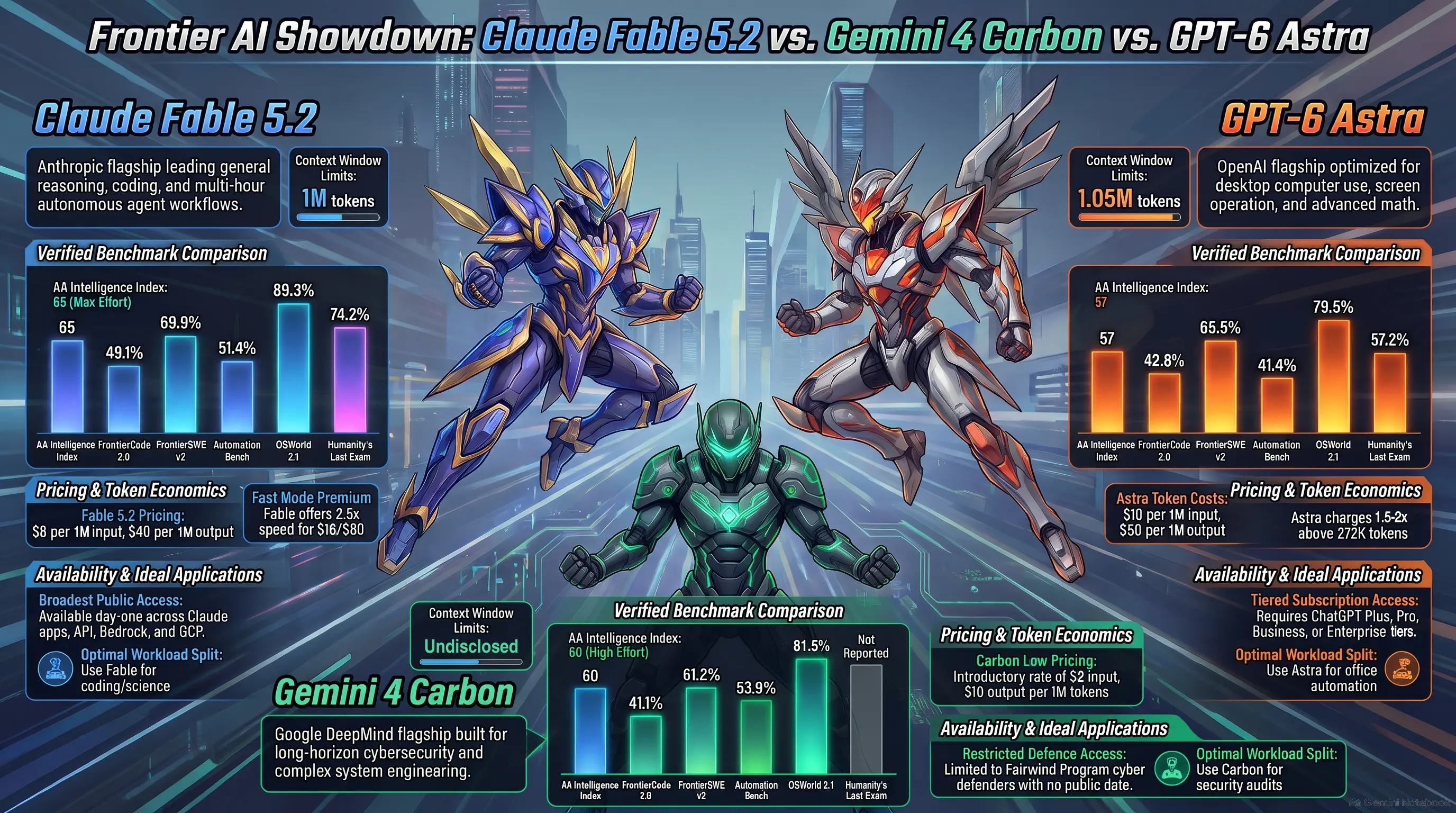
A benchmark is a standardized exam for AI. It gives every model the same tasks and counts how many it completes correctly. The table below comes from the 9 November Anthropic launch post, the only published table that places all three contenders in the same frame for the Claude Fable 5.2 vs Gemini 4 Carbon vs GPT-6 Astra matchup.
However, treat it as vendor reported, since Anthropic chose the exams and ran most of them. Even so, independent results later in this round confirm the broad picture.
| Benchmark | What It Measures | Claude Fable 5.2 | GPT-6 Astra | Gemini 4 Carbon |
|---|---|---|---|---|
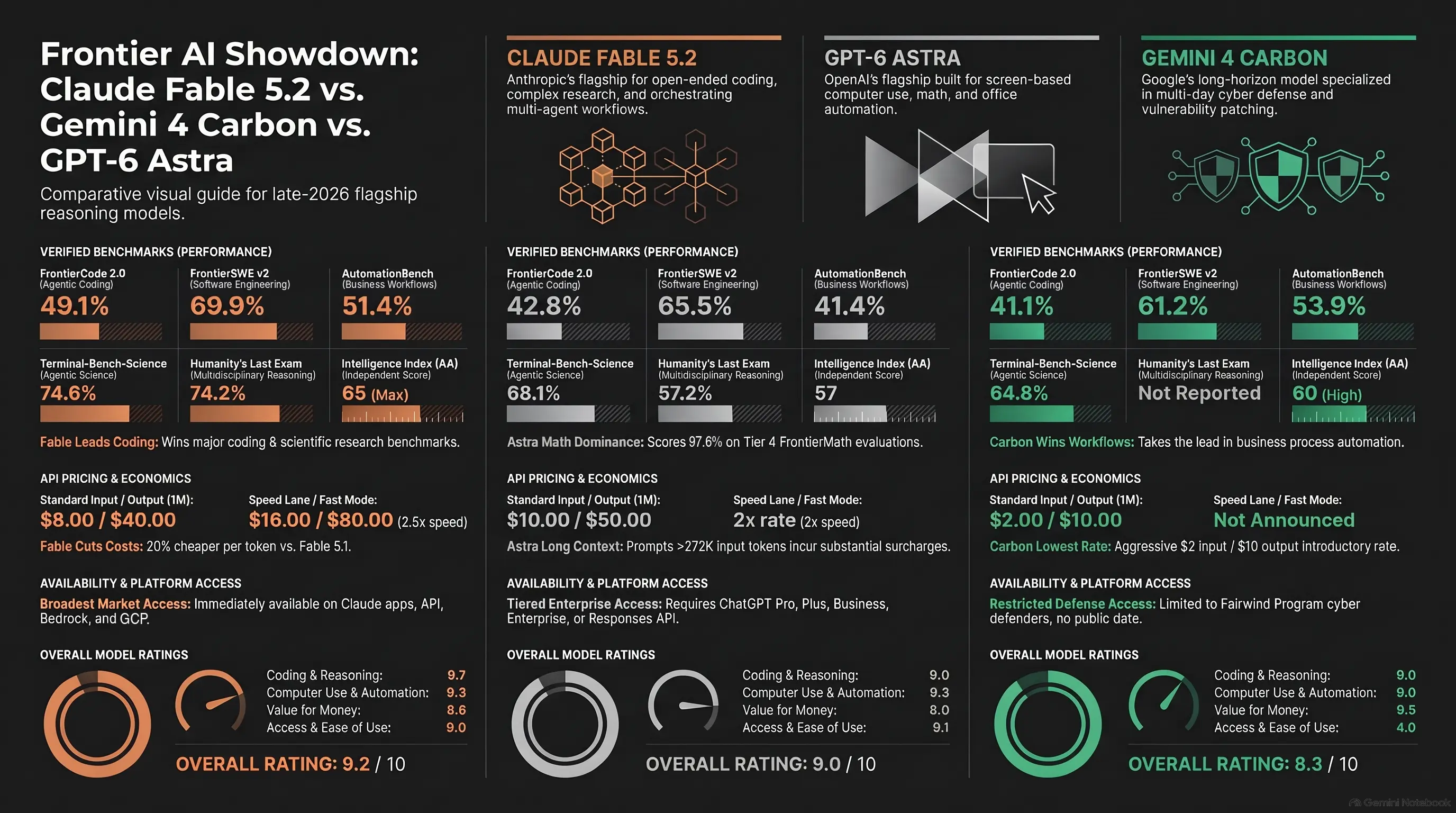
| FrontierCode 2.0 | Agentic coding | 49.1% (Xhigh) | 42.8% | 41.1% (Medium) |
| FrontierSWE v2 | Real software engineering | 69.9% | 65.5% | 61.2% |
| AutomationBench | Business workflows | 51.4% | 41.4% | 53.9% |
| Terminal-Bench-Science 0.1 | Agentic science research | 74.6% | 68.1% | 64.8% |
| OSWorld 2.1 (offline, partial) | Computer use | 89.3% | 79.5% | 81.5% |
| AA-Briefcase v1.1 | Knowledge work | 66.1% | 52.0% | 61.8% |
| Chartography (no tools) | Reading charts and graphs | 73.4% | 71.0% | 72.5% |
| Humanity’s Last Exam (with tools) | Multidisciplinary reasoning | 74.2% | 57.2% | Not reported |
Source: Anthropic, Introducing Claude Fable 5.2 and Claude Mythos 5.2, 9 November 2026. Fable scores run with safeguards on.
Note: Effort settings differ by row, and Anthropic picked the test setup. Treat any gap of one or two points as a tie, and never choose a model on a single row.
Where Does Claude Fable 5.2 Lead?
Fable 5.2 wins six of the seven rows where all three models carry a score. Moreover, the biggest margins appear in agentic coding and science. On FrontierCode 2.0, Fable scores 49.1% against 42.8% for Astra and 41.1% for Carbon.
Similarly, on Humanity’s Last Exam with tools, a hard test across dozens of subjects, it reaches 74.2% versus 57.2% for Astra. Additionally, Anthropic’s prerelease stories back the numbers. A team of 1,000 Fable 5.2 agents formalized the proof of Fermat’s Last Theorem in the Lean proof language in 30 hours, and another set of agents migrated a production service from Python to Rust that now starts about 26 times faster.
Where Does Gemini 4 Carbon Push Back?
Carbon takes the business workflow row, scoring 53.9% on AutomationBench against 51.4% for Fable and 41.4% for Astra. However, its home turf is security. In the Google tests, run without guardrails, Carbon scored 88.2% on SEC-bench Pro for finding real vulnerabilities, a new high of 54.8% on ExploitGym for checking whether a bug is exploitable, and 71.0% on CWE-bench for patching the root cause.
Additionally, Google reports zero successful attacks on the Gray Swan indirect prompt injection test. As a result, that matters for any agent that reads untrusted web pages and emails, because hidden instructions inside those pages are a top attack route.
Where Does GPT-6 Astra Still Shine?
Astra trails Fable on most Anthropic rows, yet the OpenAI launch table shows where it excels. Astra reports 97.6% on FrontierMath Tier 4, a research grade math test, 99.9% on ARC-AGI-3, and 92.7% on ScreenSpot-Pro, which checks whether a model finds the right button on a busy screen.
Additionally, OpenAI reports a hallucination rate of 4.2%, down from 12.2% for GPT-5.6 Sol. In fact, Artificial Analysis found in September that Astra matched Fable 5.1 on its index at roughly 40% of the cost per task, thanks to its low token use. Therefore, cheap thinking is a real advantage at scale.
What Does the Independent Scoreboard Say?
Vendor tables are useful. However, independent tests carry more weight. Artificial Analysis, an independent benchmarking firm, updated its Intelligence Index on 9 November. Coverage of that update reports Claude Fable 5.2 at 65 on max effort, Gemini 4 Carbon at 60 on high effort, Claude Opus 5.5 at 59 and GPT-6 Astra at 57.
That puts the newest model five points clear in its first third party ranking. On the other hand, Fable did not sweep every test. It scored 60% on Terminal-Bench 4.0 against 65% for Carbon, and 76% on AutomationBench-AA against 78% for Carbon. Therefore, the leader depends on the job.
Pro Tip: Ignore the overall rank and find the single row that matches your daily work. A coder should weigh FrontierCode and FrontierSWE. Meanwhile, an operations lead should weigh AutomationBench and OSWorld.
Read this article: Claude AI Tutorial: Are You Using Every Feature Right?
Round 4: Pricing, Plans and API Tokens, Who Gives You More for Less?
API pricing is charged per million tokens. A token is a small chunk of text, roughly three quarters of an English word, so one million tokens equals about 750,000 words. Input tokens are what you send, output tokens are what the model writes back, and output always costs more.
Fast mode is a premium speed lane at a higher rate. On the other hand, batch processing is a slower queue at half price for jobs that do not need an instant reply.
| Model | Standard Input / Output (per 1M tokens) | Fast Mode | Discounts and Catches | Consumer Access |
|---|---|---|---|---|
| Claude Fable 5.2 | $8 / $40 | Up to 2.5x faster at $16 / $80 | 20% cheaper than Fable 5.1, Batch API at 50% off | Eligible paid Claude plans, Claude Code |
| GPT-6 Astra | $10 / $50 | Up to 2x faster at 2x the price | Prompts over 272K input tokens bill 2x input and 1.5x output, Batch and Flex at 50% | GPT-6 Pro on Pro $100, Pro $200, Business, Enterprise. Plus gets Astra in ChatGPT Work and Codex |
| Gemini 4 Carbon | $2 / $10 introductory | Not announced | Rises to $4 / $20 after 30 November 2026, cached input 95% off | Gemini app, AI Mode and Antigravity on Google AI Ultra, plus the paid Gemini API |
Is Claude Fable 5.2 Free to Use?
No, Fable 5.2 is a paid model. On the API you pay $8 per million input tokens and $40 per million output tokens. Meanwhile, inside the Claude apps, Anthropic includes Fable on eligible paid plans.
As a launch promotion, Fable is included for up to 50% of weekly usage limits on Pro plans and standard Team seats, and plans that include Fable receive one to three Fable usage resets, depending on subscription length. Similarly, GPT-6 Astra follows the same logic. ChatGPT Plus users get Astra inside ChatGPT Work and Codex, while the GPT-6 Pro option in Chat requires a Pro, Business or Enterprise plan.
Which Model Gives the Best Value for Money?
On raw token price, Carbon wins by a wide margin at $2 and $10. That introductory rate ends on 30 November 2026, yet even the standard $4 and $20 still undercuts both rivals. Between the other two, Fable 5.2 is now 20% cheaper per token than Astra.
However, per token price is not the full story. Astra uses fewer tokens per task than most frontier models, so its bill per finished job often lands lower than the rate card suggests. As a result, the smart move is a five task test with your own prompts, followed by a comparison of the invoice, not the rate card.
The Secret: If budget drives your decision, look one step down the ladder. OpenAI prices GPT-6.1 Sol at $2 and $10 per million tokens and says it delivers near Astra intelligence. Likewise, Anthropic prices Claude Sonnet 5.5 at the same $2 and $10. For routine work, these two save a fortune.
Round 5: Who Is Allowed to Use Each Model Today?
Access is the quiet decider in the Claude Fable 5.2 vs Gemini 4 Carbon vs GPT-6 Astra race. Fable 5.2 launched on every major platform on day one: the Claude apps, Claude Code, the Claude Platform API as claude-fable-5-2, Amazon Bedrock, Google Cloud and Microsoft Foundry.
Similarly, GPT-6 Astra is live in ChatGPT for paying users, in the OpenAI API, on Microsoft Azure and on Amazon Bedrock. Enterprise admins must switch Astra on for their workspace, since OpenAI ships it off by default.
Gemini 4 Carbon took a slower road. Google released it first to a subset of cyber defenders through the Fairwind Program on 28 October, then opened it to the public on 10 November 2026. Paying developers and enterprises now call it as gemini-4-carbon through the Gemini API in Google AI Studio and Gemini for business.
Google AI Ultra subscribers get Carbon in the Gemini app, AI Mode in Search and Google Antigravity. Additionally, Google is giving 10,000 scientists six months of free access to Carbon.
Meanwhile, Gemini 4 Argon, the older sibling of Carbon, has been generally available since 13 October on the paid Gemini API and in the Gemini app for Google AI Pro and Ultra subscribers, and it stays available alongside Carbon. Consequently, Google AI Pro subscribers keep Argon, while Ultra subscribers and paying developers are able to test Carbon this month.
Round 6: How to Use Each Model, Step by Step
Here is the exact setup path for each model, written for complete beginners. Every step follows the official route, so you avoid unofficial resellers that charge more and protect your data less.
For example, developers paste the model IDs below straight into their code. Meanwhile, business users get the exact plan names to buy. Each path ends with a working model inside your own account, so you test it on real work the same day instead of reading more reviews.
How to Use Claude Fable 5.2
- Step 1: Sign in at claude.ai on a paid plan that includes Fable, or open Claude Code in your terminal.
- Step 2: Open the model picker and select Claude Fable 5.2.
- Step 3: Choose an effort level. Medium is the default in the Claude apps and Claude Code. Move to High or Xhigh for complex refactors or deep research.
- Step 4: Give full context in one message: the goal, the constraints, the files and the format you want back.
- Step 5: Developers call
claude-fable-5-2on the Claude Platform, oranthropic.claude-fable-5-2on Amazon Bedrock. Turn on Fast mode only when speed matters more than cost.
Why this works: Higher effort gives the model more thinking time, so it catches edge cases. Lower effort saves tokens on routine tasks. Anthropic itself recommends starting most daily coding and knowledge tasks on Claude Opus 5.5 and moving up to Fable for the most ambitious, open ended work.
How to Use GPT-6 Astra
- Step 1: Subscribe to ChatGPT Plus for Astra inside ChatGPT Work and Codex, or to Pro, Business or Enterprise for the GPT-6 Pro option in Chat.
- Step 2: Pick GPT-6 Pro from the model picker, or open Codex for coding tasks. Astra in Codex requires Codex CLI version 0.153.0 or newer.
- Step 3: For computer use tasks, describe the end result, the apps involved and every approval point before the agent submits anything.
- Step 4: Developers call
gpt-6-astrathrough the Responses API, Azure or Bedrock, and keep prompts under 272K input tokens to avoid the long context surcharge.
How to Use Gemini 4 Carbon
- Step 1: Developers and businesses, open Google AI Studio on a paid Gemini API plan, or Gemini for business, and select Gemini 4 Carbon with the model ID
gemini-4-carbon. The free tier does not include it. - Step 2: Everyday users, subscribe to Google AI Ultra and pick Gemini 4 Carbon in the Gemini app, AI Mode in Search or Google Antigravity. On Google AI Pro, Gemini 4 Argon (
gemini-4-argon) remains your Gemini 4 option. - Step 3: Budget for the $4 and $20 standard rate from 1 December 2026, once the introductory price ends on 30 November.
- Step 4: Cyber defense teams still apply through the Fairwind Program for the cyber focused version of Carbon.
Case Study: One Black Friday Launch, Three Model Strategies
Let me make this practical with a trending scenario. Black Friday lands on 27 November 2026, and thousands of small online stores are racing to fix checkout bugs, update prices and secure their sites this month.
Here is how I would split that workload across the Claude Fable 5.2 vs Gemini 4 Carbon vs GPT-6 Astra lineup, based purely on where each model leads in the published data. In fact, think of it as a three person team, where each member does the job they test best at. Therefore, the phases below map one job to one model.
Phase 1: The Engineer (Claude Fable 5.2). Give Fable the checkout repository at High effort and ask it to find the bug behind abandoned carts, write the fix and add tests. This plays to its FrontierSWE and FrontierCode lead.
Phase 2: The Operator (GPT-6 Astra). Meanwhile, hand Astra the repetitive screen work, such as updating 200 product prices in your store dashboard, syncing the sale calendar and logging each change in your CRM.
Phase 3: The Guard (Gemini 4 Carbon). Point Carbon at the new checkout code through the paid Gemini API for a security review before traffic spikes. Moreover, the introductory $2 and $10 price still applies through Black Friday week.
Prompt Template: You are a senior {Platform} engineer. Our Black Friday checkout on {Store Repository} loses {Percentage} of carts at the {Checkout Step}. Review {Files}, find the root cause, write the fix, add tests, and explain each change in plain English before you edit anything.
Read this article: Claude AI Video Editing: Is This the Smartest Reel Workflow?
Is It Safe to Use Claude Fable 5.2 vs Gemini 4 Carbon vs GPT-6 Astra at Work?
All three labs treat their flagship as dual use, meaning the same skill that patches a bug is also able to exploit one, so each ships with heavy guardrails. Anthropic keeps cybersecurity and biology safeguards on Fable 5.2 and routes blocked cybersecurity queries to Opus 4.8 and blocked biology queries to Opus 5.
Eligible customers keep zero data retention, while other customers have prompts retained for 30 days for safety monitoring. Similarly, OpenAI rates Astra Critical for cyber capability, refuses advanced tasks such as proof of concept exploits for now, and supports Zero Data Retention for eligible API customers.
Google released Carbon to vetted defenders first for the same reason, and it keeps the cyber focused version for Fairwind members only. Moreover, it reports 0.0% attack success on the Gray Swan prompt injection test and about half as many unsupported claims as Argon in internal testing.
For everyday users, the practical safety rule is simple. Never paste passwords, client contracts or health records into any model without checking the data policy of your plan first, and review every action an agent takes inside live accounts. Additionally, keep a human approval step before any agent sends money or deletes files.
Note: AI is not a lawyer or a compliance officer. Verify legal, financial and data protection questions with a qualified professional before you act.
Why Claude Fable 5.2 Wins Where Generic Chatbots Fail
Generic chat models answer one question at a time. Fable 5.2, on the other hand, is built to run a whole project. Anthropic describes Fable as an orchestrator that hands simpler subtasks to Sonnet or Haiku, and as an advisor that smaller Claude models consult on hard problems.
In one prerelease test, an engineer had Fable 5.2 coordinate over 1,000 subagents for eight days to build a prototype operating system that boots on a laptop. Likewise, testers echo the theme. Cognition engineer Adhyyan Sekhsaria said Fable 5.2 admits when it does not know something instead of hallucinating, and Shopify staff engineer Tom Pritchard compared it to working with a fellow staff level engineer.
That said, Fable is not the right pick for every job. If you need cheap volume, GPT-6.1 Sol or Claude Sonnet 5.5 cost a fraction of the price per token. Similarly, if your work is pure screen automation inside office apps, the computer use focus of Astra was built for exactly that.
If you defend networks for a living, Carbon posts the best security numbers in this comparison, and it is now open on the paid Gemini API. In the meanwhile, most teams win with a mix, each model assigned to the task where it leads.
My Honest Score Card
These scores for the Claude Fable 5.2 vs Gemini 4 Carbon vs GPT-6 Astra matchup reflect verified official documentation and independent benchmarks as of 11 November 2026, weighed against the honest weaknesses covered above. Moreover, access carries real weight, because a model you are not allowed to use delivers zero value to your business today.
Each criterion is scored out of 10, and the overall score is the average of the six rows. I will update this card once Carbon reaches public users and independent testers publish fresh results.
| Criterion | Claude Fable 5.2 | GPT-6 Astra | Gemini 4 Carbon |
|---|---|---|---|
| Innovation | 9.6 | 9.3 | 9.4 |
| Coding and Reasoning | 9.7 | 9.0 | 9.0 |
| Computer Use and Automation | 9.3 | 9.3 | 9.0 |
| Value for Money | 8.6 | 8.0 | 9.5 |
| Access and Ease of Use | 9.0 | 9.1 | 8.0 |
| Safety and Transparency | 9.0 | 9.0 | 9.1 |
| Overall Score | 9.2 / 10 | 9.0 / 10 | 9.0 / 10 |
Verdict: Claude Fable 5.2 is the strongest frontier model you are able to buy today. GPT-6 Astra is the pick for screen based office automation and math inside ChatGPT. Gemini 4 Carbon is the value pick, with the lowest price tag and the best security scores, now open to paying developers and Google AI Ultra subscribers.
Frequently Asked Questions
Here are the most common questions about Claude Fable 5.2 vs Gemini 4 Carbon vs GPT-6 Astra, answered from the official launch posts and independent test data.
Which is better, Claude Fable 5.2 or GPT-6 Astra?
In the Claude Fable 5.2 vs Gemini 4 Carbon vs GPT-6 Astra comparison, Claude Fable 5.2 leads on most published tests. In the Anthropic launch table, Fable beats Astra on FrontierCode 2.0 (49.1% vs 42.8%), FrontierSWE v2 (69.9% vs 65.5%), OSWorld 2.1 (89.3% vs 79.5%) and Humanity's Last Exam with tools (74.2% vs 57.2%). Additionally, coverage of the 9 November Intelligence Index update reports Fable at 65 and Astra at 57. However, Astra holds clear strengths in frontier math, screen based computer use inside ChatGPT, and token efficiency, which often lowers its real cost per finished task. The independent leaderboards at Artificial Analysis are the best place to track these rankings as new results arrive.
Is Gemini 4 Carbon available to the public?
Yes. Google announced Gemini 4 Carbon on 28 October 2026 and first released it to a subset of cyber defenders through its Fairwind Program. Then, on 10 November 2026, Google opened it to the public. Paying developers and enterprises now use it through the Gemini API in Google AI Studio and Gemini for business with the model ID gemini-4-carbon, at an introductory price of $2 and $10 per million tokens until 30 November 2026, rising to $4 and $20 afterward. Meanwhile, Google AI Ultra subscribers get Carbon in the Gemini app, AI Mode in Search and Google Antigravity, while Google AI Pro subscribers keep Gemini 4 Argon. The free Gemini API tier does not include Carbon.
How much does Claude Fable 5.2 cost, and what is its context window?
The official Claude Fable 5.2 model page lists a 1M token context window, 128K maximum output tokens and pricing of $8 per million input tokens and $40 per million output tokens. In fact, that is 20% cheaper than Fable 5.1, which cost $10 and $50. An optional Fast mode generates tokens up to 2.5 times faster at $16 and $80 per million tokens, and it runs on Claude Code, the Claude Platform, Google Cloud and Microsoft Foundry. Additionally, the Batch API halves both input and output prices for jobs that do not need an instant answer. In the Claude apps, Fable comes with eligible paid plans, so you pay through your subscription rather than per token.
What is the difference between Claude Fable 5.2 and Claude Mythos 5.2?
Anthropic states that Fable and Mythos are the same underlying model. However, the difference lies in safeguards and access. Fable 5.2 carries cybersecurity and biology safeguards and is open to all customers across the Claude apps, the API and the major clouds. On the other hand, Mythos 5.2 runs without some of those safeguards, so Anthropic offers it only to vetted organizations through its Cyber Verification Program and Life Sciences Verification Program, and to Claude Enterprise customers through Claude Security. On the Anthropic CVE Rediscovery evaluation, Mythos 5.2 found 10.2% more vulnerabilities than Claude Opus 5.5. For coding, writing and research, Fable 5.2 delivers the same core intelligence without any application process.
Is GPT-6 Astra free in ChatGPT?
No. GPT-6 Astra is a paid model. ChatGPT Plus users get Astra inside ChatGPT Work and Codex, while the GPT-6 Pro option in Chat, which runs on Astra, is available on the Pro $100, Pro $200, Business and Enterprise plans. Moreover, each plan carries its own usage limits, and Pro subscriptions do not include unlimited GPT-6 Pro use. On the API, Astra costs $10 per million input tokens and $50 per million output tokens, with higher rates for prompts above 272K input tokens. Therefore, if you want near Astra results on a tight budget, OpenAI positions GPT-6.1 Sol as the alternative at $2 and $10 per million tokens, available to Plus and higher plans in ChatGPT Work and Codex.
Your Next Move Before You Spend a Single Token
The Claude Fable 5.2 vs Gemini 4 Carbon vs GPT-6 Astra race has no single winner for everyone, and that is good news for you. Fable 5.2 leads the independent index and most coding and science tests. Meanwhile, Astra owns screen based automation and frontier math. Likewise, Carbon brings the best security numbers at the lowest price, and its public release on 10 November puts it within reach.
Pick the one task that eats the most hours of your week, run it through the model that leads that row, and measure the result. Stay curious, test with real work, and let the data decide. The right model, matched to the right task, saves you hours of effort and real money every single month.
Priyanshu Khatri Founder & Chief AI Analyst, SoulAI Writes
Read more articles
Claude Fable 5.2 vs Gemini 4 Carbon vs GPT-6 Astra: Best AI?
Claude Fable 5.2 vs Gemini 4 Carbon vs GPT-6 Astra: Which Frontier AI Model Deserves…
Claude Fable 5.2 vs Gemini 4 Carbon: Which AI Wins?
Claude Fable 5.2 vs Gemini 4 Carbon: Which Frontier AI Model Wins Your Work and…
Gemini 4 Carbon: Is Google’s Strongest AI Worth It?

Is Claude Fable 5.2 Worth It? Benchmarks, Pricing and API
Claude AI Models: Opus, Fable, Sonnet or Haiku, Which Wins?
Which Claude AI Models Should You Pick: Opus 5.5, Fable 5.1, Sonnet 5.5 or Haiku…

Claude AI Tutorial: Are You Using Every Feature Right?
Are You Only Chatting With Claude AI When It Is Ready to Run Your Entire…






Leave a Reply