


Gemini 4 Carbon vs Gemini 4 Argon: Which Google Model Deserves Your Money Before December 1?
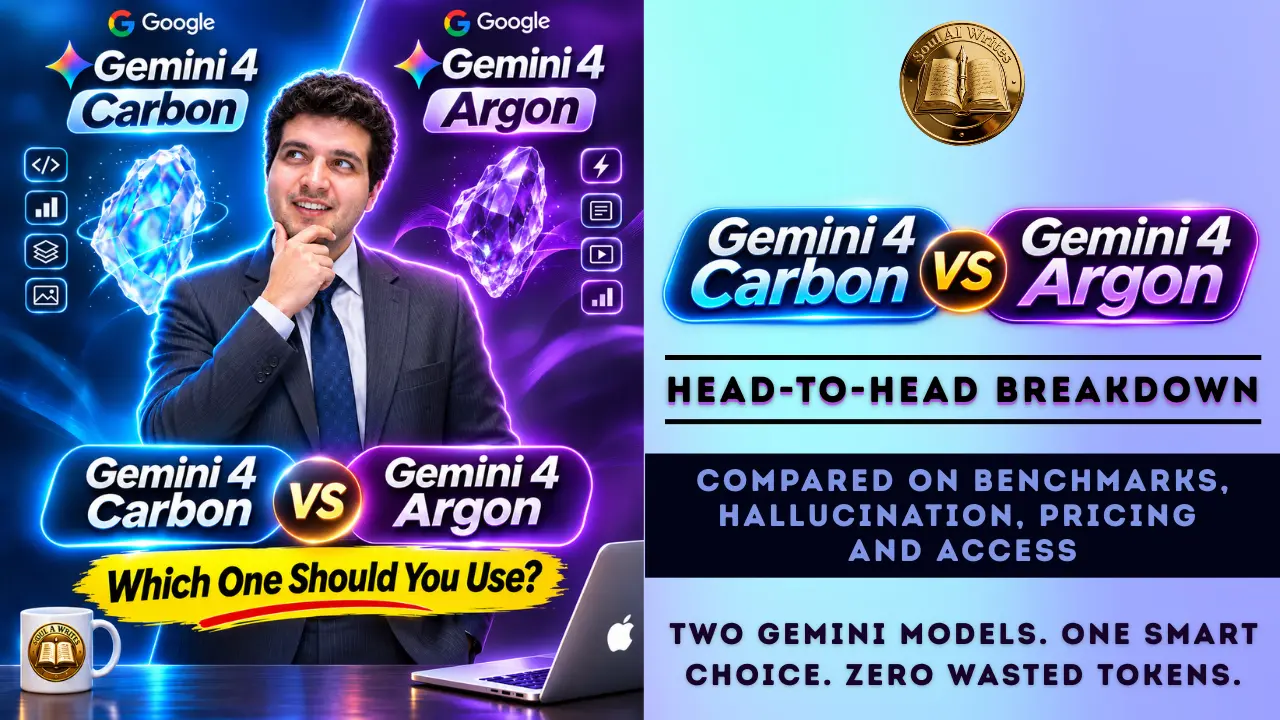
Gemini 4 Carbon vs Gemini 4 Argon: What if I told you that the newest and smartest Gemini model is the wrong pick for most of your daily work? That is what Google’s own guidance and the independent numbers point to, and it surprised many developers who rushed to switch on launch day.
Stay with me, because I will walk you through every benchmark, price, limit and use case, step by step, so you pick the right model and save your energy, your time and your money before the API price doubles on December 1.
Gemini 4 Carbon vs Gemini 4 Argon is the comparison every Gemini user is searching for right now, and for good reason. Google shipped two frontier models in roughly four weeks. Argon arrived on September 30, 2026 and opened to the public on October 13. Carbon followed with an announcement on October 28 and reached paying developers and Google AI Ultra subscribers on November 10.
Both share the same introductory price, both work with a 1M token context window, and both sit at the top of the Gemini family. However, they behave differently in ways that matter for your bill, your accuracy and your deadlines.
In this guide, you will learn what each model does, where Carbon pulls ahead, where Argon still wins, and how to start using either one today. Moreover, you will see the exact numbers from Google, Artificial Analysis and Zapier, with honest weaknesses included.
The goal of this Gemini 4 Carbon vs Gemini 4 Argon breakdown is simple: you finish reading with a clear decision, and you avoid paying for reasoning power your task does not need.
Department 1: The Workhorse. What Is Gemini 4 Argon?
Gemini 4 Argon is Google’s flagship reasoning model. According to the official Gemini API documentation for Gemini 4 Argon, it targets complex software engineering, deep math and science problems, autonomous multi step agents and long outputs of up to 1M tokens.
Google first gave Argon to cyber defenders in its Fairwind Program on September 30. Consequently, on October 13, Google opened Argon to the paid Gemini API, Google AI Studio, AI Mode in Search and the Gemini app for Google AI Pro and Ultra subscribers. In India, the Google AI Pro plan that includes Argon is listed at ₹1,950 per month.
Additionally, Google has shared how its own teams use Argon. For example, Argon agents are moving large C and C++ codebases to Rust, and one rebuilt video decoder runs 2.7 times faster than the earlier Rust port. Similarly, Argon agents found memory savings across Google data centers that Google expects to free more than 300 TiB.
On public tests, Argon scored 77.9% on DeepSWE v1.1 for long horizon coding and 91.7% on LVBench for long video understanding. In short, Argon is the dependable daily driver of the Gemini 4 family.
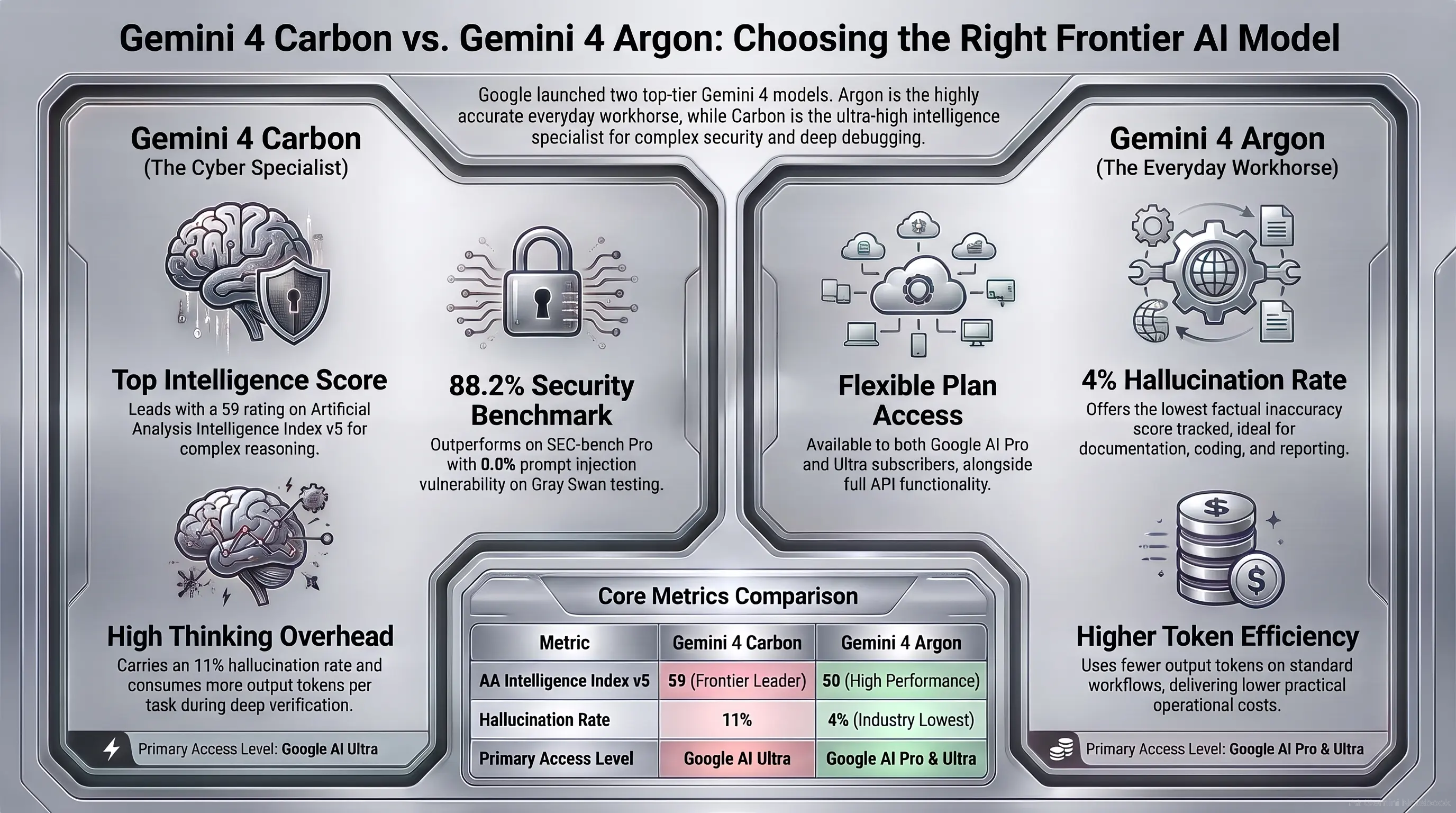
Note: Artificial Analysis measured Argon’s hallucination rate at 4%, the lowest of any model it tracked at Carbon’s launch. Keep that number in mind, because it shapes the whole comparison.
Department 2: The Specialist. What Is Gemini 4 Carbon?
Gemini 4 Carbon is the second model in the Gemini 4 family. In the official Gemini 4 Carbon announcement, Google calls it its strongest model, with state of the art cybersecurity and long horizon capabilities, and says Carbon builds on Argon.
Google also reports that internal teams watched Carbon work on engineering problems for days, pushing through dead ends to find and patch subtle bugs in large codebases. Carbon went to a subset of cyber defenders first. Later, on November 10, it reached the paid API in AI Studio and Android Studio, Gemini for business, and Ultra subscribers in the Gemini app, AI Mode and Google Antigravity.
Equally important is what Carbon is not. For example, it is not part of the free Gemini tier, and it carries no free API quota, and reports at launch list it for Google AI Ultra rather than AI Pro inside the Gemini app.
Meanwhile, the Fairwind Program keeps a specialized cyber version of Carbon with fewer safeguards for approved defenders. Google’s own message is clear: Carbon is meant for the jobs that push a model to its limits, such as hard debugging and open ended scientific research.
Read this article: Is Claude Fable 5.2 Worth It? Benchmarks, Pricing and API
Gemini 4 Carbon vs Gemini 4 Argon at a Glance
Before we go deeper, here is the full Gemini 4 Carbon vs Gemini 4 Argon picture in two tables. The first one shows what each model does and who it serves. Meanwhile, the second one lists the verified specifications side by side, so you see the real differences in access, price, context limits and factual accuracy at once.
Every number comes from Google’s official pages, Google’s published benchmark table, or the independent testing firm Artificial Analysis, as of 11 November 2026.
| Model | What it does | Standout Features | Strength / Weakness | Best For | Target Audience |
|---|---|---|---|---|---|
| Gemini 4 Carbon | Frontier reasoning model for the hardest, longest tasks | Top cyber scores, runs for days on hard engineering work, 0.0% prompt injection success on Gray Swan | Strength: highest raw intelligence in the family. Weakness: higher hallucination rate than Argon and more thinking tokens per task | Deep debugging, security audits, open ended research, multi agent coding | Senior developers, security teams, researchers, AI startups, enterprise engineering leads |
| Gemini 4 Argon | Flagship reasoning model for everyday professional work | Lowest hallucination rate tracked (4%), 1M token long decode, mature API docs, AI Pro access | Strength: accurate, cheaper per task in practice, widely available. Weakness: trails Carbon on every row of Google’s table | Coding, reports, legal and finance documents, long video and PDF analysis | Professionals, creators, YouTubers, businessmen, students on AI Pro, product teams |
| Specification | Gemini 4 Carbon | Gemini 4 Argon |
|---|---|---|
| Announced / public release | Oct 28, 2026 / Nov 10, 2026 | Sep 30, 2026 / Oct 13, 2026 |
| API model code | gemini-4-carbon (paid tier) | gemini-4-argon (paid tier) |
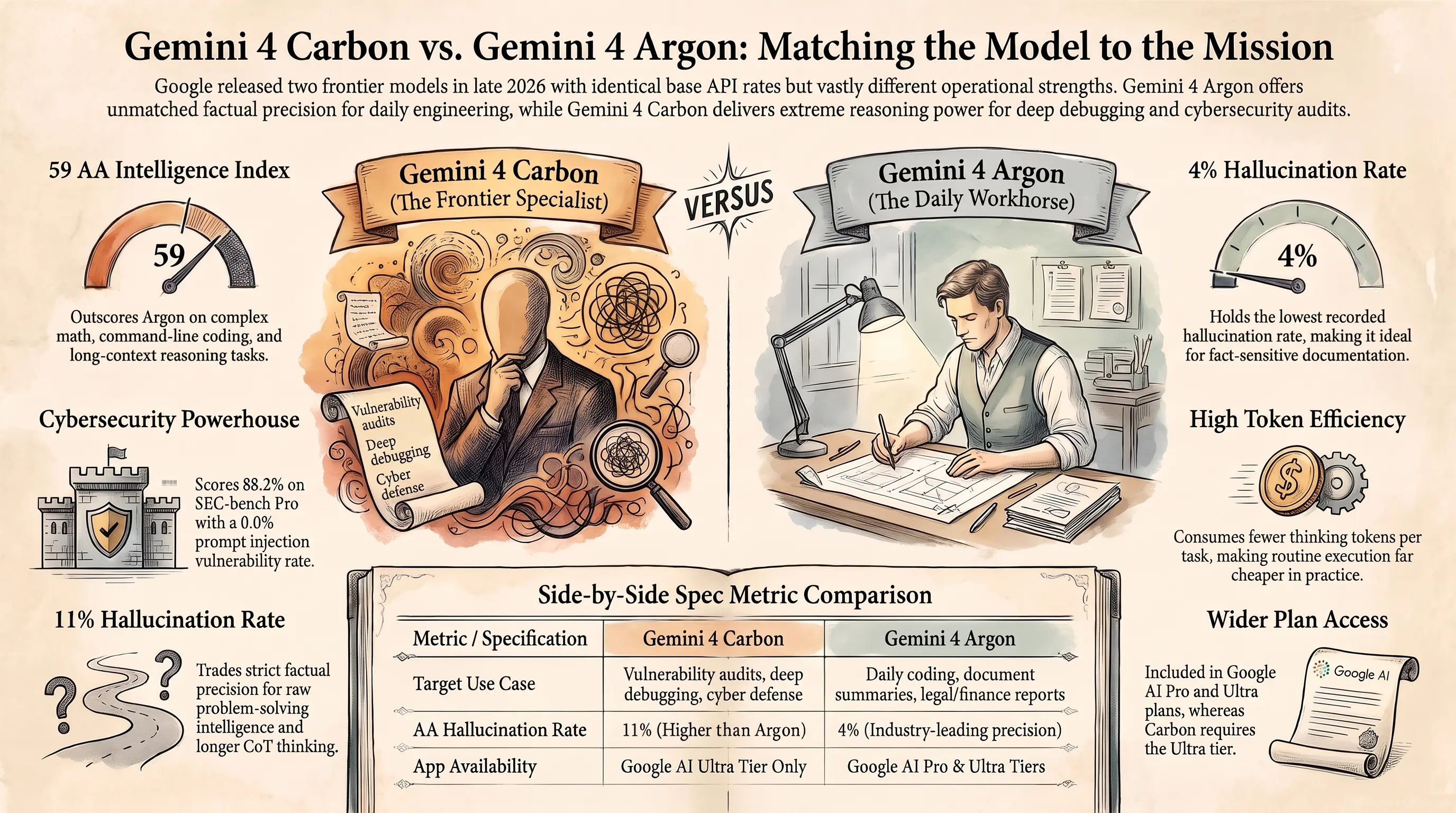
| Gemini app access | Google AI Ultra | Google AI Pro and Ultra |
| Price per 1M tokens until Nov 30 | $2 input / $10 output | $2 input / $10 output |
| Price per 1M tokens from Dec 1 | $4 input / $20 output | $4 input / $20 output |
| Context window | 1M tokens (per Artificial Analysis) | 1,048,576 tokens shared by input and output |
| Inputs / output | Text, image, video, speech / text | Text, image, video, audio, PDF / text |
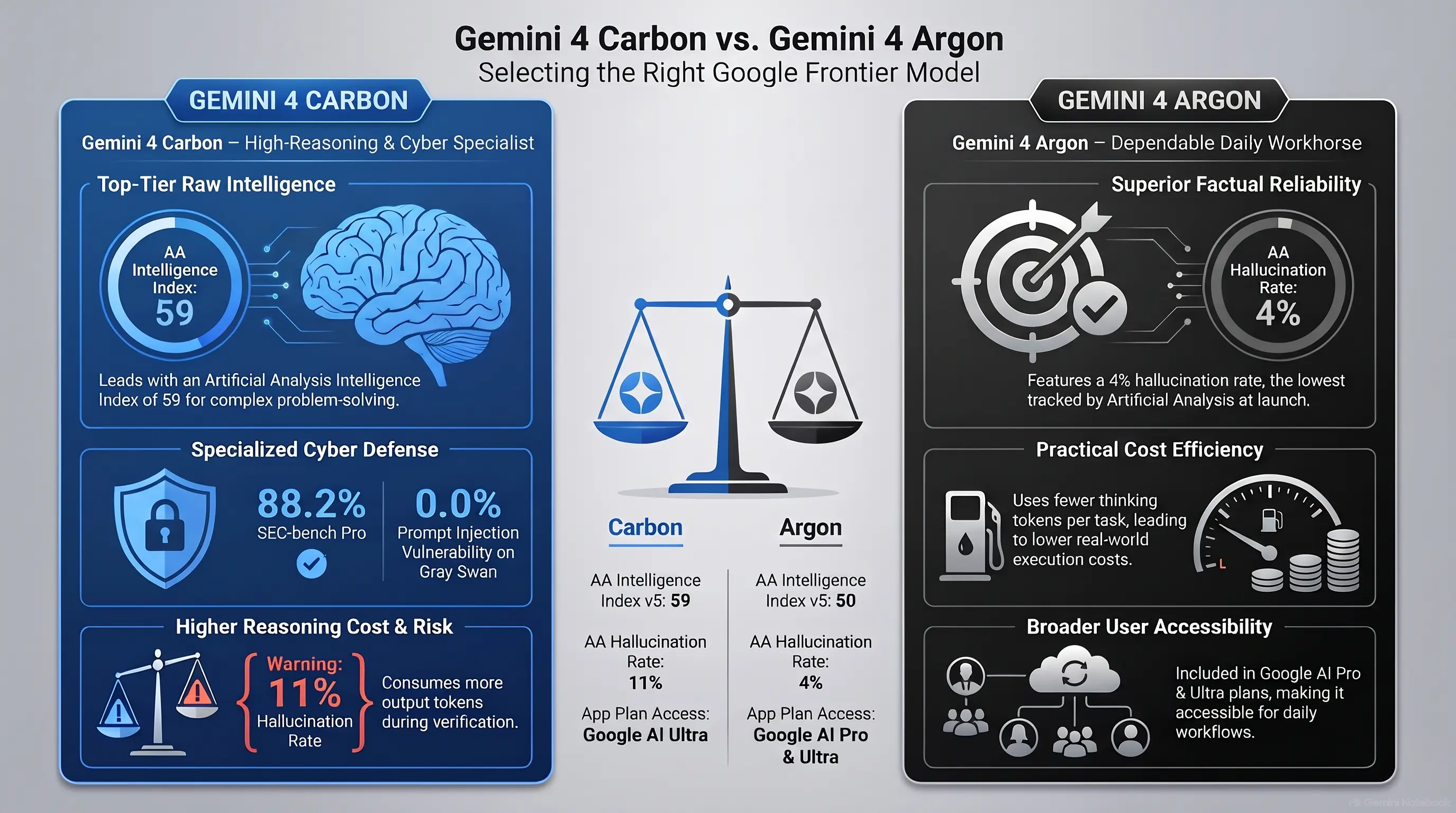
| AA Intelligence Index v5 | 59 (high) | 50 (high) |
| AA hallucination rate | 11% | 4% |
| AA cost per index task | $7.76 | $7.68 |
Phase 1: Raw Intelligence. Which Model Scores Higher on Benchmarks?
On raw intelligence, Carbon wins clearly. Artificial Analysis, an independent testing firm, placed Carbon at 59 on its Intelligence Index v5 at launch, which made it number one at the time, ahead of Claude Opus 5.5 at 58 and GPT-6 Astra at 57. Argon scored 50 on the same index.
However, the frontier moves fast. Later reports list Claude Fable 5.2 above Carbon on that index, so treat any “number one” label as a snapshot. Moreover, Artificial Analysis found that Carbon led four of the nine evaluations inside the index, including HLE Diamond and Terminal Bench Science.
Similarly, Google’s own benchmark table tells the same story. Carbon scored 65.2% against Argon’s 57.1% on Terminal-Bench 4.0, a test of command line coding work. On FrontierSWE 2, Carbon reached 61.2% against 55.0%.
In long context reasoning, the gap widens: on GraphWalks at 256K to 1M tokens, Carbon hit 96.2% while Argon reached 84.2%. Similarly, Carbon led on RiemannBench for math with 80.0% against 76.0%. Still, Carbon is not the leader everywhere. On OSWorld 2.1 for computer use, Carbon’s 81.5% trails Claude Opus 5.5 at 87.2%.
Pro Tip: Google’s table puts Carbon ahead of Argon on every row, yet the size of the gap changes a lot. Look at the benchmark closest to your real task, such as GraphWalks for long documents, instead of the headline index score.
Phase 2: Accuracy. Does Gemini 4 Carbon Hallucinate More Than Argon?
This is the most important twist in the whole Gemini 4 Carbon vs Gemini 4 Argon debate. On the AA-Omniscience test, which rewards correct answers and penalizes made up ones, Carbon scored 54 against Argon’s 46. Carbon’s accuracy rose 10 points to 58%. However, its hallucination rate also climbed from 4% to 11%.
In plain words, Carbon knows more and answers more, yet it also guesses wrong more often when it should say “I do not know.” Both Gemini models sit far below Claude Opus 5.5 and GPT-6 Astra, which Artificial Analysis measured at 50%.
On the other hand, Google’s internal testing adds a second view. Google says Carbon cut unsupported claims by roughly half compared with Argon, and reduced overreach by 26% and under service by 29% in its internal evaluations. These numbers measure different behavior from AA-Omniscience, so they do not cancel each other out.
Therefore, the practical rule is this: for fact sensitive work such as a legal summary, a medical literature review or a quote for a news article, Argon’s lower hallucination rate is a real advantage. For problem solving where the model checks its own work, Carbon’s extra knowledge pays off.
Why this works: A model that admits uncertainty saves you from silent errors. Consequently, pairing Argon for fact retrieval with Carbon for reasoning gives you the best of both scores.
Phase 3: Coding and Agents. Which Model Is Better for Developers?
For developers, Carbon brings real upgrades. Google reports that Carbon climbed 89 Elo points to number four on WebDev Arena with 1768. On Artificial Analysis’s Coding Agent Index, Carbon scored 59, only three points behind Claude Opus 5.5 at 62.
Moreover, Google says Carbon’s successful cheating on Terminal-Bench 4.0 dropped to 0.0%, and high severity misalignment alerts in live internal coding environments fell by almost 80%. On the other hand, early testers quoted by TestingCatalog described Carbon as slower and still weak on frontend user interface work, although less lazy. Those are reported impressions, not measured results.
The bigger story for builders is the new /swarm preview in Google Antigravity. It splits one request across coordinated agents that plan, edit and check work in parallel, and it lets you assign Carbon to the demanding reasoning role while lighter models handle routine edits.
For example, a store owner preparing a Black Friday sale page asks Carbon to plan the architecture and review the checkout logic, while a faster model writes the product cards. Google warns that parallel agents use quota faster than a normal chat, so start with a small task.
Prompt Template: You are the lead reviewer for {Project Name}. Read the repository and list the three riskiest functions in {Feature Area}. For each one, explain the bug risk in plain English, write a failing test, then propose a minimal patch. Do not change files outside {Folder Path}.
Phase 4: Cybersecurity. Why Is Carbon Called the Cyber Defender’s Model?
However, cybersecurity is where Carbon pulls furthest ahead. Google tested it without guardrails and reported 88.2% on SEC-bench Pro for finding vulnerabilities, against Argon’s 83.4%. On ExploitGym, which measures how well a model proves an exploit, Carbon scored 54.8% against Argon’s 42.0%. For patching on CWE-bench, Carbon reached 71.0% while Argon reached 68.0%.
Additionally, Google says Carbon delivered more than twice Argon’s success rate at writing secure code, and the Chrome team found Carbon more than ten times better than another lab’s large frontier model at producing high quality patches.
In fact, real world reports back this up. Wiz, Google’s cloud security platform, used Carbon to scan two major SaaS providers and found zero day vulnerabilities in under two hours, work that normally takes weeks.
So, is it safe to use? Google built Carbon on Argon’s safety stack, which includes real time misuse defenses and chain of thought monitoring, and Google took part in the U.S. government’s voluntary pre release testing. On the Gray Swan prompt injection benchmark, Carbon resisted every attack with a 0.0% success rate, against 0.7% for Argon.
Note: AI is not a replacement for a certified security auditor. Treat every patch Carbon writes as a draft, run your tests, and have a human approve changes before they reach production.
Read this article: What Is GPT-6 Astra? Features, Pricing and Real Tests
Phase 5: Pricing. Is Gemini 4 Carbon More Expensive Than Argon?
In the Gemini 4 Carbon vs Gemini 4 Argon price check, both models cost exactly the same on paper. Until November 30, 2026, each costs $2 per million input tokens and $10 per million output tokens. From December 1, the rate doubles to $4 and $20. Cached input tokens get a 95% discount, which works out to $0.10 per million during the offer and $0.20 afterwards.
However, the price per token is only half the story. Google’s API pricing bills thinking tokens as output, and Google says Carbon uses more thinking tokens than Argon because it explores and verifies more before answering.
As a result, independent data matters here. Artificial Analysis found Carbon cost $7.76 per index task against Argon’s $7.68, almost identical, while scoring nine points higher. Zapier’s AutomationBench offers a closer look: Carbon at medium effort scored 52.97% for about $1.65 per task, and at high effort it scored 53.88% for about $2.12.
After counting failed attempts, Zapier put the cost per successful task at $3.11 for medium and $3.94 for high. For example, a 200,000 token report with a 20,000 token answer costs about $0.60 today and $1.20 after December 1.
The Secret: Medium effort on Carbon delivered almost the same AutomationBench score as high effort at roughly 22% lower cost per task. Start every Carbon project at medium and raise the effort only when results fall short.
Is Gemini 4 Carbon Free to Use?
No, neither model is free on the API. Both Carbon and Argon need the paid tier of the Gemini API, and reports confirm Carbon is not part of the free Gemini app tier.
Inside the Gemini app, Argon is included with Google AI Pro and Ultra, while Carbon rolls out to Google AI Ultra, which costs $99.99 per month for the 5x plan and $199.99 for the 20x plan in the United States.
There are two exceptions worth knowing. Scientists are able to apply for six months of free access to both models, and qualifying cyber defense organizations apply through the Fairwind Program.
How to Use Gemini 4 Carbon and Argon: Step by Step Guide
Follow these six steps in order, and you will avoid the two most common mistakes: picking a plan that does not include your model, and running long prompts with timeouts set in seconds instead of minutes.
Step 1: Choose your surface. Use the Gemini app if you want chat and documents, AI Studio if you want to test prompts, and the API if you are building a product.
Step 2: Pick the model in the Gemini app. Open the Gemini app, tap the model picker at the top of the chat, and select 4 Argon on AI Pro or Ultra, or Carbon on Ultra. Upload your PDF, video or spreadsheet and write your request.
Step 3: Test in Google AI Studio. Sign in to AI Studio, link a billing account for the paid tier, choose gemini-4-argon or gemini-4-carbon from the model list, and compare both on the same prompt before you commit.
Step 4: Call the API. Create an API key, install the Google Gen AI SDK, and send your first request through the Interactions API, which Google’s documentation uses for Gemini 4.
from google import genai

client = genai.Client()  # reads GEMINI_API_KEY from your environment

interaction = client.interactions.create(
    model="gemini-4-argon",  # switch to "gemini-4-carbon" for harder tasks
    input="Summarize the attached Q3 earnings report in ten clear points.",
)
print(interaction)
Step 5: Set thinking and output limits. Argon supports low, medium and high thinking levels, and Google recommends medium as the default. Argon’s default output is 65,536 tokens. For long answers, turn on background mode and raise the output limit, up to 1,048,576 tokens minus your input.
Step 6: Track tokens and keep the model name in config. Log input, output and thinking tokens per request, set timeouts in minutes, and store the model name in one setting so switching between Argon and Carbon takes a single line.
Case Study 1: One Black Friday Launch, Two Models
For example, Black Friday falls on November 27 this year, right before the introductory price ends. That timing makes it a useful example of how to split work between the two models.
Picture a small Indian brand selling handmade candles on its own website. The owner needs a sale landing page, a product description for each of forty items, a refund policy summary, and a quick security check on a new discount code feature. Each of these jobs has a different risk level, so each deserves a different model rather than one expensive default for everything.
Therefore, here is the sensible split. Argon writes the forty product descriptions and summarizes the refund policy, because those tasks reward accuracy and low hallucination more than deep reasoning. Meanwhile, Carbon reviews the discount code logic for bugs that let shoppers stack coupons, because that task rewards long, careful verification.
Finally, Carbon in Antigravity with /swarm plans the landing page while a lighter model writes the layout. As a result, the owner pays for Carbon’s extra thinking tokens only where a mistake costs real money, and keeps the routine work on the cheaper, more accurate path.
Why Gemini 4 Argon Still Wins Where Carbon Is Overkill
Google itself says Argon is likely to stay the preferred model for most software engineering and knowledge work, while Carbon is for tasks that test the limits of model intelligence. Moreover, four solid reasons sit behind that advice.
First, Argon’s 4% hallucination rate is the lowest Artificial Analysis has recorded. Second, Argon spends fewer thinking tokens, so long chats stay cheaper. Third, Argon is in Google AI Pro, which costs far less than Ultra. Fourth, Argon has a full model page with documented limits and features, such as code execution, computer use, search grounding and structured outputs.
Read this article: Claude Fable 5.2 vs Gemini 4 Carbon vs GPT-6 Astra: Best AI?
Which Gemini 4 Model Should You Choose for Your Work?
The choice in the Gemini 4 Carbon vs Gemini 4 Argon decision comes down to the cost of a mistake and the length of the task. Choose Carbon if you run security audits, debug large codebases, coordinate agents for hours, or do open ended research where the model needs to check its own reasoning.
Choose Argon if you write, summarize, analyze documents, build standard apps, or need the most factual answers at the lowest real cost. Likewise, if you pay for AI Pro and not Ultra, Argon is your only Gemini 4 option in the app today, and it serves most daily tasks well.
My Honest Score Card
These scores reflect Google’s official documentation, Google’s published benchmark table and independent results from Artificial Analysis and Zapier, verified on 11 November 2026. Each criterion is scored out of 10, and the weaknesses are included on purpose.
| Criterion | Gemini 4 Carbon | Gemini 4 Argon | Why |
|---|---|---|---|
| Raw Intelligence | 9.5 | 8.5 | Carbon 59 vs Argon 50 on AA Intelligence Index v5 |
| Factual Reliability | 8.5 | 9.5 | Hallucination rate 11% vs 4% |
| Coding and Agents | 9.0 | 8.5 | Carbon leads Terminal-Bench 4.0 and FrontierSWE 2, still behind Opus 5.5 on coding agents |
| Cybersecurity | 9.6 | 8.8 | Carbon leads SEC-bench Pro, ExploitGym and CWE-bench |
| Token Efficiency | 7.5 | 8.5 | Carbon spends more thinking tokens per task |
| Value for Money | 8.5 | 9.0 | Same rates, but Argon is cheaper in practice for routine work |
| Accessibility | 7.0 | 9.0 | Carbon needs Ultra in the app, Argon works on AI Pro |
| Overall Score | 8.5 | 8.8 | Carbon for the hardest jobs, Argon for everyday work |
Your Next Move: Match the Model to the Mission
Carbon is the sharper tool, and Argon is the steadier one. Carbon wins on raw intelligence, cybersecurity and long, hard engineering tasks. Argon wins on factual accuracy, token efficiency and access, and Google itself expects it to handle most daily work.
So test both on one real task from your own week, compare the answers and the token logs, and keep the winner as your default. Additionally, the official Gemini 4 Argon launch post lists Google’s own use cases worth copying. Choose wisely before December 1, and every prompt you send saves you time and money.
Frequently Asked Questions About Gemini 4 Carbon vs Gemini 4 Argon
Here are the most common questions about Gemini 4 Carbon vs Gemini 4 Argon, answered from Google’s official pages and trusted independent reports.
Is Gemini 4 Carbon better than Gemini 4 Argon?
Carbon scores higher than Argon on every row of Google's published benchmark table, and it reached 59 against Argon's 50 on the Artificial Analysis Intelligence Index v5. It is the stronger model for cybersecurity, long horizon coding and open ended research. However, "better" depends on your task. Argon has a lower hallucination rate, 4% against Carbon's 11%, uses fewer thinking tokens and is available on the cheaper Google AI Pro plan. Google itself expects Argon to stay the preferred choice for most software engineering and knowledge work. So in the Gemini 4 Carbon vs Gemini 4 Argon question, Carbon is better for the hardest problems and Argon is better for everyday accuracy and cost.
Is Gemini 4 Carbon available for free in the Gemini app?
No. Carbon is not part of the free Gemini tier. In the Gemini app, AI Mode in Search and Google Antigravity, it is rolling out to Google AI Ultra subscribers. Developers reach it through the paid tier of the Gemini API in AI Studio and Android Studio, as confirmed in Google's post Gemini 4 Carbon is now available for developers. Argon, on the other hand, is included in Google AI Pro and Ultra. If you want free access, two routes exist: scientists apply for six months of free access to Carbon and Argon, and approved cyber defense organizations get access through the Fairwind Program.
How much do Gemini 4 Carbon and Argon cost after December 1?
Both models share one rate card. Until November 30, 2026, the introductory API price is $2 per million input tokens and $10 per million output tokens. From December 1, the standard price applies: $4 per million input tokens and $20 per million output tokens. Cached input tokens are 95% off, so they cost $0.10 per million during the offer and $0.20 after it. Thinking tokens are billed as output, and Carbon tends to use more of them than Argon. As a result, the same prompt often costs more on Carbon even though the per token rate is identical.
What is the context window of Gemini 4 Carbon vs Gemini 4 Argon?
Argon has a documented context window of 1,048,576 tokens, which input, thinking and output share together. Its default output limit is 65,536 tokens, and with long decode in background mode it writes up to the full window minus your input. For Carbon, Artificial Analysis lists a 1M token context window with text, image, video and speech inputs and text output. In the Gemini 4 Carbon vs Gemini 4 Argon comparison, the window size is effectively the same, so the real difference lies in how well each model uses it. On GraphWalks at 256K to 1M tokens, Carbon scored 96.2% against Argon's 84.2%, which shows stronger long context reasoning.
Is Gemini 4 Carbon safe to use for coding and cybersecurity work?
Google built Carbon on Argon's safety stack, which includes model training for safe behavior, real time misuse defenses, prompt injection resilience and chain of thought monitoring. Google also joined the U.S. government's voluntary pre release testing process before launch. In its published results, Carbon resisted every attack on the Gray Swan indirect prompt injection benchmark and cut high severity misalignment alerts in internal coding environments by almost 80%. Details on Argon's safeguards appear in the official Gemini 4 Argon announcement. Even so, treat every AI generated patch as a draft. Run your tests, review the diff, and keep a qualified human in charge of production security decisions.
Priyanshu Khatri Founder & Chief AI Analyst, SoulAI Writes
Read more articles
Gemini 4 Carbon vs Gemini 4 Argon: Which One Should You Use?
Gemini 4 Carbon vs Gemini 4 Argon: Which Google Model Deserves Your Money Before December…
Fable 5.1 vs 5.2: Is Claude’s Newest Model Worth It?
Fable 5.1 vs 5.2: Which Claude Fable Model Wins on Price, Speed and Benchmarks? Fable…
What Is GPT-6 Astra? Features, Pricing and Real Tests
Claude Fable 5.2 vs Gemini 4 Carbon vs GPT-6 Astra: Best AI?
Claude Fable 5.2 vs Gemini 4 Carbon vs GPT-6 Astra: Which Frontier AI Model Deserves…
Claude Fable 5.2 vs Gemini 4 Carbon: Which AI Wins?
Claude Fable 5.2 vs Gemini 4 Carbon: Which Frontier AI Model Wins Your Work and…








Leave a Reply