



Claude Opus 5.5 vs GPT-6 Astra: Which AI Model Truly Wins Your Work?
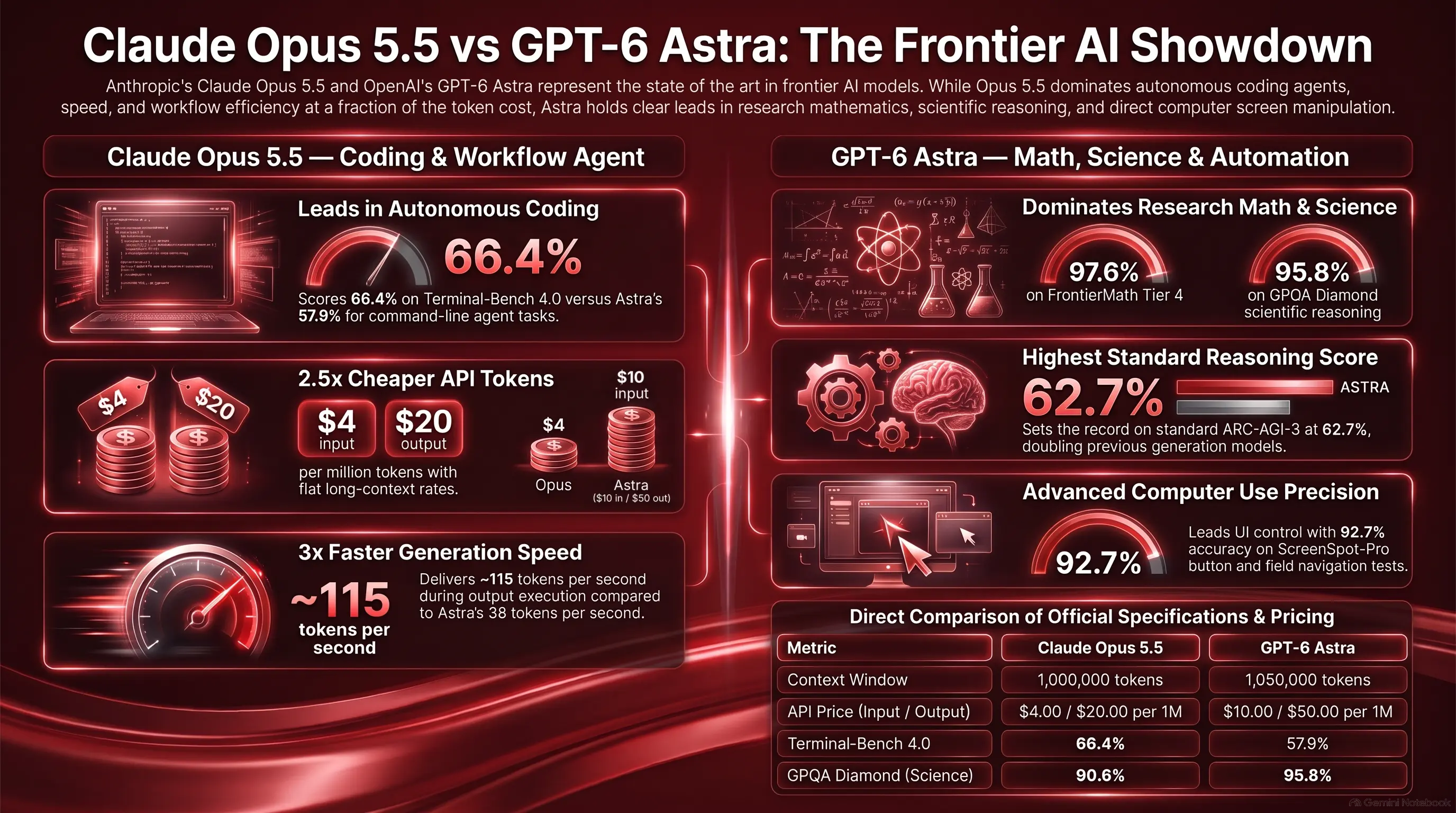
Claude Opus 5.5 vs GPT-6 Astra: On 3 September 2026, OpenAI’s president told reporters “Welcome to the AGI era,” so who would dare to challenge that claim within three weeks? Anthropic did, on 22 September, with a model that now beats GPT-6 Astra on most coding and office work tests while charging less than half the price per token.
Yet the full story hides a twist about real task costs and science that most comparison posts skip, and that twist decides which model you should open tomorrow morning. Stay with me, because I will walk you through every benchmark, every price line and every practical workflow, step by step, so you save your energy, your time and your money.
Claude Opus 5.5 vs GPT-6 Astra is the comparison developers, creators and business owners are searching for right now, and for good reason. These are the two flagship models from Anthropic, which launched Opus 5.5 on 22 September 2026, and OpenAI, which released Astra on 3 September 2026.
Both promise agentic work, which means the AI plans and finishes long tasks on its own instead of answering one message at a time. Both read up to roughly one million tokens of text in a single conversation. However, they win in different places, and the price gap between them is wide.
In this guide you will learn what each model does, how they score on independent tests, what you pay inside the apps and through the API, and which one suits your daily work. I studied the official launch pages, the documentation, independent leaderboards from Artificial Analysis and ARC Prize, and published head to head tests.
Moreover, I explain every technical word in plain language, so a student, a YouTuber or a startup founder follows each section with ease and confidence.
Read this article: Gemini 4 Carbon: Is Google’s Strongest AI Worth It?
Round 1: What Is Claude Opus 5.5 and Why Does Everyone Talk About It?
Claude Opus 5.5 is the first model in Anthropic’s new Claude 5.5 family, and Anthropic built it for long running coding and knowledge work. In simple words, it is the model you hand a big job to, such as rebuilding a website, reviewing a large codebase or writing a detailed business report, and it keeps working for hours.
Anthropic says it performs at the level of Claude Fable 5.1 on most work while costing about 40% less to run than Opus 5 on typical workloads. Additionally, it writes output more than 30% faster than Opus 5, and it follows writing style instructions more closely, putting the key point first.
Its API name is claude-opus-5-5, and it runs inside the Claude apps, Claude Code, Cowork, Amazon Bedrock, Google Cloud and Microsoft Foundry. The official documentation lists a 1 million token context window, a 128,000 token maximum output and a knowledge cutoff of June 2026.
One change surprises many users: thinking is always on. Instead of switching reasoning off, you choose an effort level from Low to Max, and the default is Medium. As a result, short questions stay quick while hard problems get deeper thought without any extra setting from you.
Round 2: What Is GPT-6 Astra and What Makes It Different?
GPT-6 Astra is OpenAI’s newest frontier model, which OpenAI calls its most intelligent and aligned model to date. OpenAI positions it for computer use, browsing, software engineering, cybersecurity, science and professional work. Computer use means the AI looks at a screen and clicks, types and scrolls through browsers, spreadsheets and desktop apps the way a person does.
According to the official GPT-6 Astra announcement from OpenAI, the model sets new records on FrontierMath Tier 4, Terminal-Bench Science 0.1 and ScreenSpot-Pro, a test of how precisely an AI finds buttons and fields on a screen.
Astra runs in ChatGPT, Codex, the OpenAI API under the name gpt-6-astra, Microsoft Azure and Amazon Bedrock. OpenAI’s developer post lists a 1,050,000 token context window, a 128,000 token maximum output and a knowledge cutoff of 30 April 2026. Therefore, Opus 5.5 carries about two months of newer world knowledge.
Meanwhile, Astra brings real strengths in mathematics: OpenAI reports that it helped improve a bound on close prime pairs from 240 to 186, a genuine research result. In fact, Astra is the first OpenAI model rated at the Critical cybersecurity level under its Preparedness Framework, which shapes how OpenAI releases it.
Round 3: Claude Opus 5.5 vs GPT-6 Astra Specs at a Glance
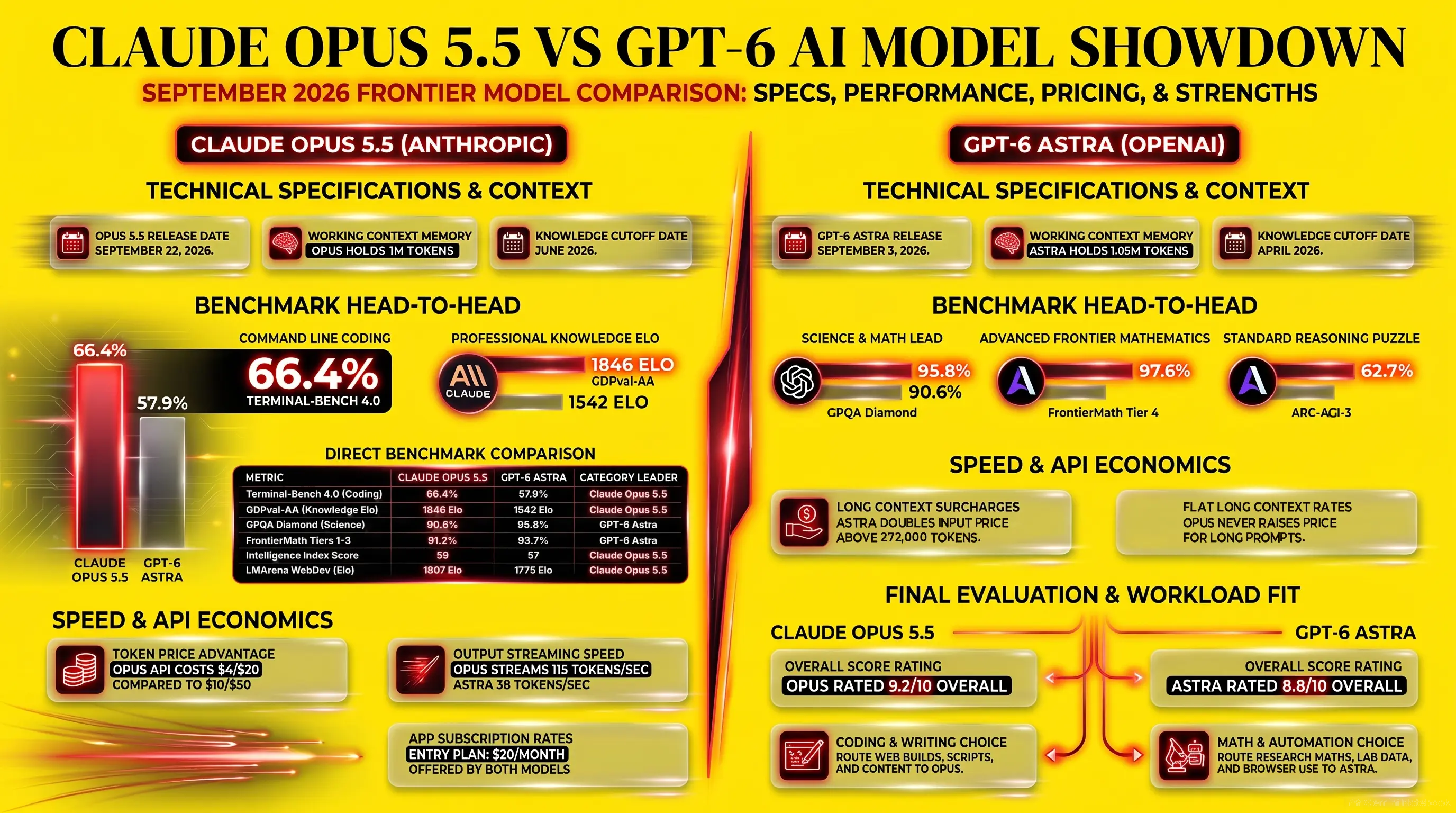
Before the benchmarks, here is the quick spec sheet. Think of a token as a small piece of a word, roughly three quarters of an English word on average. A context window is how much text, code or document content the model holds in its working memory during one conversation.
Both models sit near one million tokens, which equals several long books at once. However, the price you pay for that memory differs, and that difference becomes important once your prompts grow long. The table below uses official figures from Anthropic and OpenAI, verified at the time of writing.
| Spec | Claude Opus 5.5 | GPT-6 Astra |
|---|---|---|
| Developer and release date | Anthropic, 22 September 2026 | OpenAI, 3 September 2026 |
| API model name | claude-opus-5-5 | gpt-6-astra |
| Context window | 1,000,000 tokens | 1,050,000 tokens |
| Maximum output | 128,000 tokens (300,000 on Batch API beta) | 128,000 tokens |
| Knowledge cutoff | June 2026 | 30 April 2026 |
| API price per 1M tokens (input / output) | $4 / $20 | $10 / $50 |
| Fast mode | Up to 2.5x speed at $8 / $40 | Up to 2x speed at 2x standard price |
Round 4: Claude Opus 5.5 vs GPT-6 Astra Benchmarks, Who Leads Where?
A benchmark is a standard exam for AI models, so we compare them on the same questions under the same rules. Anthropic’s own launch table shows Opus 5.5 ahead of Astra on most rows, with two clear exceptions in science and automation.
Similarly, OpenAI’s table shows Astra leading on mathematics, science and computer control. The honest picture is a split decision, and the split follows a clear pattern you will use later when choosing a model for your projects.
Which Is Better for Coding and AI Agents?
For coding agents, Opus 5.5 holds the stronger record. On Terminal-Bench 4.0, which tests whether an AI finishes real tasks inside a command line, Anthropic reports 66.4% for Opus 5.5 against 57.9% for Astra. On FrontierCode v1.1, the gap shrinks to 54.4% versus 53.3%, which is close to a tie.
On GDPval-AA, a test of real professional work across many jobs, Opus 5.5 scores 1846 Elo against 1542 for Astra. Additionally, Opus 5.5 leads Humanity’s Last Exam with tools at 67.7% versus 57.2%. However, Astra wins AutomationBench, a business workflow test, by a narrow 41.4% to 40.0%.
Note: Each vendor ran these tests in its own setup, and Anthropic kept safeguards on, so treat gaps under two points as a tie.
Which Is Better for Science, Math and Reasoning?
This is Astra’s home ground. On Terminal-Bench Science 0.1, which tests agents doing scientific research tasks in a terminal, Astra scores 64.6% against 58.7% for Opus 5.5. On GPQA Diamond, a set of graduate level science questions, FullStack’s comparison lists Astra at 95.8% against 90.6%, its widest lead.
On FrontierMath Tiers 1 to 3, Astra posts 93.7% against 91.2%, and OpenAI reports 97.6% on the hardest Tier 4. Moreover, Astra edges SimpleQA Verified, a factual accuracy test, at 75.6% versus 72.2%. Therefore, if your work involves research maths, chemistry or biology data, Astra deserves your attention despite its price.
The ARC-AGI-3 Story Most Blogs Get Wrong
ARC-AGI-3 is a reasoning test where an AI explores unfamiliar puzzle games, figures out the rules and plans moves, much like a child learning a new board game. OpenAI announced a 99.9% score, which fuelled the AGI headlines. However, that result came from a custom testing adapter that keeps the model’s reasoning between moves.
Under ARC Prize’s standard testing setup, which ARC Prize uses for fair comparison across models, Astra scored 62.7%. That is still the highest standard score on record, more than double Claude Opus 5’s verified 30.2%. As a result, Astra’s reasoning lead is genuine, but the near perfect number describes the full system, not the model alone.
What Do Independent Leaderboards Say?
Vendor tables tell one side, so independent testers matter. Artificial Analysis, an independent AI benchmarking firm, currently scores Claude Opus 5.5 at 59 and GPT-6 Astra at 57 on its Intelligence Index at maximum effort. It measures Opus 5.5 output at about 115 tokens per second against 38 for Astra, so Opus writes roughly three times faster once it starts.
On the other hand, Astra reaches its first answer token sooner and finishes the index tasks in less total time, because it uses fewer tokens per task. Meanwhile, the LMArena WebDev leaderboard, where real users vote on website builds, shows Opus 5.5 at 1807 Elo against 1775 for Astra.
Round 5: Claude Opus 5.5 vs GPT-6 Astra Pricing in Plain Language
How Much Does GPT-6 Astra Cost Compared to Opus 5.5?
On the API, where developers pay per token, Opus 5.5 costs $4 per million input tokens and $20 per million output tokens. Astra costs $10 and $50, which is exactly 2.5 times higher on both lines. Cached input, which is text the model has already read and stored for reuse, costs $0.20 on Opus 5.5 against $1.00 on Astra, a fivefold gap.
Moreover, Astra applies a long prompt surcharge: above 272,000 input tokens, FullStack reports that input pricing doubles and output pricing rises 1.5 times for the full request. Opus 5.5 keeps flat rates across its entire one million token window, and its Batch API cuts both prices by 50% for jobs that wait.
Is It Free to Use Claude Opus 5.5 or GPT-6 Astra?
Neither flagship is available on a free plan. Claude Opus 5.5 is included in Claude Pro, which costs $20 per month billed monthly or $17 per month on annual billing, and in Max plans starting at $100 per month. Anthropic also raised the five hour usage limits on Pro, Max, Team and seat based Enterprise plans when Opus 5.5 launched.
In ChatGPT, GPT-6 Astra is part of the $20 Plus plan, while the Pro tiers at $100, $200 and $500 per month add expanded Astra access and Pro reasoning powered by Astra. Therefore, both companies charge the same $20 entry price, and your choice depends on usage limits and workflow rather than the sticker price.
Why Per Token Price Is Not the Whole Story
Here is the twist I promised at the start. A cheaper token does not always mean a cheaper task, because models use different amounts of tokens to finish the same job. Artificial Analysis spent $8,910 running its full index on Opus 5.5 against $5,661 for Astra, since Opus thinks longer at max effort.
Similarly, in MindStudio’s twelve task head to head, Astra built a branded website in 32 minutes for $11.33, while Opus 5.5 took 40 minutes and $18.32. However, MindStudio judged the Opus 5.5 website and video work stronger on creative quality. As a result, the honest rule is simple: compare cost per finished task at your chosen effort level, not price per token alone.
Read this article: Claude Fable 5.2 vs Gemini 4 Carbon vs GPT-6 Astra: Best AI?
Round 6: Is It Safe to Use Claude Opus 5.5 or GPT-6 Astra?
Both companies put heavy safety work behind these launches. Anthropic reports that Opus 5.5 achieved the best scores of any model on its automated behavioural audit of nearly 2,000 scenarios, and it attempted to bypass containment boundaries about 85% less often than Opus 5. Outside groups including METR tested it before release, and most advanced security tasks are routed to Claude Opus 4.8.
Meanwhile, OpenAI reports that Astra stayed within its authorised scope in every case of a new test, against 48% overreach for GPT-5.6 Sol without safeguards, and its internal hallucination rate fell to 4.2% from 12.2%.
Astra refuses advanced offensive tasks such as building proof of concept exploits, while vetted security teams get wider access through OpenAI’s Daybreak program. Anthropic runs similar Cyber and Life Sciences Verification Programs for approved groups. Both models support zero data retention for eligible business customers, so your prompts are not stored after processing.
AI is not a lawyer, doctor or financial adviser, so verify any legal, medical or money decision with a qualified expert before you act. Therefore, treat both models as fast, careful assistants and keep a human review step for anything important.
Claude Opus 5.5 vs GPT-6 Astra Feature Breakdown: Who Should Use Which?
The table below turns the full Claude Opus 5.5 vs GPT-6 Astra research into one decision view. It lists what each model does best, its standout features, honest strengths and weaknesses, and exactly who benefits most. If you need a budget option, Claude Sonnet 5.5 and GPT-6.1 Sol both cost $2 and $10 per million tokens.
In fact, routing simple work to these cheaper models and saving the flagships for hard jobs is how most professional teams keep their monthly bills under control without losing quality on difficult tasks.
| Model | What It Does | Standout Features | Strength / Weakness | Best For | Target Audience |
|---|---|---|---|---|---|
| Claude Opus 5.5 | Long running coding, writing and knowledge work agent | Terminal-Bench 4.0 66.4%, GDPval-AA 1846 Elo, flat 1M context pricing | Strength: coding agents, clear writing, low token price. Weakness: trails on science, maths and computer use | Code projects, website builds, reports | Developers, Startup Founders, Content Creators, Agencies |
| GPT-6 Astra | Frontier reasoning, science and computer use agent | FrontierMath Tier 4 97.6%, ARC-AGI-3 62.7% standard, ScreenSpot-Pro 92.7% | Strength: maths, science, screen control. Weakness: 2.5x token price, surcharge above 272K tokens | Research maths, lab data, browser automation | Scientists, Researchers, Data Analysts, Enterprise Teams |
Step by Step Guide: How to Use Claude Opus 5.5
- Step 1: Sign in at claude.ai on Pro or higher, since the Free plan does not include Opus, and select Opus 5.5 in the model picker.
- Step 2: Create a Project, upload your brand guides, code or reports, and add short instructions so every chat follows your rules.
- Step 3: Keep effort at Medium for daily work and raise it to High or Max for hard debugging.
- Step 4: For coding, run Claude Code in your project folder and describe the complete goal.
- Step 5: Developers call
claude-opus-5-5with prompt caching and send overnight jobs through the half price Batch API.
Stripe’s Cristian Rivera reported that one session rebased 40 stacked pull requests, and all 40 passed their checks.
Read this article: Claude Fable 5.2 vs Gemini 4 Carbon vs GPT-6 Astra: Best AI?
Step by Step Guide: How to Use GPT-6 Astra
- Step 1: Sign in at chatgpt.com on Plus, Pro, Business or Enterprise, since Free and Go plans do not include Astra.
- Step 2: Business and Enterprise users ask their admin to switch Astra on, because OpenAI kept it off by default at launch.
- Step 3: Choose Astra in ChatGPT Work or Codex for agent tasks, or Pro reasoning on Pro tiers.
- Step 4: For computer use, describe the full outcome, such as “collect these ten prices into a spreadsheet”, and watch the first run before approving repeats.
- Step 5: Developers call
gpt-6-astraand keep prompts under 272,000 tokens to avoid the surcharge.
Jane Street’s John Crepezzi reported that Astra’s code needs less iteration to reach production quality.
Practical Examples: Two Trending Tasks to Try Today
November is peak season for Black Friday sales, year end reports and holiday content, so I chose two real, trending jobs for these examples. Each one comes with a ready to use prompt template, and the curly brackets mark the parts you replace with your own details.
I matched each job to the model that the benchmarks favour, so you see the routing rule in action. However, nothing stops you from running the same prompt on both models and comparing the output side by side, which is the most honest test of all for your own work.
Case Study 1: The Black Friday Landing Page (Best on Claude Opus 5.5)
An online store owner needs a fast, mobile friendly sale page with a countdown timer, product cards and a discount banner before Friday. This is the kind of web build where Opus 5.5 leads the WebDev arena, and where MindStudio rated its creative design output higher.
Open Claude Code or a Claude Project, upload your brand colours and product list, then paste the template below. As a result, you receive working code, a short explanation of each section and a test checklist for phones and desktops.
Prompt Template: Build a responsive Black Friday landing page for {Store Name}, which sells {Product Category}. Use brand colours {Hex Codes}. Include a hero banner with {Discount Offer}, a countdown timer to {Sale End Date and Time}, six product cards from the attached list, and a sticky “Shop Now” button. Write clean HTML, CSS and JavaScript in separate files, explain each section in one line, and finish with a mobile testing checklist.
Case Study 2: The Holiday Price Tracker (Best on GPT-6 Astra)
A small electronics reseller wants to compare holiday prices for ten products across several public shopping sites every morning. This task needs the AI to open a browser, search, read pages and fill a spreadsheet, which is where Astra’s computer use strengths show.
Inside ChatGPT Work, give Astra the full outcome instead of single clicks. Meanwhile, keep the task to public pages only and respect each site’s terms. Consequently, you get a clean comparison sheet and a simple chart without spending your morning on copy and paste.
Prompt Template: Visit {Website 1}, {Website 2} and {Website 3}. Find the current listed price for each product in this list: {Product Names}. Record product name, site, price and page link in a new spreadsheet, highlight the lowest price per product in green, then create a bar chart comparing the lowest prices. Summarise the three biggest price gaps in plain language.
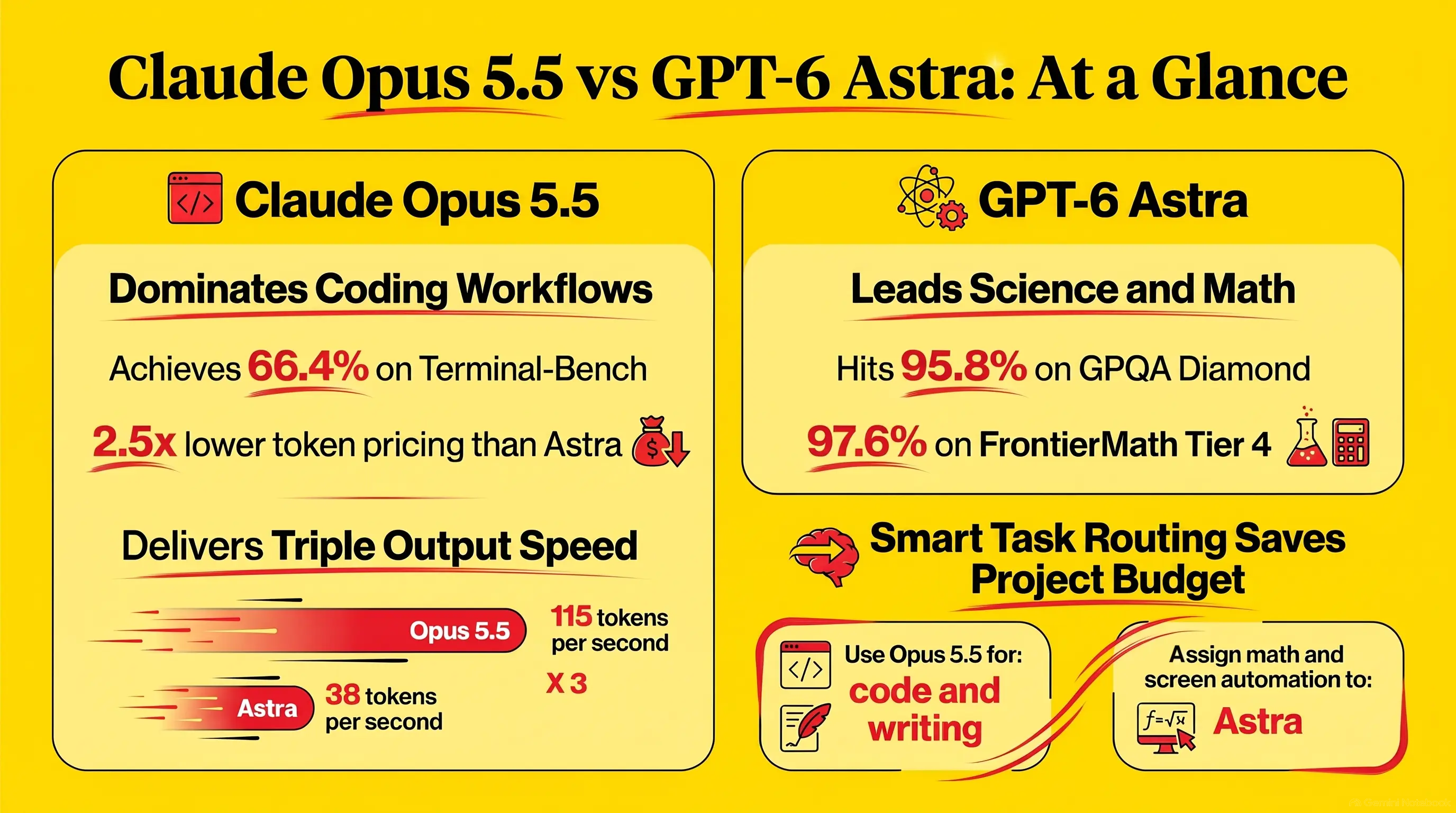
The Secret: Route by job, not by brand. Default to Opus 5.5 for coding and writing, and send only maths, science and screen automation to Astra.
Claude Opus 5.5 vs GPT-6 Astra: Which One Should You Choose?
Choose Claude Opus 5.5 if you write code, build websites, run long agent sessions, produce reports or work with huge documents. It leads on coding agents and professional work, writes faster, and costs 2.5 times less per token with flat long context pricing.
Choose GPT-6 Astra if your work centres on research maths, science, factual accuracy or automating browsers and desktop apps. It holds the strongest verified reasoning score and the best screen control results. Moreover, if you already live inside ChatGPT or Codex, Astra fits your existing habits without switching tools.
My Honest Score Card
These scores reflect the verified benchmarks, independent leaderboards and published head to head tests covered in this Claude Opus 5.5 vs GPT-6 Astra review, weighted for everyday professional use. A score of 10 means best in class among current frontier models.
I scored weaknesses as honestly as strengths, so you see where each model falls short before you spend money. Your results will shift with your tasks, effort level and prompts, so run a short trial on real work before committing a team budget.
| Criterion | Claude Opus 5.5 | GPT-6 Astra |
|---|---|---|
| Innovation | 9.2 / 10 | 9.4 / 10 |
| Ease of Use | 9.1 / 10 | 8.7 / 10 |
| Coding and Agent Work | 9.5 / 10 | 8.9 / 10 |
| Writing and Knowledge Work | 9.5 / 10 | 8.8 / 10 |
| Science, Maths and Reasoning | 8.7 / 10 | 9.7 / 10 |
| Computer Use | 8.8 / 10 | 9.3 / 10 |
| Speed | 9.2 / 10 | 8.3 / 10 |
| Value for Money | 9.4 / 10 | 7.5 / 10 |
| Overall Score | 9.2 / 10 | 8.8 / 10 |
Your Next Move: Pick the Right Mind for the Job
The race between these two models is not a knockout. Instead, it is a clear division of strengths that you turn into an advantage. Let Opus 5.5 carry your code, content, reports and long projects, and call on Astra when maths, science or screen automation decides the outcome.
Test both on one real task this week, measure the cost per finished result, and keep the winner as your default. Moreover, revisit the official Anthropic and OpenAI release notes as updates arrive. Get creative, build boldly, and let the right model save you hours of work and a meaningful share of your monthly budget.
Frequently Asked Questions About Claude Opus 5.5 vs GPT-6 Astra
Here are clear answers to the questions readers ask most about Claude Opus 5.5 vs GPT-6 Astra.
Is Claude Opus 5.5 better than GPT-6 Astra?
For most everyday professional work, yes. Claude Opus 5.5 leads on coding agents with 66.4% on Terminal-Bench 4.0 against 57.9%, on professional knowledge work with 1846 Elo on GDPval-AA against 1542, and on the independent Artificial Analysis Intelligence Index with 59 against 57. It also writes output faster and costs 2.5 times less per token. However, GPT-6 Astra is better for research maths, graduate level science, factual accuracy and computer use, where it holds clear leads. So the right answer depends on your work: Opus 5.5 as the default, Astra as the specialist for science and automation tasks.
How much does GPT-6 Astra cost compared to Claude Opus 5.5?
On the API, GPT-6 Astra costs $10 per million input tokens and $50 per million output tokens, while Claude Opus 5.5 costs $4 and $20. Cached input costs $1.00 on Astra and $0.20 on Opus 5.5. Astra also charges more for prompts above 272,000 input tokens, while Opus keeps flat rates across its full window. In the apps, both start at $20 per month, with Claude Pro listed on the official Claude pricing page and ChatGPT Plus including Astra. Remember that Astra often uses fewer tokens per task, so always compare cost per finished job, not price per token alone.
Which is better for coding, Claude Opus 5.5 or GPT-6 Astra?
Claude Opus 5.5 holds the stronger coding record on most public tests. It leads Terminal-Bench 4.0 by 8.5 points, tops the LMArena WebDev leaderboard at 1807 Elo against 1775, and early testers such as GitHub reported it used among the fewest tokens and steps in Copilot CLI and VS Code. Astra stays close on FrontierCode v1.1 at 53.3% against 54.4%, and OpenAI calls it its best software engineering model to date. Astra also shines on deep architecture refactoring and CAD generation, scoring 95.9% on BenchCAD. For daily coding agents and website builds, start with Opus 5.5, then test Astra on your own repository.
Did GPT-6 Astra truly score 99.9% on ARC-AGI-3?
OpenAI reported 99.9% on ARC-AGI-3, but that figure came from a custom testing adapter that preserves the model's reasoning between moves and compresses long histories. Under ARC Prize's standard testing setup, which allows a fair comparison between different models, Astra scored 62.7%, the highest standard result on record and more than double Claude Opus 5's 30.2%. ARC Prize also noted that Astra used fewer actions than the median human on 96% of levels. ARC Prize co founder François Chollet has said that saturating this benchmark does not prove AGI. Therefore, Astra's reasoning lead is genuine, while the headline number reflects the full system rather than the model alone.
Which has the bigger context window, and what does that mean for me?
GPT-6 Astra lists 1,050,000 tokens and Claude Opus 5.5 lists 1,000,000 tokens, a difference of about 5%, which is too small to matter for most people. A context window is the model's working memory, and one million tokens holds roughly 555,000 words on Claude's current tokenizer, according to the official Claude Opus 5.5 documentation. Both models also produce up to 128,000 tokens in one reply. The bigger difference is price: Astra's rates rise above 272,000 input tokens, while Opus 5.5 keeps the same rate up to one million. Therefore, Opus 5.5 is the cheaper choice for huge documents and full codebases.
Priyanshu Khatri Founder & Chief AI Analyst, SoulAI Writes
Read more articles

Claude Opus 5.5 vs GPT-6 Astra: Which AI Model Wins?
Claude Opus 5.5 vs GPT-6 Astra: Which AI Model Truly Wins Your Work? Claude Opus…

Gemini 4 Carbon vs Gemini 4 Argon: Which One Should You Use?
Gemini 4 Carbon vs Gemini 4 Argon: Which Google Model Deserves Your Money Before December…
Fable 5.1 vs 5.2: Is Claude’s Newest Model Worth It?
Fable 5.1 vs 5.2: Which Claude Fable Model Wins on Price, Speed and Benchmarks? Fable…

What Is GPT-6 Astra? Features, Pricing and Real Tests

Claude Fable 5.2 vs Gemini 4 Carbon vs GPT-6 Astra: Best AI?
Claude Fable 5.2 vs Gemini 4 Carbon vs GPT-6 Astra: Which Frontier AI Model Deserves…

Claude Fable 5.2 vs Gemini 4 Carbon: Which AI Wins?
Claude Fable 5.2 vs Gemini 4 Carbon: Which Frontier AI Model Wins Your Work and…









Leave a Reply